


Physiological signature of late-onset nonallergic asthma of obesity
- PMID: 32832525
- PMCID: PMC7430141
- DOI: 10.1183/23120541.00049-2020
Physiological signature of late-onset nonallergic asthma of obesity
Abstract
Introduction: Obesity can lead to a late-onset nonallergic (LONA) form of asthma for reasons that are not understood. We sought to determine whether this form of asthma is characterised by any unique physiological features.
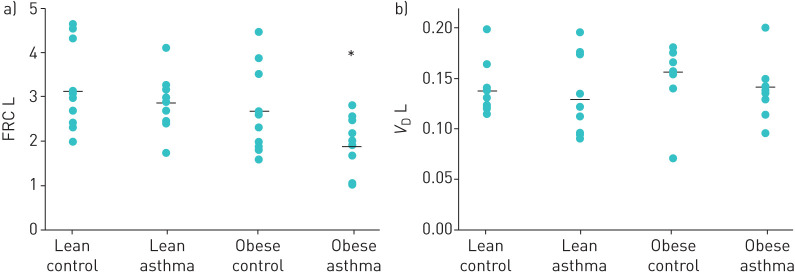
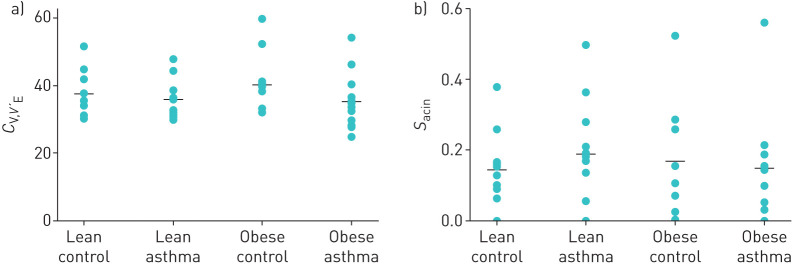
Methods: Spirometry, body plethysmography, multiple breath nitrogen washout (MBNW) and methacholine challenge were performed in four subject groups: Lean Control (n=11), Lean Asthma (n=11), Obese Control (n=11) and LONA Obese Asthma (n=10). The MBNW data were fitted with a novel computational model that estimates functional residual capacity (FRC), dead space volume (VD), the coefficient of variation of regional specific ventilation (CV,V'E) and a measure of structural asymmetry at the level of the acinus (sacin).
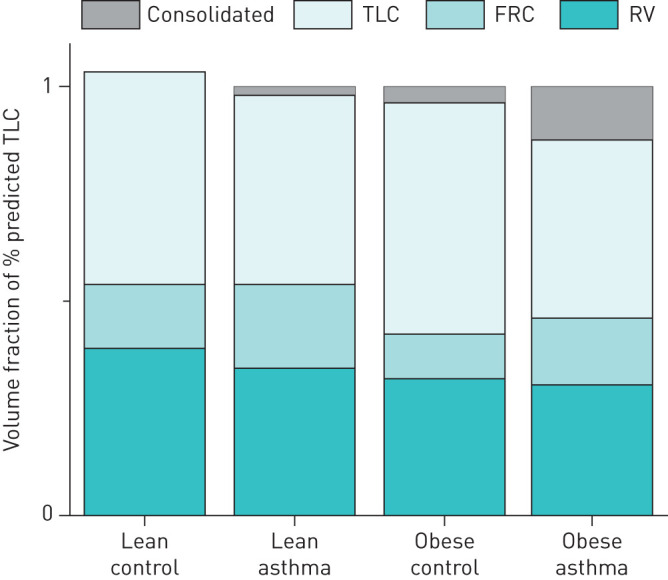
Results: Body mass index and waist circumference values were similar in both obese groups, and significantly greater than in lean asthmatic individuals and controls. Forced vital capacity was significantly lower in the LONA Asthma group compared with the other groups (p<0.001). Both asthma groups exhibited similar hyperresponsiveness to methacholine. FRC was reduced in the Obese LONA Asthma group as measured by MBNW, but not in obese controls, whereas FRC was reduced in both obese groups as measured by plethysmography. VD, CV,V'E and sacin were not different between groups.
Conclusions: Chronic lung compression characterises all obese subjects, as reflected by reduced plethysmographic FRC. Obese LONA asthma is characterised by a reduced ability to recruit closed lung units, as seen by reduced MBNW FRC, and an increased tendency for airway closure as seen by a reduced forced vital capacity.
Copyright ©ERS 2020.
Conflict of interest statement
Conflict of interest: A.E. Dixon reports that MitoQ supplied the study drug for a clinical trial outside the submitted work. Conflict of interest: U. Peters has nothing to disclose. Conflict of interest: R. Walsh has nothing to disclose. Conflict of interest: N. Daphtary has nothing to disclose. Conflict of interest: E.S. MacLean has nothing to disclose. Conflict of interest: K. Hodgdon has nothing to disclose. Conflict of interest: D.A. Kaminsky reports personal fees from MGC Diagnostics, Inc., for participating as faculty on a course outside the submitted work. Conflict of interest: J.H.T. Bates reports grant R01 HL130847 from the NIH-NHLBI during the conduct of the study. He is a consultant for an minor shareholder in Oscillavent, LLC (Iowa), and a consultant for Healthy Design, LLC (Vermont), outside the submitted work. In addition, he has patents (Device and method for lung measurement, US patent application US 20160007882 A1; Variable ventilation as a diagnostic tool for assessing lung mechanical function, PCT Application WO2015127377 A1) pending.
Figures
References
Grants and funding
LinkOut - more resources
Full Text Sources
Miscellaneous