


Heart failure in COVID-19 patients: prevalence, incidence and prognostic implications
- PMID: 32833283
- PMCID: PMC7461427
- DOI: 10.1002/ejhf.1990
Heart failure in COVID-19 patients: prevalence, incidence and prognostic implications
Abstract
Aims: Data on the impact of COVID-19 in chronic heart failure (CHF) patients and its potential to trigger acute heart failure (AHF) are lacking. The aim of this work was to study characteristics, cardiovascular outcomes and mortality in patients with confirmed COVID-19 infection and a prior diagnosis of heart failure (HF). Further aims included the identification of predictors and prognostic implications for AHF decompensation during hospital admission and the determination of a potential correlation between the withdrawal of HF guideline-directed medical therapy (GDMT) and worse outcomes during hospitalization.
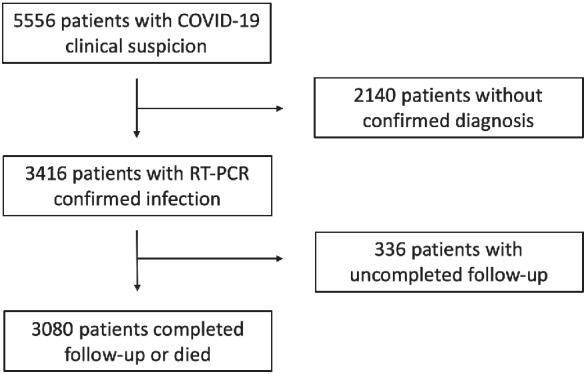
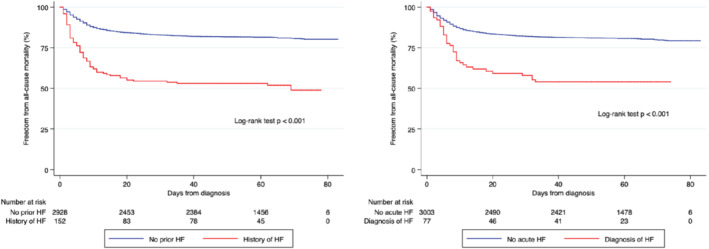
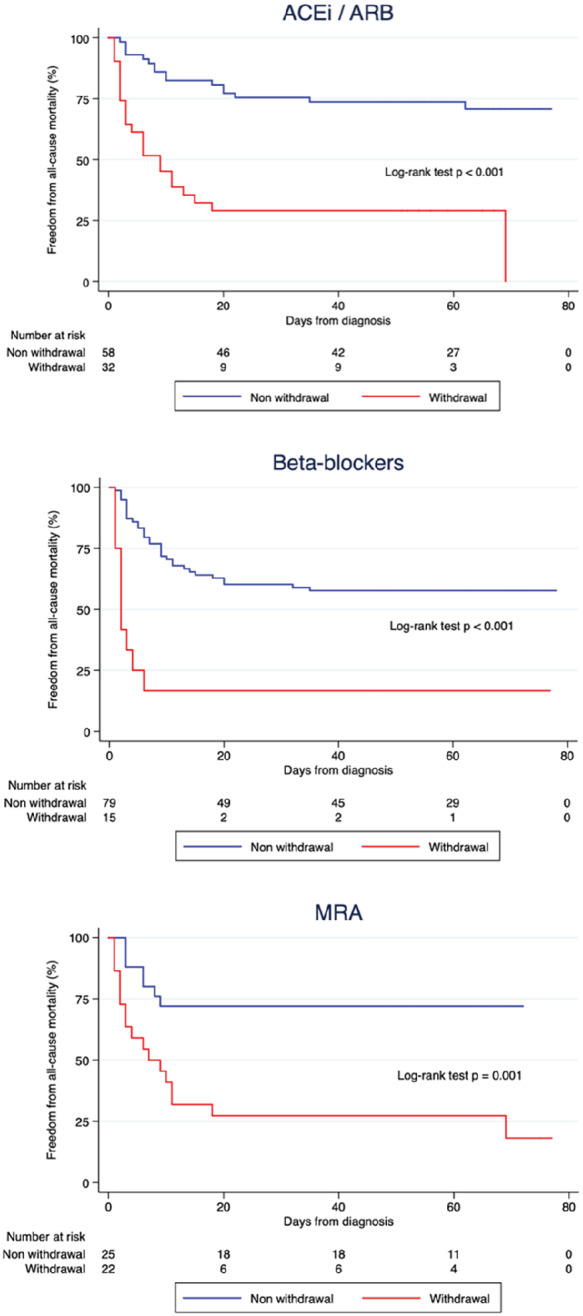
Methods and results: Data for a total of 3080 consecutive patients with confirmed COVID-19 infection and follow-up of at least 30 days were analysed. Patients with a previous history of CHF (n = 152, 4.9%) were more prone to the development of AHF (11.2% vs. 2.1%; P < 0.001) and had higher levels of N-terminal pro brain natriuretic peptide. In addition, patients with previous CHF had higher mortality rates (48.7% vs. 19.0%; P < 0.001). In contrast, 77 patients (2.5%) were diagnosed with AHF, which in the vast majority of cases (77.9%) developed in patients without a history of HF. Arrhythmias during hospital admission and CHF were the main predictors of AHF. Patients developing AHF had significantly higher mortality (46.8% vs. 19.7%; P < 0.001). Finally, the withdrawal of beta-blockers, mineralocorticoid receptor antagonists and angiotensin-converting enzyme inhibitors or angiotensin receptor blockers was associated with a significant increase in in-hospital mortality.
Conclusions: Patients with COVID-19 have a significant incidence of AHF, which is associated with very high mortality rates. Moreover, patients with a history of CHF are prone to developing acute decompensation after a COVID-19 diagnosis. The withdrawal of GDMT was associated with higher mortality.
Keywords: COVID-19; Drug withdrawal; Heart failure; Morbidity; Mortality; NT-proBNP.
© 2020 European Society of Cardiology.
Figures
Comment in
-
COVID-19: getting to the heart of the matter.Eur J Heart Fail. 2020 Dec;22(12):2216-2218. doi: 10.1002/ejhf.2007. Epub 2020 Oct 5. Eur J Heart Fail. 2020. PMID: 32945558 Free PMC article. No abstract available.
References
-
- Zhou F, Yu T, Du R, Fan G, Liu Y, Liu Z, Xiang J, Wang Y, Song B, Gu X, Guan L, Wei Y, Li H, Wu X, Xu J, Tu S, Zhang Y, Chen H, Cao B. Clinical course and risk factors for mortality of adult inpatients with COVID‐19 in Wuhan, China: a retrospective cohort study. Lancet 2020;395:1054–1062. - PMC - PubMed
-
- Panhwar MS, Kalra A, Gupta T, Kolte D, Khera S, Bhatt DL, Ginwalla M. Effect of influenza on outcomes in patients with heart failure. JACC Heart Fail 2019;7:112–117. - PubMed
-
- Mueller C, McDonald K, de Boer RA, Maisel A, Cleland JGF, Kozhuharov N, Coats AJS, Metra M, Mebazaa A, Ruschitzka F, Lainscak M, Filippatos G, Seferovic PM, Meijers WC, Bayes‐Genis A, Mueller T, Richards M, Januzzi JL Jr. Heart Failure Association of the European Society of Cardiology practical guidance on the use of natriuretic peptide concentrations. Eur J Heart Fail 2019;21:715–731. - PubMed
-
- Lang RM, Badano LP, Mor‐Avi V, Afilalo J, Armstrong A, Ernande L, Flachskampf FA, Foster E, Goldstein SA, Kuznetsova T, Lancellotti P, Muraru D, Picard MH, Rietzschel ER, Rudski L, Spencer KT, Tsang W, Voigt JU. Recommendations for cardiac chamber quantification by echocardiography in adults: an update from the American Society of Echocardiography and the European Association of Cardiovascular Imaging. Eur Heart J Cardiovasc Imaging 2015;16:233–271. - PubMed
MeSH terms
Substances
LinkOut - more resources
Full Text Sources
Medical
Research Materials
Miscellaneous
