Review
. 2020 Sep:130:115984.
doi: 10.1016/j.trac.2020.115984. Epub 2020 Jul 20.

The vision of point-of-care PCR tests for the COVID-19 pandemic and beyond

Affiliations
Review

The vision of point-of-care PCR tests for the COVID-19 pandemic and beyond

Hanliang Zhu et al. Trends Analyt Chem. 2020 Sep.

Abstract

Infectious diseases, such as the most recent case of coronavirus disease 2019, have brought the prospect of point-of-care (POC) diagnostic tests into the spotlight. A rapid, accurate, low-cost, and easy-to-use test in the field could stop epidemics before they develop into full-blown pandemics. Unfortunately, despite all the advances, it still does not exist. Here, we critically review the limited number of prototypes demonstrated to date that is based on a polymerase chain reaction (PCR) and has come close to fulfill this vision. We summarize the requirements for the POC-PCR tests and then go on to discuss the PCR product-detection methods, the integration of their functional components, the potential applications, and other practical issues related to the implementation of lab-on-a-chip technologies. We conclude our review with a discussion of the latest findings on nucleic acid-based diagnosis.

Keywords: COVID-19 diagnoses; Future of PCR; Microfluidics; Miniaturization; Point of care; Polymerase chain reaction.


Conflict of interest statement

The authors declare that they have no known competing financial interests or personal relationships that could have appeared to influence the work reported in this paper.

Figures
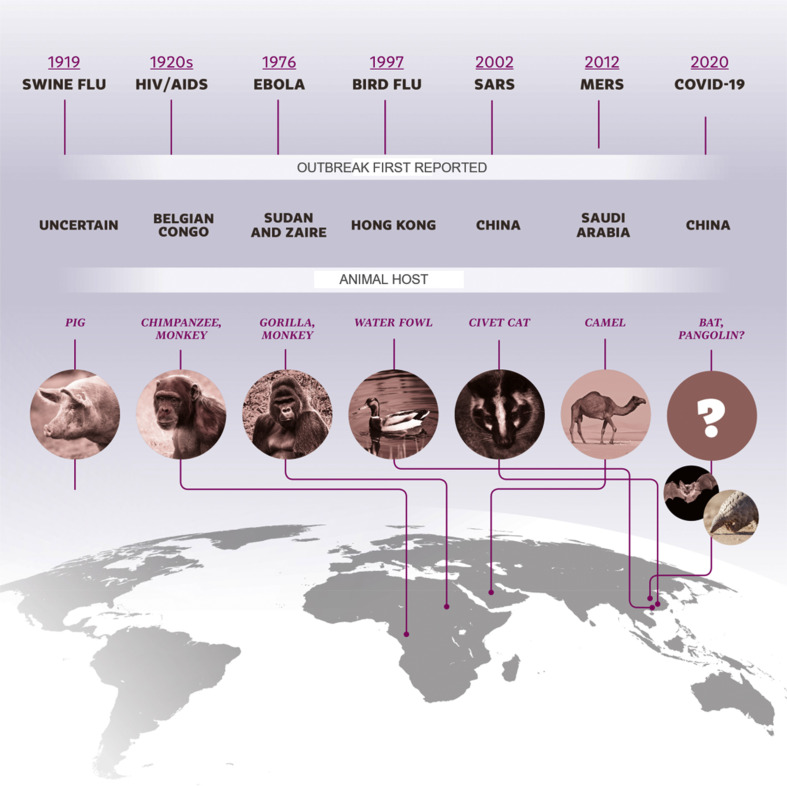
Fig. 1
Fig. 1
A timeline of the major viral infections over the past 100 years, showing the geographical location of the first reported case and the interspecies transmission.
Fig. 2
Fig. 2
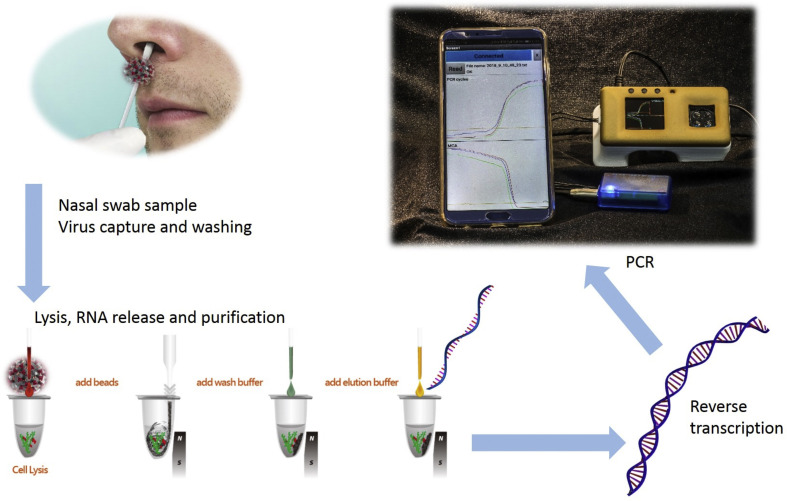
A conceptual demonstration of the detection of viruses in the field, based on real-time RT-PCR at POC. The process starts with a nasal swab to obtain a sample that might contain the virus. The sample is purified using paramagnetic beads and viruses are captured, followed by virus lysis to release the RNA, and purification Then, the RNA is reverse transcribed to cDNA; the number of cDNA molecules is multiplied by the PCR, and the results are displayed and possibly transferred to a centralized laboratory via a mobile device [19].
Fig. 3
Fig. 3
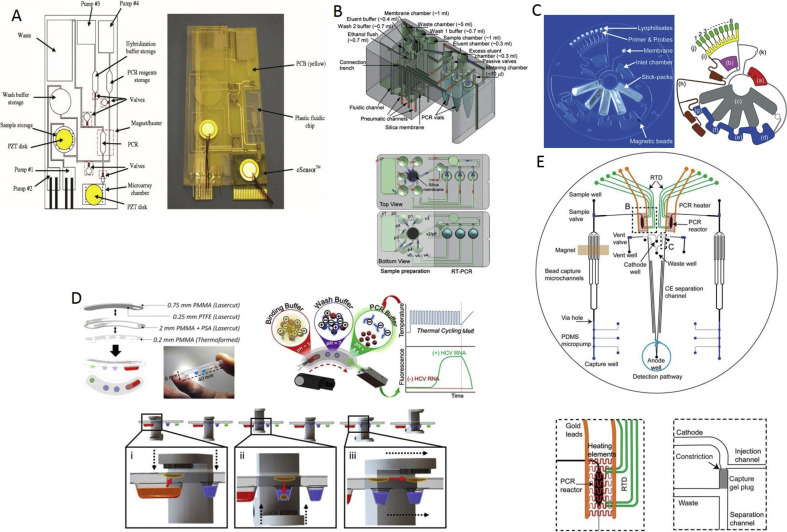
The cores of the fully integrated PCR systems. (A) (left) Schematic of the plastic fluidic cartridge using three electrochemical and one thermopneumatic pump; (right) Photograph of the fabricated unit, consisting of a plastic fluidic cartridge, the PCB, and the eSensor microarray chip [82]. (B) (up) Drawing of the all-in-one cartridge. (down) The top and bottom views of the all-in-one cartridge [83]. (C) (left) Photograph of the LabDisk. (right) Schematic of the LabDisk [84]. (D) (top left) Schematic of the cartridge; (top right) Principle of the platform; (down) Schematic of the particle transfer [85]. (E) (up) Schematic of the microdevice; (bottom left) View of the PCR chamber; (bottom right) View of the gel-based capture part [86].
Fig. 4
Fig. 4
The systems currently available for COVID-19 POC testing (POCT). (A) A system performing 25 reactions at a time using magnetic beads for sample preparation, followed by a LAMP [89]. (B) Cobas® Liat® System by Roche originally designed as a universal molecular biology platform for diagnoses based on a real-time PCR [90]. (C) ID NOW, made by Abbott Laboratories, originally sought to diagnose seasonal flu; it has currently been converted into a COVID-19 system, based on an isothermal DNA amplification originally developed for the seasonal flu test [91]. (D) Bosch's new microfluidic system is capable of virus diagnostics; the sample preparation is integrated with a multiplexed end-point PCR [92].

References

    1. Cui J., Li F., Shi Z.-L. Origin and evolution of pathogenic coronaviruses. Nat. Rev. Microbiol. 2019;17:181. doi: 10.1038/s41579-018-0118-9. - DOI - PMC - PubMed
    1. Lu R., Zhao X., Li J., Niu P., Yang B., Wu H., Wang W., Song H., Huang B., Zhu N. Genomic characterisation and epidemiology of 2019 novel coronavirus: implications for virus origins and receptor binding. Lancet. 2020 doi: 10.1016/S0140-6736(20)30251-8. - DOI - PMC - PubMed
    1. W.H.O. 7 July 2020. Coronavirus Disease (COVID-19) Situation Report-169.https://www.who.int/docs/default-source/coronaviruse/situation-reports/2...
    1. Chen L., Liu W., Zhang Q., Xu K., Ye G., Wu W., Sun Z., Liu F., Wu K., Zhong B. RNA based mNGS approach identifies a novel human coronavirus from two individual pneumonia cases in 2019 Wuhan outbreak, Emerg. Microb. Infect. 2020;9:313. doi: 10.1080/22221751.2020.1725399. - DOI - PMC - PubMed
    1. Webster R.G., Bean W.J., Gorman O.T., Chambers T.M., Kawaoka Y. Evolution and ecology of influenza A viruses. Microbiol. Mol. Biol. Rev. 1992;56:152. https://doi.org/10146-0749/92/010152-28. - PMC - PubMed