. 2021 Jan:111:106617.
doi: 10.1016/j.aml.2020.106617. Epub 2020 Jul 15.

Simulating the spread of COVID-19 via a spatially-resolved susceptible-exposed-infected-recovered-deceased (SEIRD) model with heterogeneous diffusion

Affiliations

Simulating the spread of COVID-19 via a spatially-resolved susceptible-exposed-infected-recovered-deceased (SEIRD) model with heterogeneous diffusion

Alex Viguerie et al. Appl Math Lett. 2021 Jan.

Abstract

We present an early version of a Susceptible-Exposed-Infected-Recovered-Deceased (SEIRD) mathematical model based on partial differential equations coupled with a heterogeneous diffusion model. The model describes the spatio-temporal spread of the COVID-19 pandemic, and aims to capture dynamics also based on human habits and geographical features. To test the model, we compare the outputs generated by a finite-element solver with measured data over the Italian region of Lombardy, which has been heavily impacted by this crisis between February and April 2020. Our results show a strong qualitative agreement between the simulated forecast of the spatio-temporal COVID-19 spread in Lombardy and epidemiological data collected at the municipality level. Additional simulations exploring alternative scenarios for the relaxation of lockdown restrictions suggest that reopening strategies should account for local population densities and the specific dynamics of the contagion. Thus, we argue that data-driven simulations of our model could ultimately inform health authorities to design effective pandemic-arresting measures and anticipate the geographical allocation of crucial medical resources.

Keywords: COVID-19; Compartmental models; Mathematical biology; Mathematical epidemiology; Mathematical modeling; Partial differential equations.


Figures

Fig. 1
Fig. 1
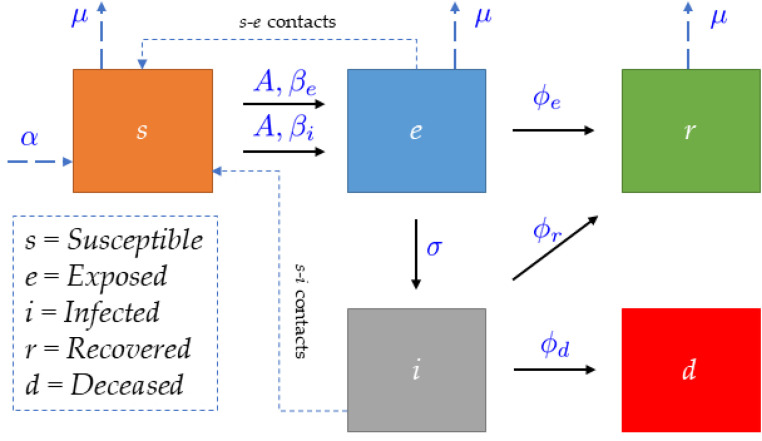
Flow chart describing the dynamics of contagion between the population subgroups considered in our model.
Fig. 2
Fig. 2
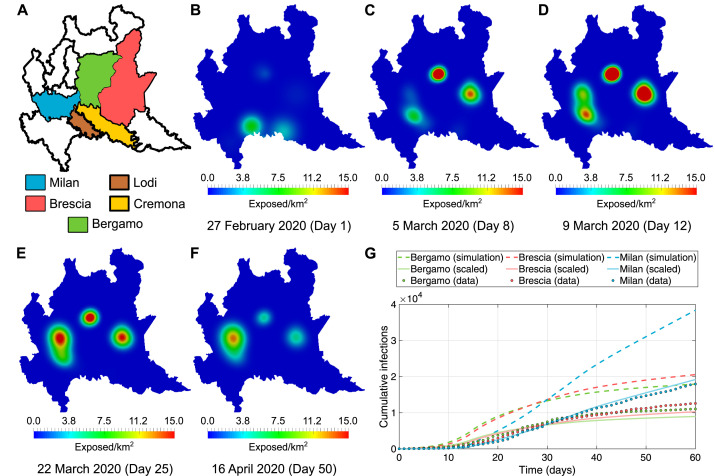
Model forecast of COVID-19 spread in Lombardy. (A) Main areas affected by the pandemic in Lombardy. (B) Initially, the main affected areas are Lodi and Cremona and, to lesser extent, Bergamo and Brescia. (C–E) Our model predicts increasing exposures in Bergamo and Brescia. The outbreak in Lodi soon moves north into the Milan metro area, where it further spreads despite the lockdown restrictions. (F) The model also predicts that governmental restrictions eventually succeed in reducing the exposure to the disease, which is faster in Brescia and Bergamo than in Milan. (G) Cumulative curves of infections according to reported data (dots) and simulations (dashed lines) for the three main areas of contagion: Bergamo, Brescia, and Milan. The model has been calibrated to match the data reported for the deceased subgroup, resulting in a forecast of a larger number of infections. To highlight the qualitative agreement of our simulations, we also show the numerical results scaled to match the order of magnitude of the reported infectious data (solid lines).
Fig. 3
Fig. 3
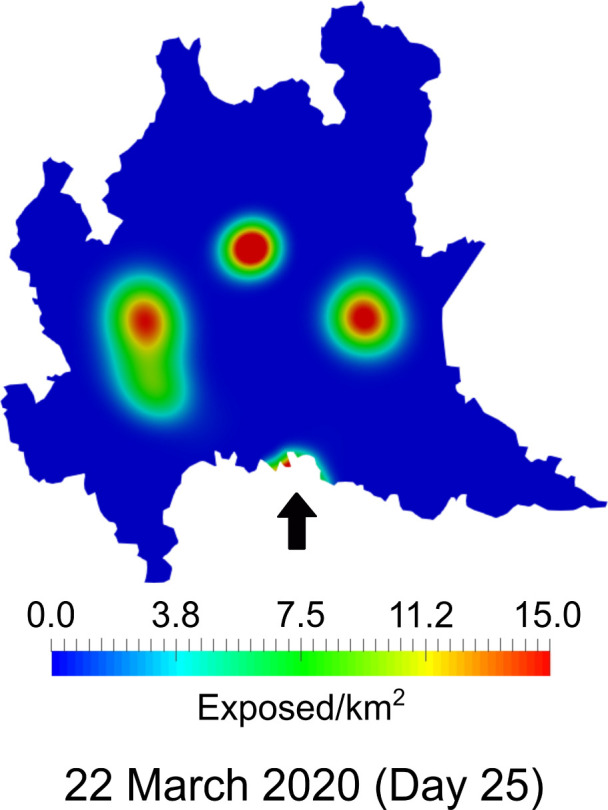
Effect of the boundary conditions: a spike of the outbreak in Cremona (black arrow) induced by an inflow of individuals from Piacenza, a city in Emilia Romagna southbound of Lombardy.
Fig. 4
Fig. 4
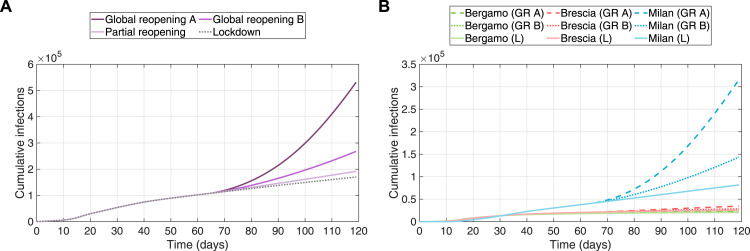
Results of simulations over alternative reopening cases. (A) Cumulative infected cases in Lombardy over the different reopening scenarios. Our simulations suggest that maintaining a strict lockdown outside of Milan offers little benefit; however, keeping lockdown restriction in Milan may prevent explosive growth. (B) Comparison of the cumulative infections in the three largest metropolitan areas (i.e., Bergamo, Brescia and Milan) for the global reopening A (GR A, dashed lines), global reopening B (GR B, dotted lines), and maintenance of lockdown (L, solid lines).

References

    1. Remuzzi A., Remuzzi G. COVID-19 and Italy: What next? Lancet. 2020 - PMC - PubMed
    1. Ferguson N., Laydon D., Nedjati G.G., Imai N., Ainslie K., Baguelin M., Bhatia S., Boonyasiri A., Cucunuba P.Z., Cuomo-Dannenburg G. Imperial College London; 2020. Impact of non-pharmaceutical interventions (NPIs) to reduce COVID19 mortality and healthcare demand.
    1. Gatto M., Bertuzzo E., Mari L., Miccoli S., Carraro L., Casagrandi R., Rinaldo A. Spread and dynamics of the COVID-19 epidemic in Italy: Effects of emergency containment measures. Proc. Natl. Acad. Sci. USA. 2020 doi: 10.1073/pnas.2004978117. - DOI - PMC - PubMed
    1. Giordano G., Blanchini F., Bruno R., Colaneri P., Di Filippo A., Di Matteo A., Colaneri M. Modelling the COVID-19 epidemic and implementation of population-wide interventions in Italy. Nat. Med. 2020:1–6. - PMC - PubMed
    1. Zhang X., Rao H., Wu Y., Huang Y., Dai H. Comparison of the spatiotemporal characteristics of the COVID-19 and SARS outbreaks in mainland China. medRxiv. 2020 - PMC - PubMed