Review
. 2020 Jul;10(7):1175-1191.
doi: 10.1016/j.apsb.2020.05.009. Epub 2020 May 30.

Highly pathogenic coronaviruses: thrusting vaccine development in the spotlight

Affiliations
Review

Highly pathogenic coronaviruses: thrusting vaccine development in the spotlight

Chunting He et al. Acta Pharm Sin B. 2020 Jul.

Abstract

Coronaviruses (CoVs) are a large family of viruses that cause illness ranging from the common cold to more severe diseases such as Severe Acute Respiratory Syndrome (SARS) and Middle East Respiratory Syndrome (MERS). Severe Acute Respiratory Syndrome coronavirus 2 (SARS-CoV-2) disease (COVID-19) has caused major public health crises. There have been more than 4,400,000 reported cases of COVID-2019 and more than 300,000 reported deaths to date (16/05/2020). SARS-CoV, MERS-CoV and SARS-CoV-2 have attracted widespread global attention due to their high infectivity and pathogenicity. To date, there is no specific treatment proven effective against these viral infectious diseases. Vaccination is considered one of the most effective strategies to prevent viral infections. Therefore, the development of effective vaccines against highly pathogenic coronaviruses is essential. In this review, we will briefly describe coronavirus vaccine design targets, summarize recent advances in the development of coronavirus vaccines, and highlight current adjuvants for improving the efficacy of coronavirus vaccines.

Keywords: Adjuvant; Coronaviruses; MERS-CoV; SARS-CoV; SARS-CoV-2; Vaccine.


Figures

Image 1
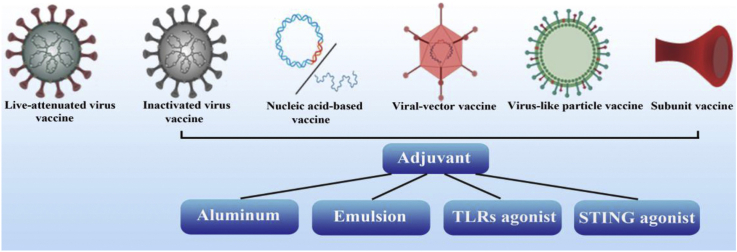
Graphical abstract
Figure 1
Figure 1
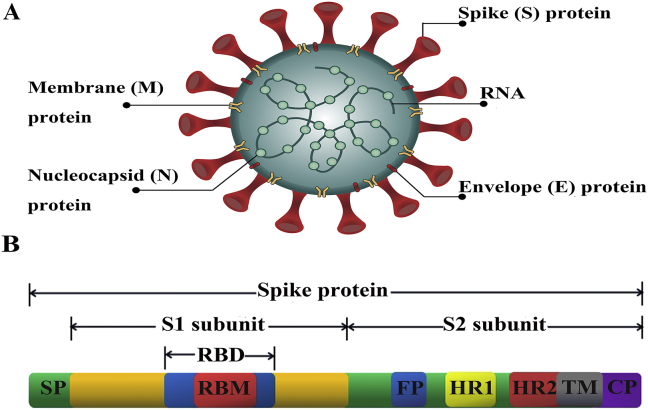
Coronavirus and spike protein (S) structures. (A) Schematic structure of coronavirus and its key structural proteins, including spike (S), nucleocapsid (N), membrane (M), envelope (E) proteins. (B) Schematic structure of coronavirus S protein and its functional regions. S protein is composed of S1 and S2 subunits. SP, signal peptide. RBD, receptor-binding domain. RBM, receptor-binding motif. FP, fusion peptide. HR1 and HR2, heptad repeat one and two regions. TM, transmembrane. CP, cytoplasmic tail.
Figure 2
Figure 2
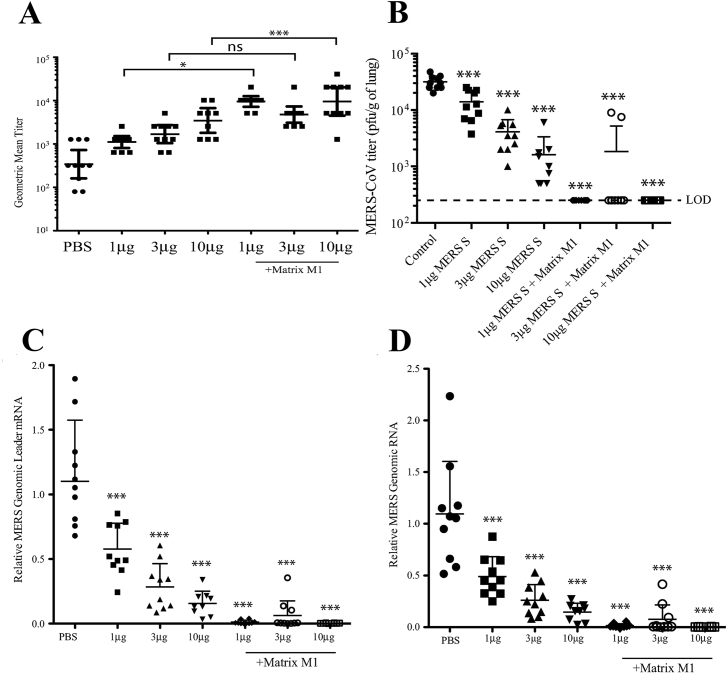
Vaccination of MERS S nanoparticle plus Matrix M1 protects mice from MERS-CoV challenge. (A) Neutralizing antibody levels against infections of live MERS-CoV. GMT ± standard deviation is graphed for each group of 10 mice. Dots represent individual mice. *P < 0.05, ***P < 0.001, ns means not significant. (B) Lung MERS-CoV replication was determined by plaque assay. (C) MERS-CoV specific Leader mRNA expression (D) MERS-CoV genomic RNA expression. Mean ± standard deviation are graphed for each group of 10 mice. Dots represent individual mice. LOD means limit of detection. ***P < 0.001. The figure was adapted with permission from Ref. 42. Copyright ©2017 Elsevier.
Figure 3
Figure 3
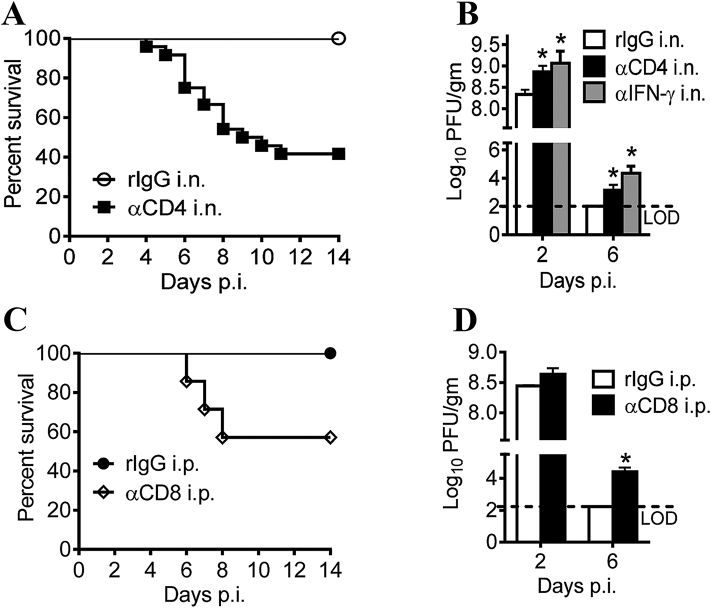
Airway T cells are protective against SARS-CoV challenge. (A) Survival rate of SARS-CoV infected mice after depletion of airway CD4+ T cells. n = 5, rIgG i.n.; n = 24, aCD4 i.n. (B) Virus titers of SARS-CoV infected mice after depletion of airway CD4+ T cells. Titers are expressed as PFU/g tissue. n = 3 mice/group/time point. *P < 0.05. Data are representative of two independent experiments. (C) Survival rate of SARS-CoV infected mice after depletion of airway CD8+ T cells. n = 5, rIgG i.p.; n = 7, aCD8 i.p. (D) Virus titers of SARS-CoV infected mice after depletion of airway CD8+ T cells. n = 3 mice/group/time point. *P < 0.05. Data are representative of two independent experiments. The figure was adapted with permission from Ref. 45. Copyright © 2016 Elsevier.
Figure 4
Figure 4
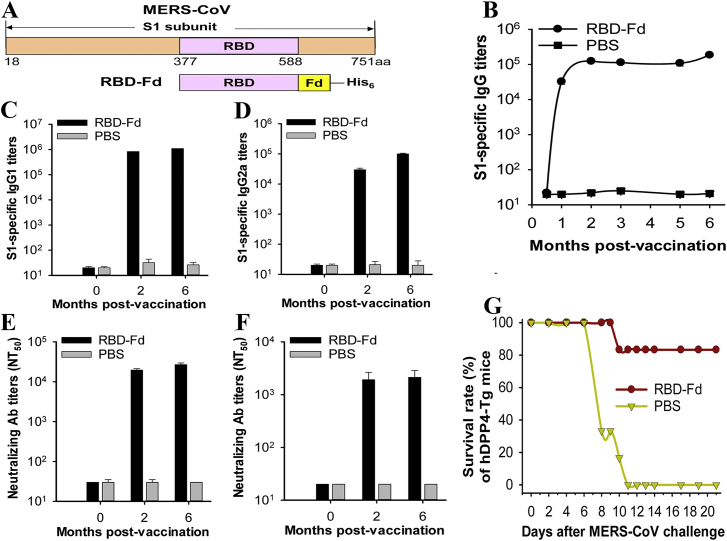
MERS-CoV RBD in trimeric form with MF59 protects human dipeptidyl peptidase 4 (hDPP4) transgenic mice from MERS-CoV infection. (A) Schematic structure of MERS-CoV S1 subunit and construction of RBD-Fd. A His6 tag was added at the C-terminus of RBD-Fd (B) MERS-CoV S1-specific IgG antibody titers. (C) and (D) MERS-CoV S1-specific IgG1 and IgG2a antibody titers. (E) and (F) neutralizing antibody levels against infections of pseudotyped and live MERS-CoV of EMC2012 strain. (G) Survival rate of MERS-CoV infected mice after vaccination. Fd: foldon. The figure was adapted with permission from Ref. 104. Copyright © 2017 Elsevier.
Figure 5
Figure 5
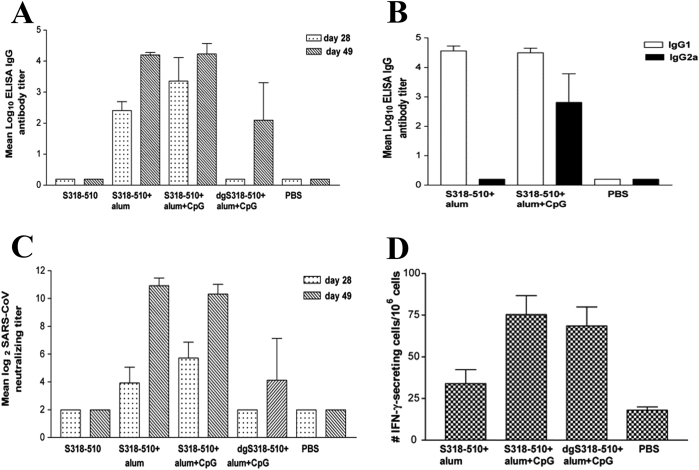
Mice immunized with SARS-CoV spike protein amino acids 318–510 (S318–510) with alum plus CpG elicited strong antibody and cellular immune responses. (A) SARS-CoV-specific IgG antibody titers. (B) SARS-CoV-specific IgG1 and IgG2a antibody titers. (C) Neutralizing antibody levels against infections of SARS-CoV of Tor-2 strain. The figure was adapted with permission from Ref. 124. Copyright © 2007 Elsevier.

References

    1. Zhu N., Zhang D., Wang W., Li X., Yang B., Song J. A novel coronavirus from patients with pneumonia in China. N Engl J Med. 2019;2020:727–733. - PMC - PubMed
    1. World Health Organization . 2020. Coronavirus disease (COVID-2019) situation reports.https://www.who.int/emergencies/diseases/novel-coronavirus-2019/situatio... [cited 2020 May 16th]. Available from:
    1. Ahmad T., Khan M., Haroon Musa TH., Nasir S., Hui J. COVID-19: zoonotic aspects. Trav Med Infect Dis. 2020:101607. - PMC - PubMed
    1. World Health Organization. Cumulative number of reported probable cases of severe acute respiratory syndrome (SARS) [cited 2020 March 30]. Available from: http://www.who.int/csr/sars/country/en/.
    1. World Health Organization. Middle East respiratory syndrome coronavirus (MERS-CoV) [cited 2020 March 30]. Available from: https://www.who.int/emergencies/mers-cov/en/

LinkOut - more resources