


NO2 levels after the COVID-19 lockdown in Ecuador: A trade-off between environment and human health
- PMID: 32834965
- PMCID: PMC7392595
- DOI: 10.1016/j.uclim.2020.100674
NO2 levels after the COVID-19 lockdown in Ecuador: A trade-off between environment and human health
Abstract
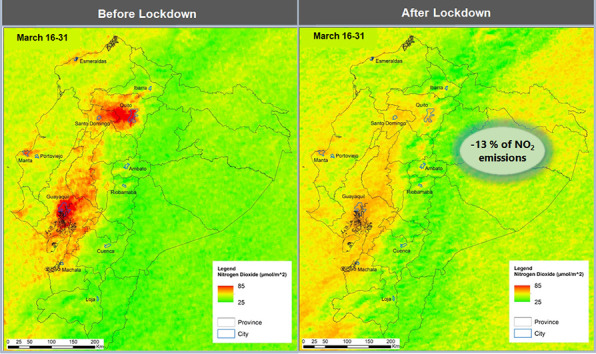
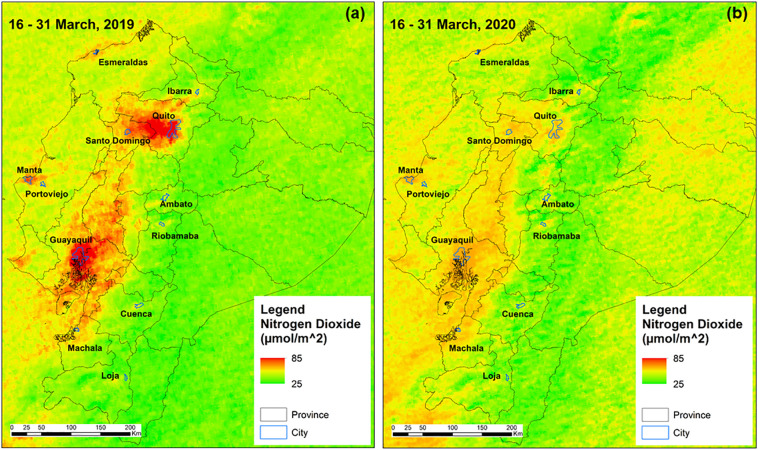
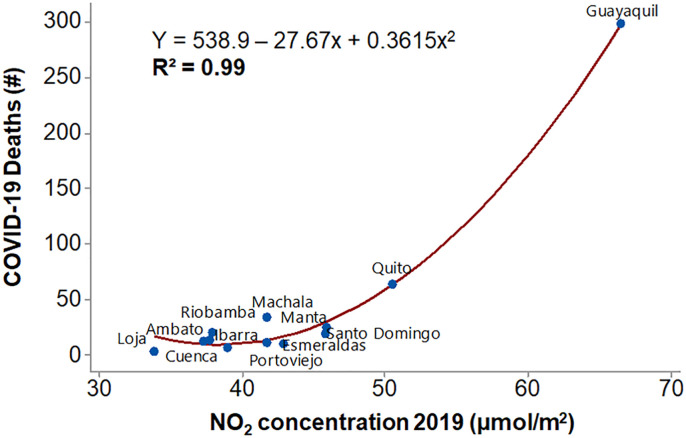
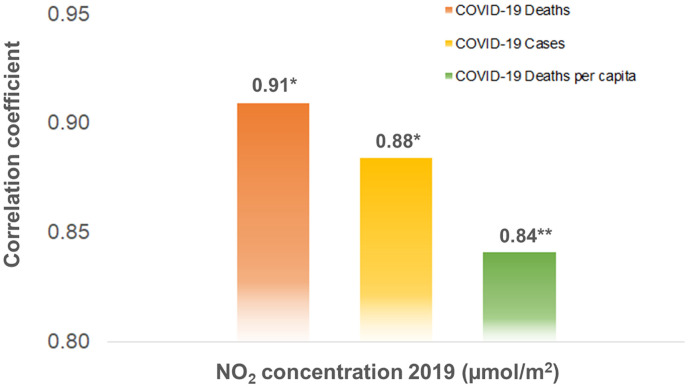
The negative effects on human health, along with the fatalities caused by the new coronavirus, have led governments worldwide to take strict measures. However, a reduction in air pollution has been found in many regions on a global scale. This study is focused on how the COVID-19 pandemic is impacting on the air quality in Ecuador, one of the most alarming cases of COVID-19 contagion in Latin America, occupying the first place as regards deaths per capita. The spatio-temporal variations in NO2 concentrations in 12 highly populated cities were evaluated by comparing the NO2 tropospheric concentrations before (2019) and after (2020) the COVID-19 lockdown. The atmospheric data was collected from the TROPOMI on the Sentinel-5P satellite of the European Space Agency. A reduction in NO2 concentrations (-13%) was observed as a consequence of the COVID-19 lockdown in Ecuador. However, this reduction occurred to the greatest extent in the cases of Guayaquil (-23.4%) and Quito (-22.4%), the two most highly populated cities. Linking NO2 levels to confirmed cases/deaths of COVID-19, a strong correlation between air NO2 concentrations and the cases/mortality caused by coronavirus (r = 0.91; p<0.001) was observed. This work highlights the crucial role played by air quality as regards human health.
Keywords: Air quality; Coronavirus disease; Highly populated cities; Human health; Nitrogen dioxide; Pandemic.
© 2020 Elsevier B.V. All rights reserved.
Conflict of interest statement
The authors declare that they have no known competing financial interests or personal relationships that could have appeared to influence the work reported in this paper.
Figures
References
-
- Andino-Enriquez M.A., Hidalgo-Bonilla S.P., Ladino L.A. Comparison of tropospheric ozone and nitrogen dioxide concentration levels in Ecuador and other latitudes. Rev. Bionat. 2018;3:586–594. doi: 10.21931/RB/2018.03.02.5. - DOI
-
- Cai J., Ge Y., Li H., Yang C., Liu C., Meng X., Wang W., Niu C., Kan L., Schikowski T., Yan B., Chillrud S.N., Kan H., Jin L. Application of land use regression to assess exposure and identify potential sources in PM2.5, BC, NO2 concentrations. Atmos. Environ. 2020;223 doi: 10.1016/j.atmosenv.2020.117267. - DOI - PMC - PubMed
LinkOut - more resources
Full Text Sources