


How scientific research reacts to international public health emergencies: a global analysis of response patterns
- PMID: 32836522
- PMCID: PMC7282204
- DOI: 10.1007/s11192-020-03531-4
How scientific research reacts to international public health emergencies: a global analysis of response patterns
Abstract
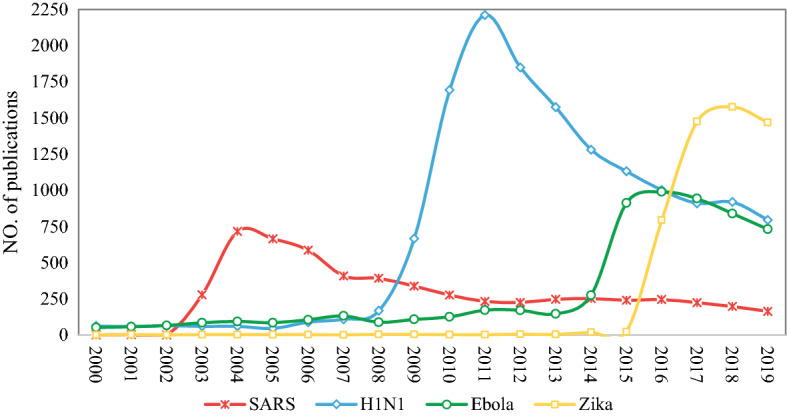
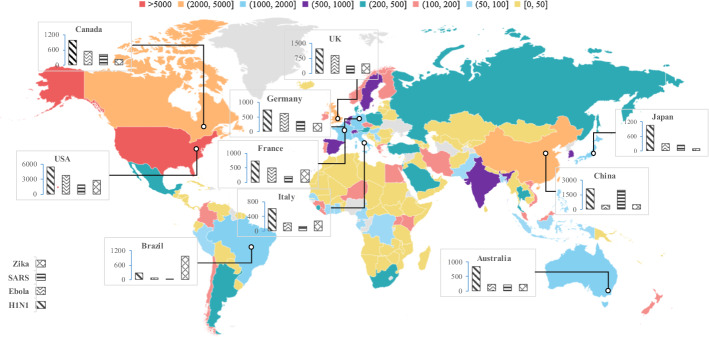
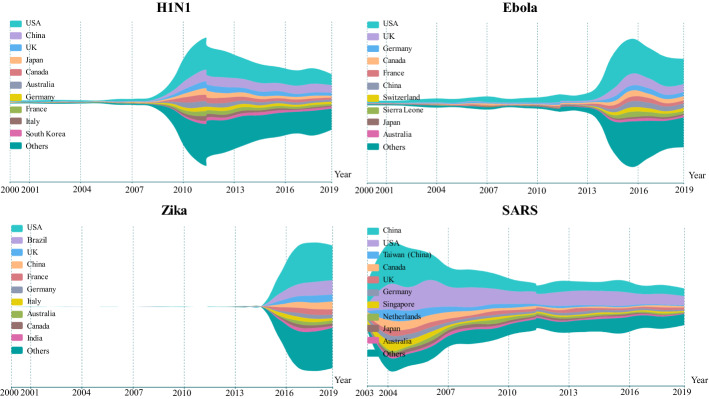
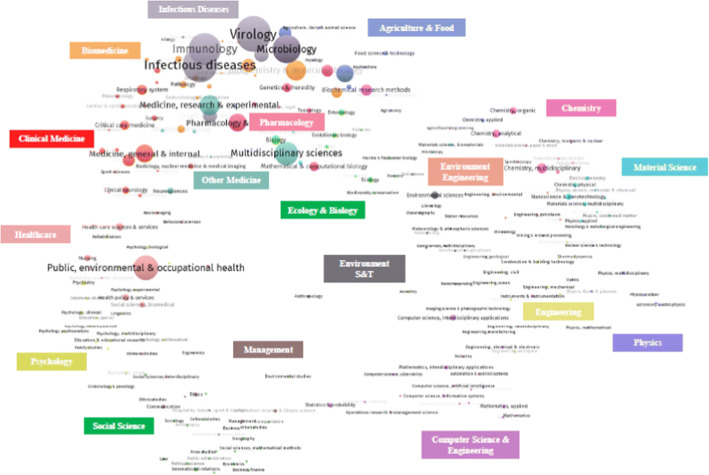
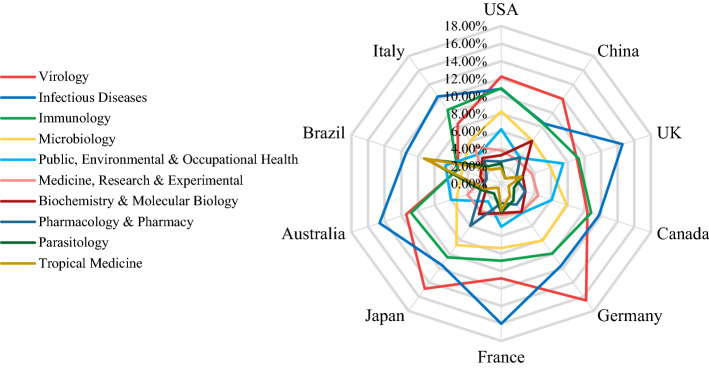
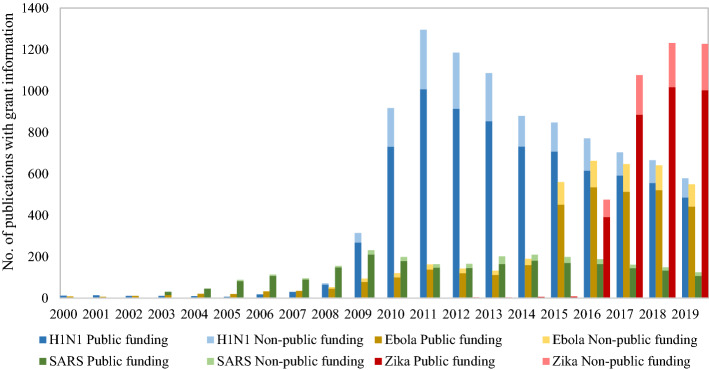
As of the middle of April 2020, the unprecedented COVID-19 pandemic has claimed more than 137,000 lives (https://coronavirus.jhu.edu/map.html). Because of its extremely fast spreading, the attention of the global scientific community is now focusing on slowing down, containing and finally stopping the spread of this disease. This requires the concerted action of researchers and practitioners of many related fields, raising, as always in such situations the question, of what kind of research has to be conducted, what are the priorities, how has research to be coordinated and who needs to be involved. In other words, what are the characteristics of the response of the global research community on the challenge? In the present paper, we attempt to characterise, quantify and measure the response of academia to international public health emergencies in a comparative bibliometric study of multiple outbreaks. In addition, we provide a preliminary review of the global research effort regarding the defeat of the COVID-19 pandemic. From our analysis of six infectious disease outbreaks since 2000, including COVID-19, we find that academia always responded quickly to public health emergencies with a sharp increase in the number of publications immediately following the declaration of an outbreak by the WHO. In general, countries/regions place emphasis on epidemics in their own region, but Europe and North America are also concerned with outbreaks in other, developed and less developed areas through conducting intensive collaborative research with the core countries/regions of the outbreak, such as in the case of Ebola in Africa. Researches in the fields of virology, infectious diseases and immunology are the most active, and we identified two characteristic patterns in global science distinguishing research in Europe and America that is more focused on public health from that conducted in China and Japan with more emphasis on biomedical research and clinical pharmacy, respectively. Universities contribute slightly less than half to the global research output, and the vast majority of research funding originates from the public sector. Our findings on how academia responds to emergencies could be beneficial to decision-makers in research and health policy in creating and adjusting anti-epidemic/-pandemic strategies.
Keywords: Bibliometrics; COVID-19; PHEIC; Response pattern; Scientometrics.
© The Author(s) 2020.
Figures






References
-
- Alvarez-Bornstein B, Morillo F, Bordons M. Funding acknowledgments in the Web of Science: completeness and accuracy of collected data. Scientometrics. 2017;112(3):1793–1812. doi: 10.1007/s11192-017-2453-4. - DOI
-
- Botelho, G., & Wilson, J. (2014). Thomas Eric Duncan: First Ebola death in U.S. CNN. Retrieved 6 April, 2020 https://edition.cnn.com/2014/10/08/health/thomas-eric-duncan-ebola/.
-
- Carley S, Porter AL, Leydesdorff IRL. Visualization of disciplinary profiles: Enhanced science overlay maps. Journal of Data and Information Science. 2017;2(3):68–111. doi: 10.1515/jdis-2017-0015. - DOI
LinkOut - more resources
Full Text Sources
Research Materials
Miscellaneous