


Coronavirus mapping in scientific publications: When science advances rapidly and collectively, is access to this knowledge open to society?
- PMID: 32836526
- PMCID: PMC7328881
- DOI: 10.1007/s11192-020-03590-7
Coronavirus mapping in scientific publications: When science advances rapidly and collectively, is access to this knowledge open to society?
Abstract
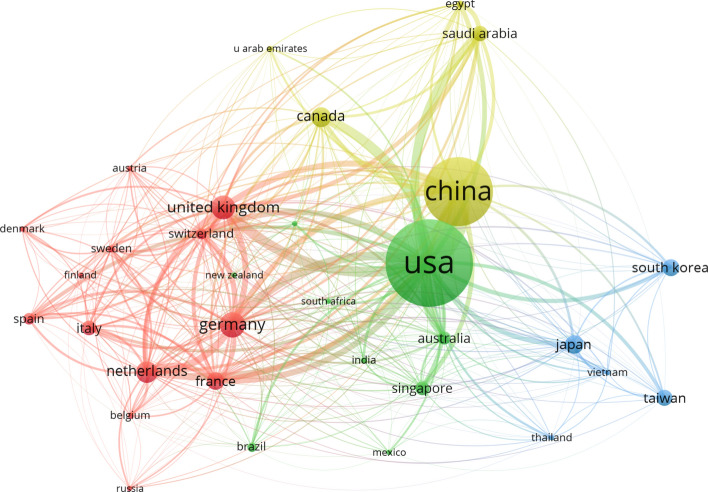
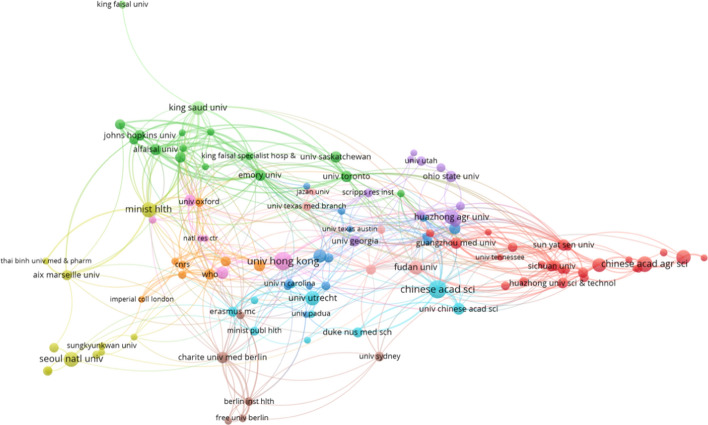
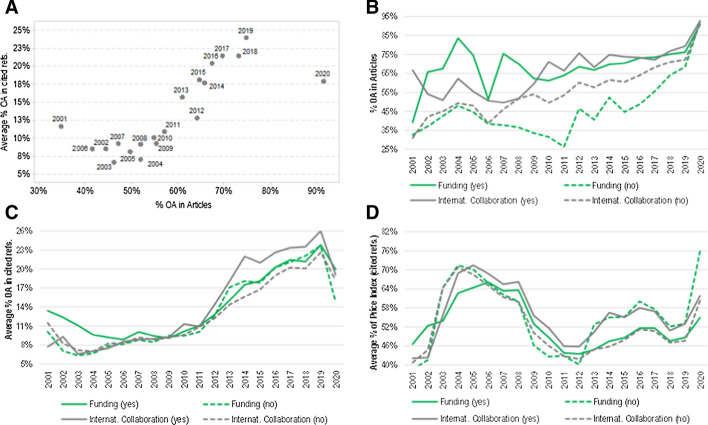
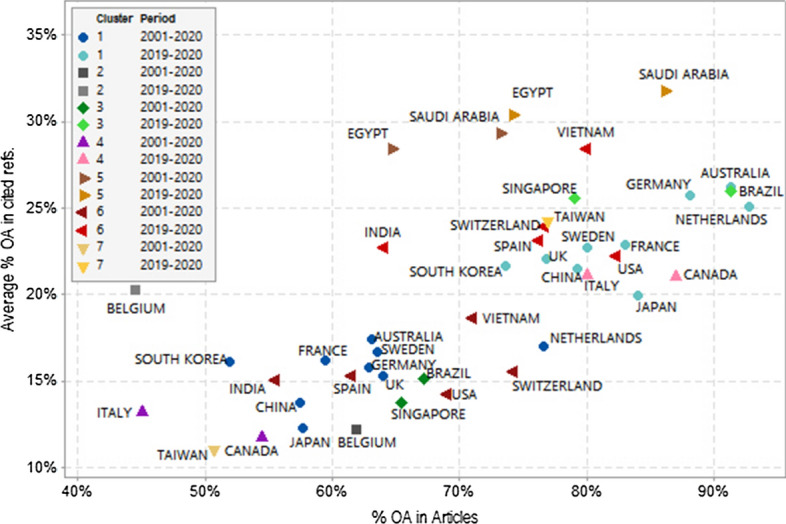
The COVID-19 pandemic is creating a global health emergency. Mapping this health emergency in scientific publications demands multiple approaches to obtain a picture as complete as possible. To progress in the knowledge of this pandemic and to control its effects, international collaborations between researchers are essentials, as well as having open and immediate access to scientific publications, what we called "coopetition". Our main objectives are to identify the most productive countries in coronavirus publications, to analyse the international scientific collaboration on this topic, and to study the proportion and typology of open accessibility to these publications. We have analyzed 18,875 articles indexed in Web of Science. We performed the descriptive statistical analysis in order to explore the performance of the more prolific countries and organizations, as well as paying attention to the last 2 years. Registers have been analyzed separately via the VOSviewer software, drawing a network of links among countries and organizations to identify the starred countries and organizations, and the strongest links of the net. We have explored the capacity of researchers to generate scientific knowledge about a health crisis emergency, and their global capacity to collaborate among them in a global emergency. We consider that science is moving rapidly to find solutions to international health problems but access to this knowledge by society is not so quick due to several limitations (open access policies, corporate interests, etc.). We have observed that papers from China in the last 3 months (from January 2020 to March 2020) have a strong impact compared with papers published in years before. The United States and China are the major producers of documents of our sample, followed by all European countries, especially the United Kingdom, Germany, the Netherlands, and France. At the same time, the leading role of Saudi Arabia, Canada or South Korea should be noted, with a significant number of documents submitted but very different dynamics of international collaboration. The proportion of international collaboration is growing in all countries in 2019-2020, which contrasts with the situation of the last two decades. The organizations providing the most documents to the sample are mostly Chinese. The percentage of open access articles on coronavirus for the period 2001-2020 is 59.2% but if we focus in 2020 the figures increase up to 91.4%, due to the commitment of commercial publishers with the emergency.
Keywords: 2019-nCoV; Bibliometric analysis; COVID-19; Coronavirus; Open access; SARS-CoV-2; Scientific collaborations.
© Akadémiai Kiadó, Budapest, Hungary 2020.
Figures




References
-
- Abadal E, Melero R, Rodrigues R, Navas-Fernández M. Spanish scholarly journals in WoS and Scopus: the impact of open access. Journal of Scholarly Publishing. 2015 doi: 10.3138/jsp.47.1.04. - DOI
-
- Belli S, Baltà J. Stocktaking scientific publication on bi-regional collaboration between Europe 28 and Latin America and the Caribbean. Scientometrics. 2019;121(3):1447–1480. doi: 10.1007/s11192-019-03266-x. - DOI
-
- Belli, S., Cardenas, R., Velez, M., Rivera, A., & Santoro, V. (2019). Open science and open access, a scientific practice for sharing knowledge. In ICAI 2019 workshop (pp. 156–167).
LinkOut - more resources
Full Text Sources
Miscellaneous