


Predictive models of COVID-19 in India: A rapid review
- PMID: 32836710
- PMCID: PMC7298493
- DOI: 10.1016/j.mjafi.2020.06.001
Predictive models of COVID-19 in India: A rapid review
Abstract
Background: The mathematical modelling of coronavirus disease-19 (COVID-19) pandemic has been attempted by a wide range of researchers from the very beginning of cases in India. Initial analysis of available models revealed large variations in scope, assumptions, predictions, course, effect of interventions, effect on health-care services, and so on. Thus, a rapid review was conducted for narrative synthesis and to assess correlation between predicted and actual values of cases in India.
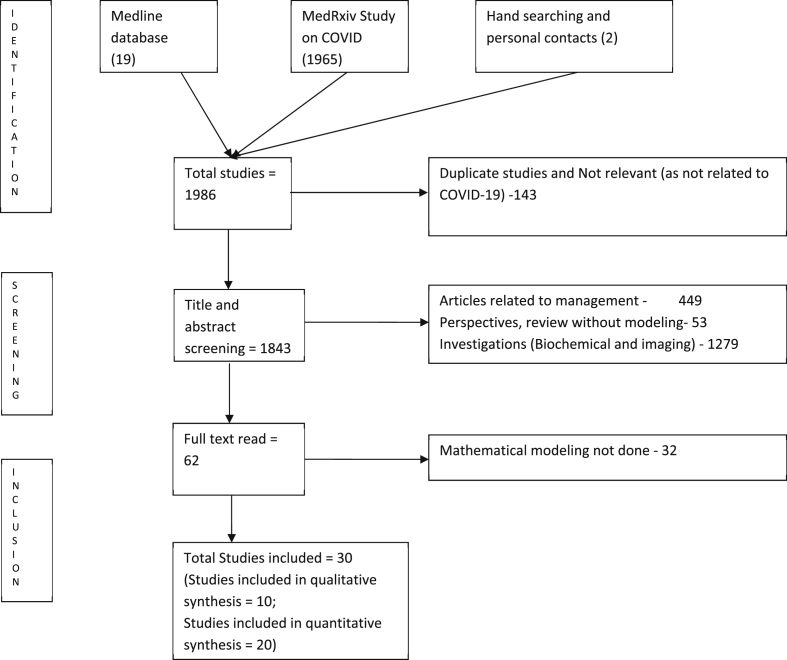
Methods: A comprehensive, two-step search strategy was adopted, wherein the databases such as Medline, google scholar, MedRxiv, and BioRxiv were searched. Later, hand searching for the articles and contacting known modelers for unpublished models was resorted. The data from the included studies were extracted by the two investigators independently and checked by third researcher.
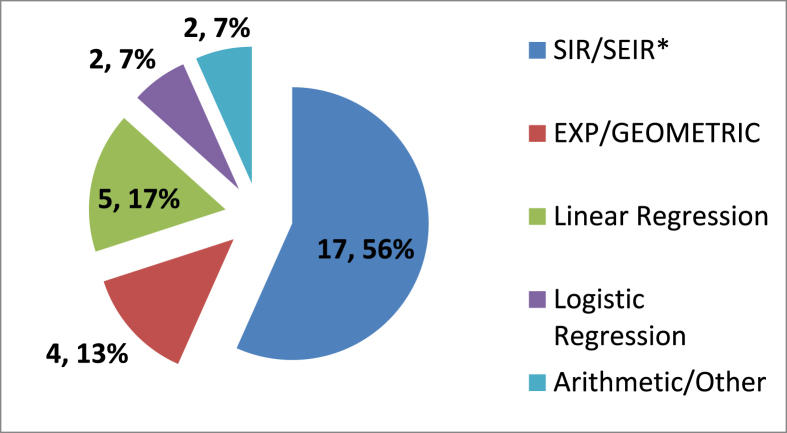
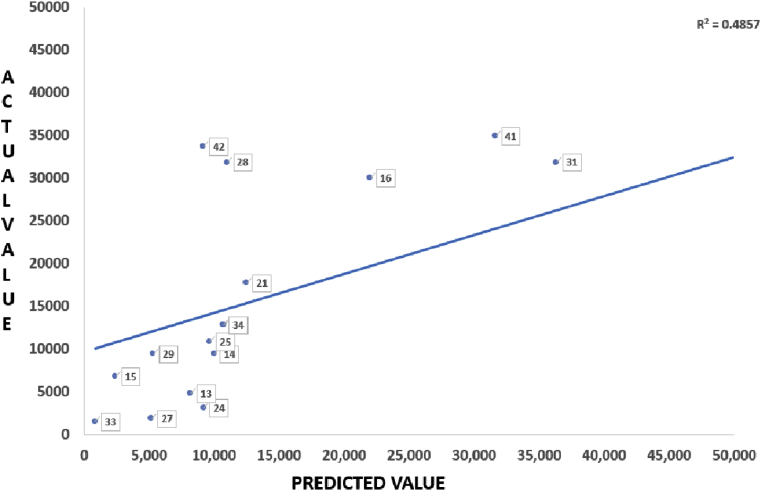
Results: Based on the literature search, 30 articles were included in this review. As narrative synthesis, data from the studies were summarized in terms of assumptions, model used, predictions, main recommendations, and findings. The Pearson's correlation coefficient (r) between predicted and actual values (n = 20) was 0.7 (p = 0.002) with R2 = 0.49. For Susceptible, Infected, Recovered (SIR) and its variant models (n = 16) 'r' was 0.65 (p = 0.02). The correlation for long-term predictions could not be assessed due to paucity of information.
Conclusion: Review has shown the importance of assumptions and strong correlation between short-term projections but uncertainties for long-term predictions. Thus, short-term predictions may be revised as more and more data become available. The assumptions too need to expand and firm up as the pandemic evolves.
Keywords: COVID-19; India; Mathematical modeling; Systematic review.
© 2020 Director General, Armed Forces Medical Services. Published by Elsevier, a division of RELX India Pvt. Ltd.
Conflict of interest statement
The authors have none to declare.
Figures
References
-
- Acuna-Soto R., Stahle D.W., Therrell M.D., Gomez Chavez S., Cleaveland M.K. Drought, epidemic disease, and the fall of classic period cultures in Mesoamerica (AD 750–950). Hemorrhagic fevers as a cause of massive population loss. Med Hypotheses. 2005;65:405–409. doi: 10.1016/j.mehy.2005.02.025. - DOI - PubMed
-
- WHO | Disease outbreaks by year. WHO. Available at: http://www.who.int/csr/don/archive/year/en/[accessed April 23, 2020].
-
- Kermack W.O., McKendrick A.G., Walker G.T. vol. 115. 1927. A contribution to the mathematical theory of epidemics; pp. 700–721. (Proceedings of the Royal Society of London Series A, Containing Papers of a Mathematical and Physical Character). - DOI
LinkOut - more resources
Full Text Sources
Research Materials
