


Psychological and Behavioural Responses to Coronavirus Disease 2019: The Role of Personality
- PMID: 32836766
- PMCID: PMC7361622
- DOI: 10.1002/per.2281
Psychological and Behavioural Responses to Coronavirus Disease 2019: The Role of Personality
Abstract
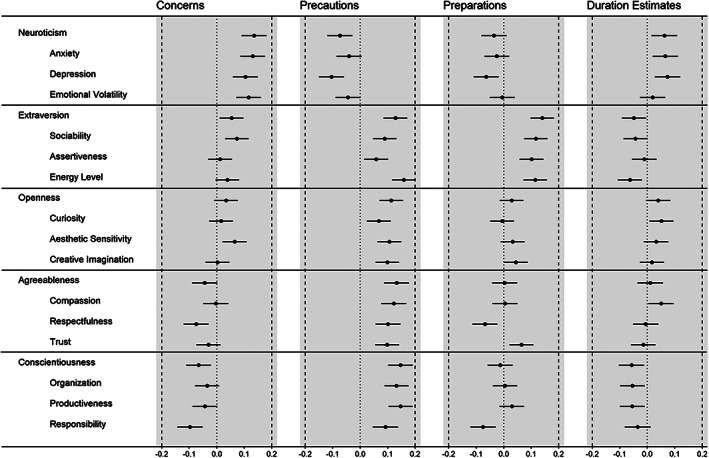
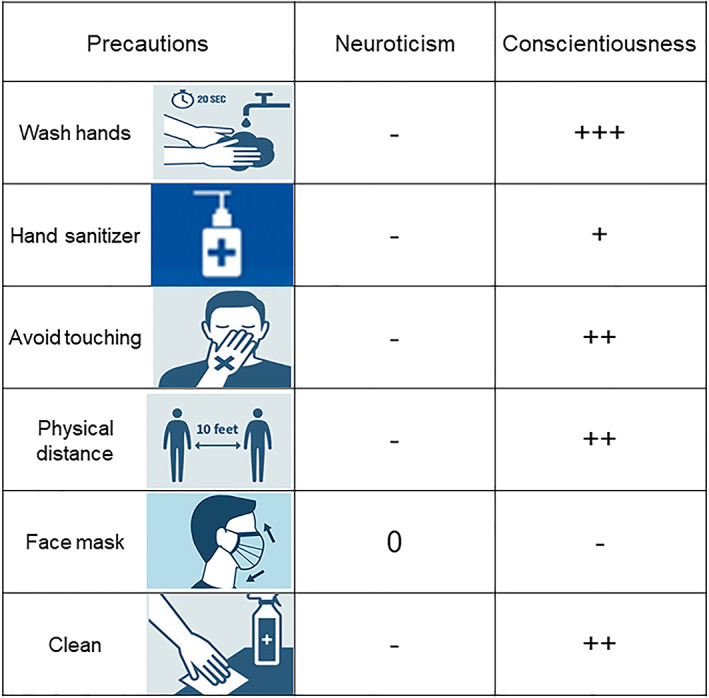
This study examined the associations between personality traits and psychological and behavioural responses to the coronavirus disease 2019 (COVID-19) pandemic. Personality was assessed in January/February 2020 when the public was not aware of the spread of coronavirus in the USA. Participants were reassessed in late March 2020 with four sets of questions about the pandemic: concerns, precautions, preparatory behaviours, and duration estimates. The sample consisted of N = 2066 participants (mean age = 51.42; range = 18-98; 48.5% women). Regression models were used to analyse the data with age, gender, education, race, and ethnicity as covariates. Consistent with the preregistered hypotheses, higher neuroticism was related to more concerns and longer duration estimates related to COVID-19, higher extraversion was related to shorter duration estimates, and higher conscientiousness was associated with more precautions. In contrast to the preregistered hypotheses, higher neuroticism was associated with fewer precautions and unrelated to preparatory behaviours. Age moderated several trait-response associations, suggesting that some of the responses were associated more strongly in older adults, a group at risk for complications of COVID-19. For example, older adults high in conscientiousness prepared more. The present findings provide insights into how personality predicts concerns and behaviours related to the COVID-19 pandemic. © 2020 European Association of Personality Psychology.
Keywords: COVID‐19; behavioural responses; conscientiousness; neuroticism; personality traits.
© 2020 European Association of Personality Psychology.
Conflict of interest statement
The authors declare no potential conflicts of interest concerning the research, the authorship, and publication of this article.
Figures
References
-
- Abdelrahman, M. (2020). Personality traits, risk perception and protective behaviors during COVID‐19 [Preprint]. PsyArXiv. 10.31234/osf.io/6g7kh - DOI - PMC - PubMed
-
- Aiken, L. S. , & West, S. G. (2011). Multiple regression: Testing and interpreting interactions, SAGE, Thousand Oaks, California, USA: Sage Publications, Inc.
-
- Alba, J. W. , & Williams, E. F. (2013). Pleasure principles: A review of research on hedonic consumption. Journal of Consumer Psychology, 23, 2–18. 10.1016/j.jcps.2012.07.003 - DOI
-
- American Psychological Association . (2020). COVID‐19 isn't just a danger to older people's physical health. https://www.apa.org/news/apa/2020/03/covid-19-danger-physical-health
Grants and funding
LinkOut - more resources
Full Text Sources