Review
. 2021 Jan;16(1):4-23.
doi: 10.1016/j.ajps.2020.06.001. Epub 2020 Jul 4.

Recent insights for the emerging COVID-19: Drug discovery, therapeutic options and vaccine development

Affiliations
Review

Recent insights for the emerging COVID-19: Drug discovery, therapeutic options and vaccine development

Yuefei Zhu et al. Asian J Pharm Sci. 2021 Jan.

Abstract

SARS-CoV-2 has been marked as a highly pathogenic coronavirus of COVID-19 disease into the human population, causing over 5.5 million confirmed cases worldwide. As COVID-19 has posed a global threat with significant human casualties and severe economic losses, there is a pressing demand to further understand the current situation and develop rational strategies to contain the drastic spread of the virus. Although there are no specific antiviral therapies that have proven effective in randomized clinical trials, currently, the rapid detection technology along with several promising therapeutics for COVID-19 have mitigated its drastic transmission. Besides, global institutions and corporations have commenced to parse out effective vaccines for the prevention of COVID-19. Herein, the present review will give exhaustive details of extensive researches concerning the drug discovery and therapeutic options for COVID-19 as well as some insightful discussions of the status of COVID-19.

Keywords: COVID-19; Coronavirus; Drug discovery; Precise prevention and control; SARS-CoV-2; Vaccine development.


Conflict of interest statement

The authors assert that there is no conflict of interests concerning the publication of this review.

Figures

Image, graphical abstract
Graphical abstract
Fig. 1
Fig. 1
Cumulatively identified cases of COVID-19 worldwide, as of 28 May 2020 . As indicated in this figure, the overall data still presents a slow upward trend, suggesting that the epidemic has not been effectively alleviated.
Fig. 2
Fig. 2
Structure of SARS-CoV-2 S in the pre-fusion conformation and the genome, along with the crystal structure of the C-terminal domain of SARS-CoV-2 (SARS-CoV-2-CTD) S protein in complex with human ACE2. (A) Schematic of SARS-CoV-2 S primary structure colored by domain. SS, signal sequence; S2′, S2′ protease cleavage site; FP, fusion peptide; HR1, heptad repeat 1; CH, central helix; CD, connector domain; HR2, heptad repeat 2; TM, transmembrane domain; CT, cytoplasmic tail. Arrows denote protease cleavage sites. (B) Ribbon diagrams of the SARS-CoV-2 S ectodomain cryoEM structures. (C) The SARS-CoV-2 S1 subunits. (D) The SARS-CoV-2 S2 subunits. (E) A hACE2-binding mode of SARS-CoV-2. Reproduced with permission , , .
Fig. 3
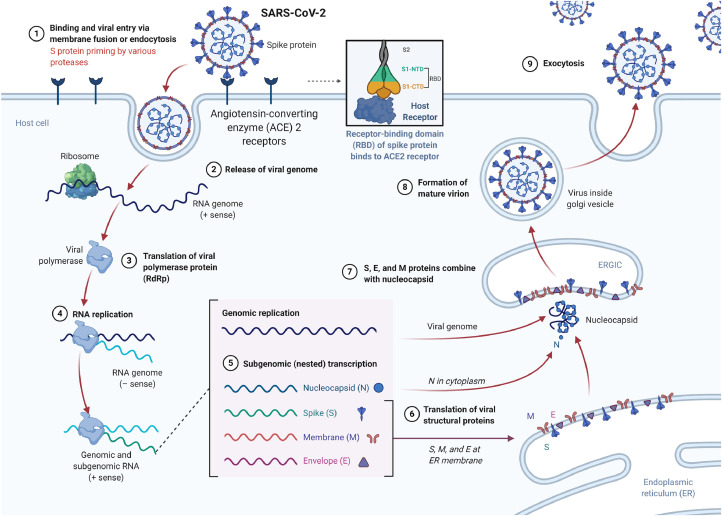
Fig. 3
The possible viral entry and replication mechanism of SARS-CoV-2. When the S protein of SARS-CoV-2 binds to the cellular receptor ACE2, it begins its life cycle. After the receptor is bound, the conformational change of the S protein helps the viral envelope to fuse with the cell membrane through the endosome pathway. Then, SARS-CoV-2 releases the RNA into the host cell. Genomic RNA is translated into viral replicase polyproteins pp1a and 1ab, which are then cleaved into small products by viral proteases. The polymerase generates a series of subgenomic mRNAs through discontinuous transcription, which is ultimately translated into related viral proteins. Viral proteins and genomic RNA are subsequently assembled into virions in the ER and Golgi, and then transported through vesicles and released from the cells. ERGIC, ER-Golgi intermediate compartment. Created with BioRender.com.
Fig. 4
Fig. 4
COVID-19 diagnostic test by RT-PCR. First, cotton swab is deployed to collect the secretion sample from the patient ’s nose or throat. The virus particles in the sample are then deactivated along with the separation of RNA strands. Then, the purified RNA strands are copied by utilizing reverse transcription and amplified by RT-PCR to detect the presence of virus-specific gene sequences. Created with BioRender.com.
Fig. 5
Fig. 5
The potential mechanism of SARS-CoV-2 inducing cytokine storm. Increased cytokine levels (IL-6, IL-10, and TNF-α) are associated with severe COVID-19. ISGs, IFN-stimulated genes. Parts of this figure created with BioRender.com.
Fig. 6
Fig. 6
Crucial SARS-CoV-2 targets for novel antiviral drug development. ACE2 receptor, receptor-binding domain along with the main protease Mpro can be leveraged as antiviral targets. Created with BioRender.com.
Fig. 7
Fig. 7
Potential antiviral mechanism of remdesivir against SARS-CoV-2. The active molecule metabolized from remdesivir prodrug (GS-441524) may intercept RdRp early in viral replication, thereby interfering with the downstream steps of the SARS-CoV-2 replication cycle. Created with BioRender.com.
Fig. 8
Fig. 8
Clinical phase vaccine candidates for COVID-19. aAPC, artificial antigen-presenting cell; MHC, major histocompatibility complex class; VLP, virus-like particle; DC, dendritic cell; LV, lentiviral vector; CTLs, cytotoxic T lymphocytes; HLA-A, a group of human leukocyte antigens (HLA) that are coded for by the HLA-A locus. Created with BioRender.com.

References

    1. Chan J.F.W., Yuan S., Kok K.H., To K.K.W., Chu H., Yang J. A familial cluster of pneumonia associated with the 2019 novel coronavirus indicating person-to-person transmission: a study of a family cluster. Lancet. 2020;395:514–523. - PMC - PubMed
    1. Andersen K.G., Rambaut A., Lipkin W.I., Holmes E.C., Garry R.F. The proximal origin of SARS-CoV-2. Nat Med. 2020:1–3. - PMC - PubMed
    1. Chan J.F.W., Lau S.K.P., Woo P.C.Y. The emerging novel Middle East respiratory syndrome coronavirus: the “knowns” and “unknowns.”. J Formos Med Assoc. 2013;112:372–381. - PMC - PubMed
    1. Zumla A., Chan J.F.W., Azhar E.I., Hui D.S.C., Yuen K.Y. Coronaviruses—drug discovery and therapeutic options. Nat Rev Drug Discov. 2016;15:327. - PMC - PubMed
    1. Xia S., Liu M., Wang C., Xu W., Lan Q., Feng S. Inhibition of SARS-CoV-2 (previously 2019-nCoV) infection by a highly potent pan-coronavirus fusion inhibitor targeting its spike protein that harbors a high capacity to mediate membrane fusion. Cell Res. 2020:1–13. - PMC - PubMed