Review
. 2020 Nov:26:149-159.
doi: 10.1016/j.jare.2020.08.002. Epub 2020 Aug 6.

Molecular diagnostic technologies for COVID-19: Limitations and challenges

Affiliations
Review

Molecular diagnostic technologies for COVID-19: Limitations and challenges

Adeel Afzal. J Adv Res. 2020 Nov.

Abstract

Background: To curb the spread of the COVID-19 (coronavirus disease 2019) pandemic, the world needs diagnostic systems capable of rapid detection and quantification of the novel coronavirus (SARS-CoV-2). Many biomedical companies are rising to the challenge and developing COVID-19 diagnostics. In the last few months, some of these diagnostics have become commercially available for healthcare workers and clinical laboratories. However, the diagnostic technologies have specific limitations and reported several false-positive and false-negative cases, especially during the early stages of infection.

Aim: This article aims to review recent developments in the field of COVID-19 diagnostics based on molecular technologies and analyze their clinical performance data.

Key concepts: The literature survey and performance-based analysis of the commercial and pre-commercial molecular diagnostics address several questions and issues related to the limitations of current technologies and highlight future research and development challenges to enable timely, rapid, low-cost, and accurate diagnosis of emerging infectious diseases.

Keywords: COVID-19; Clinical sensitivity; In vitro diagnostics; Point-of-care; Real-time RT-PCR; SARS-CoV-2.


Conflict of interest statement

The author declares that he has no known competing financial interests or personal relationships that could have appeared to influence the work reported in this paper.

Figures
None
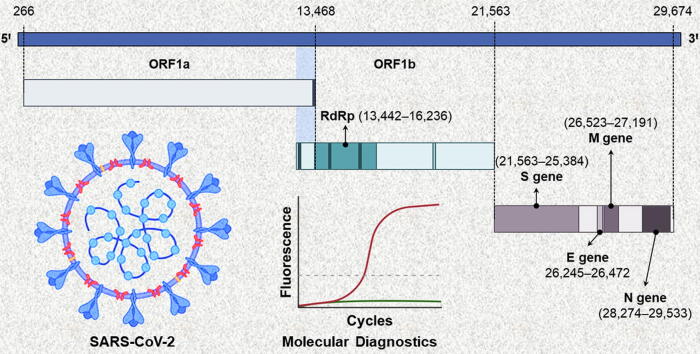
Graphical abstract
Fig. 1
Fig. 1
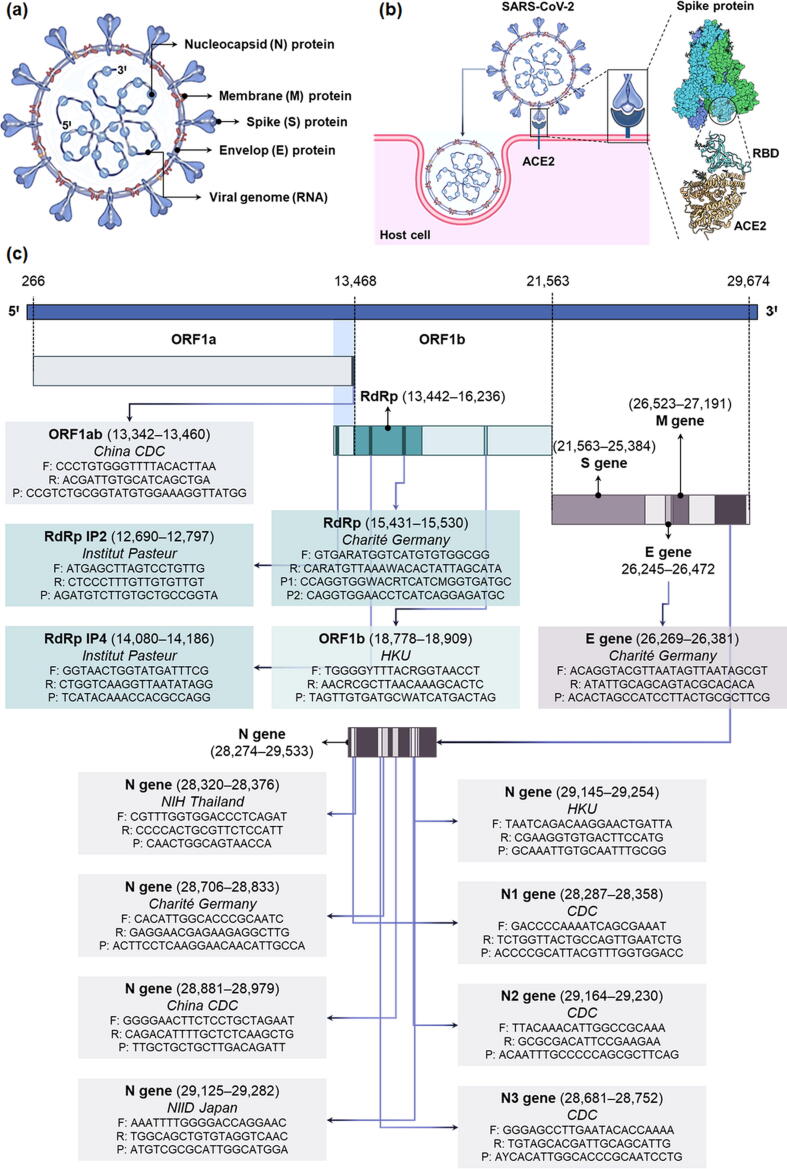
(a) The structure of SARS-CoV-2. (b) A schematic showing the interaction of SARS-CoV-2 with host cells and cellular entry mechanism. The virus first binds to angiotensin-converting enzyme 2 (ACE2) receptors on the host cell membrane through a receptor-binding domain (RBD) on the spike protein. Subsequently, it is endocytosed into the host cell. (c) The genomic constitution of SARS-CoV-2 RNA. The viral genome consists of two large genes: ORF1a, and ORF1b, which encode non-structural proteins (NSP) including RdRp, whereas the smaller structural genomic region hosts S, E, M, and N genes, which encode the structural proteins. CDC: Centers for Disease Control and Prevention; E gene: gene encoding envelop protein of SARS-CoV-2; HKU: Hong Kong University; M gene: gene encoding membrane protein of SARS-CoV-2; N gene: gene encoding nucleocapsid protein of SARS-CoV-2; NIH: National Institute of Health (Thailand); NIID: National Institute of Infectious Diseases (Japan); ORF1a/b: open reading frame 1a and b of SARS-CoV-2; RdRp: RNA-dependent RNA polymerase of SARS-CoV-2; SARS-CoV-2: severe acute respiratory syndrome coronavirus 2; S gene: gene encoding spike protein of SARS-CoV-2.
Fig. 2
Fig. 2
A molecular representation of the real-time RT-PCR principle. The template (viral RNA) is converted to cDNA (complementary DNA) by reverse transcriptase (RNA dependent DNA polymerase enzyme). Subsequently, cDNA is amplified in a polymerase chain reaction (PCR) in three steps: (1) denaturation of cDNA at 95 °C, (2) annealing of the primers and probe to the respective denatured cDNA strands at 60 °C, and (3) extension or synthesis of RNA copies by DNA polymerase at 72 °C. The amplified products follow the same cycle to generate a large number of RNA copies. TaqMan probe is used to quantify RNA copies by producing fluorescence signal during amplification cycles.
Fig. 3
Fig. 3
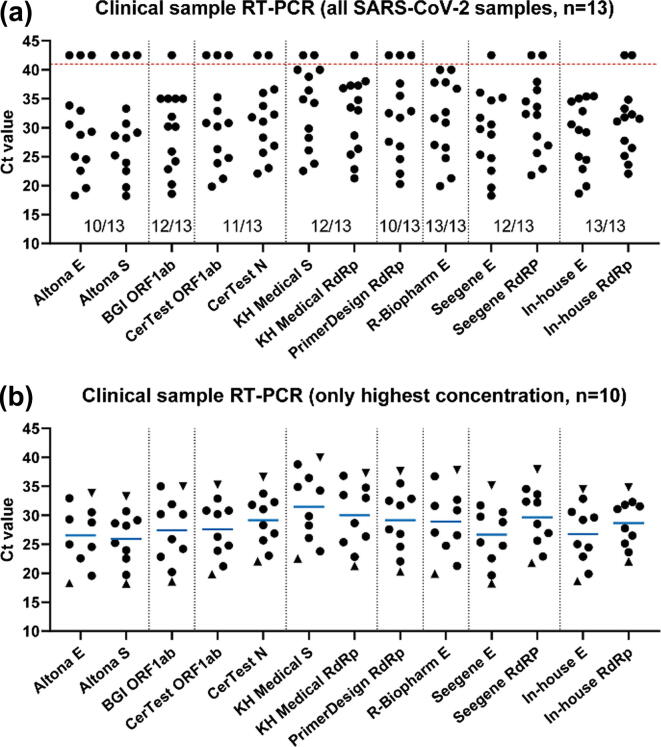
The evaluation of commercially available RT-PCR kits shows variations in the rate of detection and Ct values. (a) Experimental Ct values obtained for commercial RT-PCR assays (n = 13). The data points on top of the horizontal line (red, dotted) are negative, indicated with Ct = 42.5 for plotting purposes. The rate of detection of the RT-PCR kit is mentioned below the data points. (b) The data points for the clinical samples (n = 10) with the highest viral load that were positively identified by all RT-PCR assays. The horizontal lines (blue) indicate the mean Ct value, triangles show the Ct values of the samples with the highest (sample 1) and lowest (sample 10) viral load according to the in-house E gene PCR. E: envelop protein of SARS-CoV-2; RdRp: RNA-dependent RNA polymerase of SARS-CoV-2; N: nucleocapsid protein of SARS-CoV-2; ORF1ab: open reading frame 1a and b of SARS-CoV-2; RT-PCR: reverse transcriptase-polymerase chain reaction; S: spike protein of SARS-CoV-2; SARS-CoV-2: severe acute respiratory syndrome coronavirus 2 (reprinted with permission from ; copyright Elsevier, 2020).

References

    1. Cotten M., Watson S.J., Kellam P., Al-Rabeeah A.A., Makhdoom H.Q., Assiri A. Transmission and evolution of the Middle East respiratory syndrome coronavirus in Saudi Arabia: a descriptive genomic study. The Lancet. 2013;382:1993–2002. - PMC - PubMed
    1. Baize S., Pannetier D., Oestereich L., Rieger T., Koivogui L., Magassouba N. Emergence of Zaire Ebola virus disease in Guinea. N Engl J Med. 2014;371:1418–1425. - PubMed
    1. Campos G.S., Bandeira A.C., Sardi S.I. Zika Virus Outbreak, Bahia, Brazil. Emerg Infect Dis. 2015;21:1885–1886. doi: 10.3201/eid2110.150847. - DOI - PMC - PubMed
    1. Wu J.T., Leung K., Leung G.M. Nowcasting and forecasting the potential domestic and international spread of the 2019-nCoV outbreak originating in Wuhan, China: a modelling study. The Lancet. 2020;395:689–697. - PMC - PubMed
    1. World Health Organization W. Coronavirus disease 2019 (COVID-19): situation report, 72; 2020.