


Colchicine in COVID-19: an Old Drug, New Use
- PMID: 32837853
- PMCID: PMC7367785
- DOI: 10.1007/s40495-020-00225-6
Colchicine in COVID-19: an Old Drug, New Use
Abstract
Purpose of review: Coronavirus disease 2019 (COVID-19), caused by severe acute respiratory syndrome-coronavirus-2 (SARS-CoV-2) infection, is a pandemic causing havoc globally. Currently, there are no Food and Drug Administration (FDA)-approved drugs to treat COVID-19. In the absence of effective treatment, off-label drug use, in lieu of evidence from published randomized, double-blind, placebo-controlled clinical trials, is common in COVID-19. Although it is vital to treat affected patients with antiviral drugs, there is a knowledge gap regarding the use of anti-inflammatory drugs in these patients.
Recent findings: Colchicine trials to combat inflammation in COVID-19 patients have not received much attention. We await the results of ongoing colchicine randomized controlled trials in COVID-19, evaluating colchicine's efficacy in treating COVID-19.
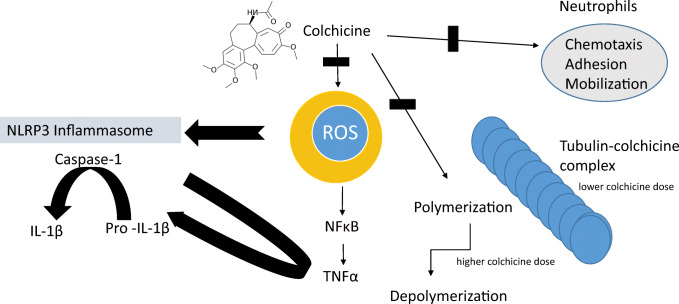
Summary: This review gives a spotlight on colchicine's anti-inflammatory and antiviral properties and why colchicine may help fight COVID-19. This review summarizes colchicine's mechanism of action via the tubulin-colchicine complex. Furthermore, it discussed how colchicine interferes with several inflammatory pathways, including inhibition of neutrophil chemotaxis, adhesion, and mobilization; disruption of superoxide production, inflammasome inhibition, and tumor necrosis factor reduction; and its possible antiviral properties. In addition, colchicine dosing and pharmacokinetics, as well as drug interactions and how they relate to ongoing, colchicine in COVID-19 clinical trials, are examined.
Keywords: Anti-inflammatory; Antiviral; COVID-19; Colchicine; Colchicine-tubulin complex; SARS-CoV-2 infection.
© Springer Nature Switzerland AG 2020.
Conflict of interest statement
Conflict of InterestDr. Schlesinger declares Grants: Pfizer, AMGEN; Advisory boards and consulting: Novartis, Selecta, Mallinckrodt, Horizon Therapeutics, IFM Therapeutics, Johnson and Johnson. Dr. Brunetti declares: Grants: CSL Behring, Astellas Pharma; Advisory boards and consulting: Horizon Blue Cross Blue Shield of New Jersey. Dr. Firestein has nothing to declare.
References
-
- Weede RP. Poison in the pot: the legacy of Lead Southern Illinois University Press: Carbondale and Edwardsville. 1984;83.
-
- Corrodi H, Hardegger E. Die Konfiguration des Colchicins und verwandter Verbindungen Helv. Chem Acta. 1955;38:2030–2033. doi: 10.1002/hlca.19550380743. - DOI
-
- Schlesinger N, Schumacher R, Catton M, et al. Colchicine for acute gout. Cochrane Database Syst Rev. 2006;4:CD006190. - PubMed
LinkOut - more resources
Full Text Sources
Other Literature Sources
Research Materials
Miscellaneous