


Prognostic factors associated with mortality risk and disease progression in 639 critically ill patients with COVID-19 in Europe: Initial report of the international RISC-19-ICU prospective observational cohort
- PMID: 32838231
- PMCID: PMC7338015
- DOI: 10.1016/j.eclinm.2020.100449
Prognostic factors associated with mortality risk and disease progression in 639 critically ill patients with COVID-19 in Europe: Initial report of the international RISC-19-ICU prospective observational cohort
Abstract
Background: Coronavirus disease 2019 (COVID-19) is associated with a high disease burden with 10% of confirmed cases progressing towards critical illness. Nevertheless, the disease course and predictors of mortality in critically ill patients are poorly understood.
Methods: Following the critical developments in ICUs in regions experiencing early inception of the pandemic, the European-based, international RIsk Stratification in COVID-19 patients in the Intensive Care Unit (RISC-19-ICU) registry was created to provide near real-time assessment of patients developing critical illness due to COVID-19.
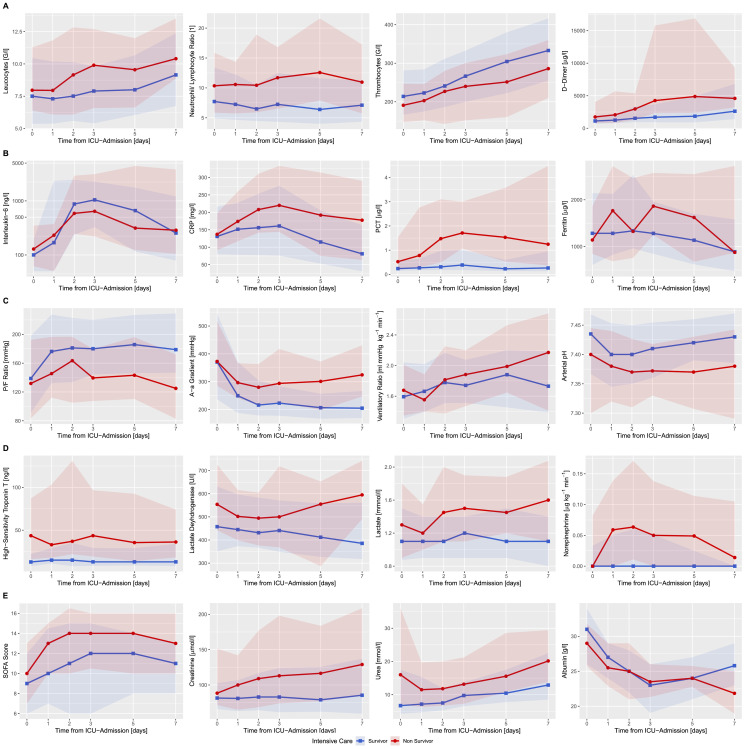
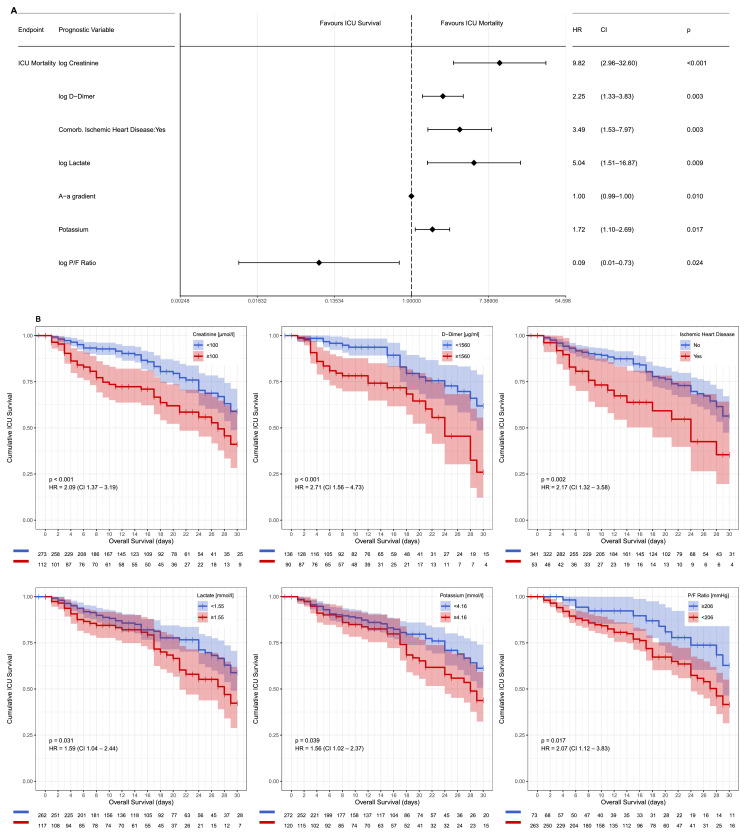
Findings: As of April 22, 2020, 639 critically ill patients with confirmed SARS-CoV-2 infection were included in the RISC-19-ICU registry. Of these, 398 had deceased or been discharged from the ICU. ICU-mortality was 24%, median length of stay 12 (IQR, 5-21) days. ARDS was diagnosed in 74%, with a minimum P/F-ratio of 110 (IQR, 80-148). Prone positioning, ECCO2R, or ECMO were applied in 57%. Off-label therapies were prescribed in 265 (67%) patients, and 89% of all bloodstream infections were observed in this subgroup (n = 66; RR=3·2, 95% CI [1·7-6·0]). While PCT and IL-6 levels remained similar in ICU survivors and non-survivors throughout the ICU stay (p = 0·35, 0·34), CRP, creatinine, troponin, d-dimer, lactate, neutrophil count, P/F-ratio diverged within the first seven days (p<0·01). On a multivariable Cox proportional-hazard regression model at admission, creatinine, d-dimer, lactate, potassium, P/F-ratio, alveolar-arterial gradient, and ischemic heart disease were independently associated with ICU-mortality.
Interpretation: The European RISC-19-ICU cohort demonstrates a moderate mortality of 24% in critically ill patients with COVID-19. Despite high ARDS severity, mechanical ventilation incidence was low and associated with more rescue therapies. In contrast to risk factors in hospitalized patients reported in other studies, the main mortality predictors in these critically ill patients were markers of oxygenation deficit, renal and microvascular dysfunction, and coagulatory activation. Elevated risk of bloodstream infections underscores the need to exercise caution with off-label therapies.
Keywords: Acute respiratory distress syndrome; COVID-19; Coronavirus; Pandemic; Public health.
© 2020 The Authors.
Conflict of interest statement
The authors declare no conflicts of interest regarding the present study.
Figures
References
-
- Organization W.H. Coronavirus disease 2019 (COVID-19): situation report, 93. 2020.
LinkOut - more resources
Full Text Sources
Research Materials
Miscellaneous
