


[Period Prevalence of SARS-CoV-2 in an Unselected Sample of Pregnant Women in Jena, Thuringia]
- PMID: 32838448
- PMCID: PMC7516362
- DOI: 10.1055/a-1206-1033
[Period Prevalence of SARS-CoV-2 in an Unselected Sample of Pregnant Women in Jena, Thuringia]
Abstract
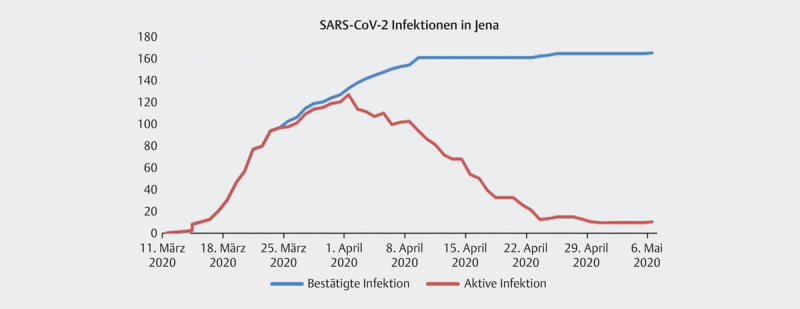
Introduction: Following an exponential increase in SARS-CoV-2 infections, the city of Jena, Thuringia, was the first in Germany to introduce mandatory mouth and nose coverings. An estimation of the SARS-CoV-2 period prevalence was achieved by screening an unselected cohort of pregnant women. Of interest was the number of unreported cases.
Methods: Upon admission to hospital, patients were screened for SARS-CoV-2 by a specific real-time PCR and antibodies determined by a specific SARS-CoV-2 IgG in serum by ELISA. The SARS-CoV-2 period prevalence was estimated using the Clopper-Pearson exact method, the group comparison with Fischer's exact test.
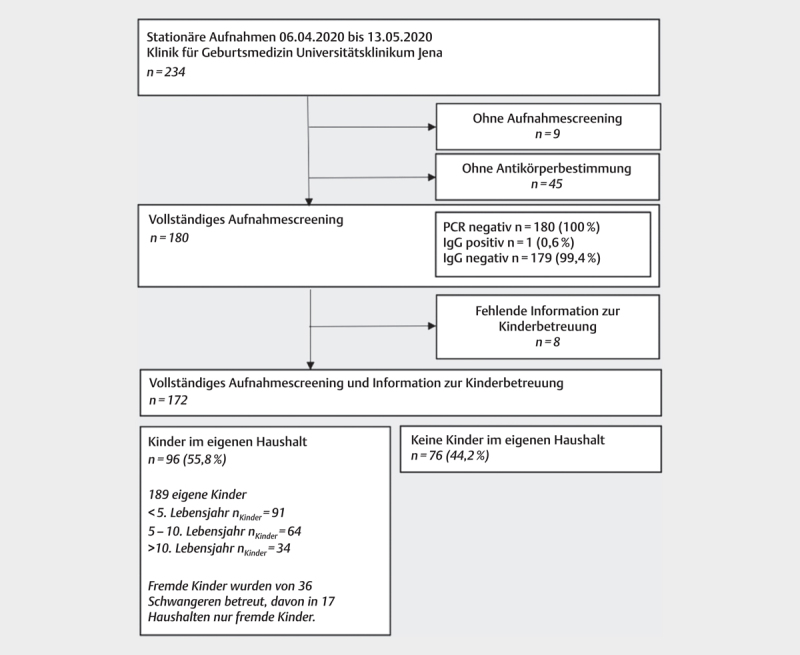
Results: From 6 April to 13 May 2020, 234 pregnant women were admitted to the Department of Obstetrics. A total of 225 (96.2%) SARS-CoV-2 PCRs were carried out and all remained negative. Specific IgG antibodies were detected in one (0.6%) of 180 (76.9%) antibody tests performed. The interval estimate of the period prevalence thus results in a 95% confidence interval between 0-1.7%. For 96 households with children, the period prevalence is 0-3.8%, which does not differ from the 0-4.8% for 76 households without children (p=1.00).
Discussion: This is the first report on the SARS-CoV-2 period prevalence of an unselected sample of pregnant women in Germany. Antibody testing showed no evidence of the feared high number of unreported asymptomatic SARS-CoV-2 infections. The seroconversion rate was below 1% (0.6%).
Einleitung: Die Stadt Jena, Thüringen, führte nach exponentiellem Anstieg der SARS-CoV-2 Infektionen bundesweit erstmalig eine Pflicht zur Bedeckung von Mund und Nase ein. Durch Screening einer unselektierten Kohorte von Schwangeren sollte eine Schätzung der SARS-CoV-2 Periodenprävalenz erfolgen. Von Interesse war die Frage nach der Dunkelziffer.
Methoden: Bei stationärer Aufnahme erfolgte ein Screening sowie eine Antikörperbestimmungen auf SARS-CoV-2, mittels spezifischer Real-Time-PCR und Bestimmung spezifischer SARS-CoV-2 IgG im Serum mittels ELISA. Die Schätzung der SARS-CoV2 Periodenprävalenz erfolgte nach der exakten Methode von Clopper und Pearson, der Gruppenvergleich mit Fischers exaktem Test.
Ergebnisse: Vom 06.04. bis 13.05.2020 wurden 234 Schwangere stationär aufgenommen. 225 (96,2%) durchgeführte SARS-CoV2 PCR verblieben negativ. Bei einer (0,6%) von 180 (76,9%) erfolgten Antikörperbestimmungen wurden spezifische IgG-Antikörper detektiert. Die Intervallschätzung der Periodenprävalenz ergibt damit ein 95%-Konfidenzintervall zwischen 0–1,7%. Für 96 Haushalten mit Kindern ergibt sich eine Periodenprävalenz von 0–3,8%, die sich nicht von der für 76 Haushalte ohne Kinder von 0–4,8% unterscheidet (p=1,00).
Diskussion: Erstmalig wird die SARS-CoV-2 Periodenprävalenz einer unselektierten Stichprobe Schwangerer in Deutschland erfasst. Es ergab sich kein Hinweis für eine befürchtet hohe Dunkelziffer asymptomatischer Schwangerer für unbemerkte SARS-CoV-2 Infektionen mittels Antikörpernachweis. Die messbare Serokonversionsrate lag bei unter 1% (0,6%).
© Georg Thieme Verlag KG Stuttgart · New York.
Conflict of interest statement
Die Autorinnen/Autoren geben an, dass kein Interessenkonflikt besteht.
Figures
References
-
- Clopper C J, Pearson E S.The Use of Confidence or Fiducial Limits Illustrated in the Case of the Binomial Biometrika 193426404–413.doi: 10.2307/2331986
MeSH terms
LinkOut - more resources
Full Text Sources
Miscellaneous
