


US racial inequality may be as deadly as COVID-19
- PMID: 32839337
- PMCID: PMC7486779
- DOI: 10.1073/pnas.2014750117
US racial inequality may be as deadly as COVID-19
Abstract
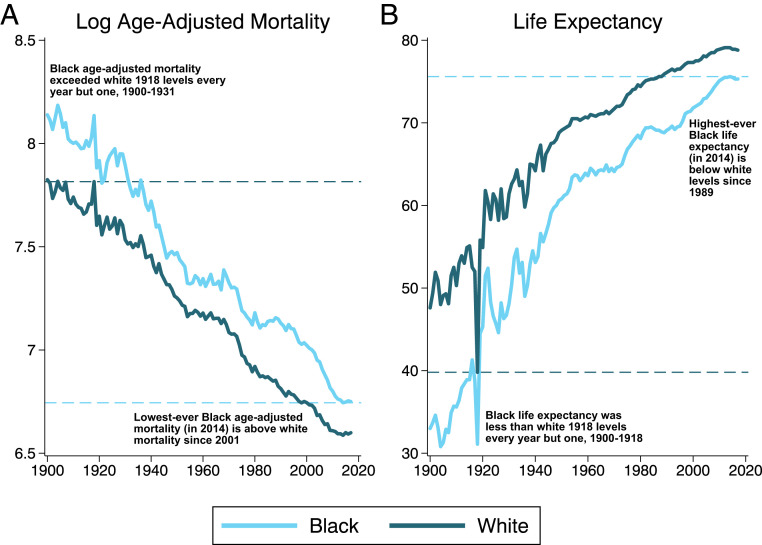
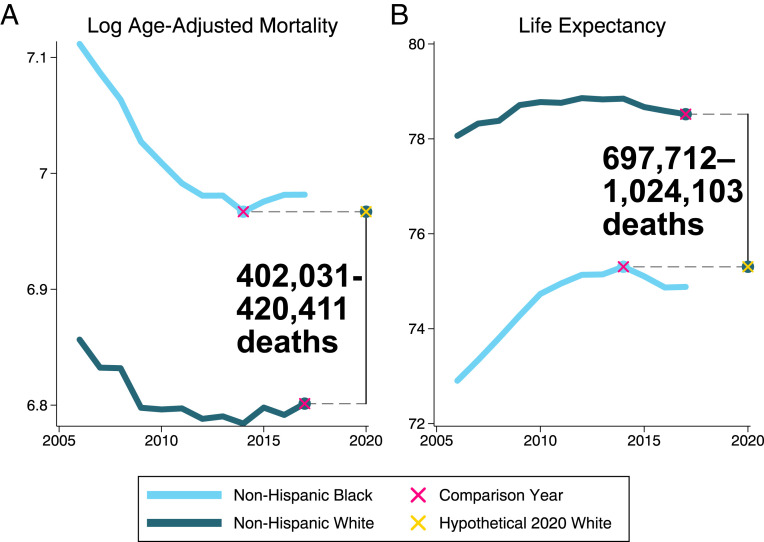
The COVID-19 pandemic is causing a catastrophic increase in US mortality. How does the scale of this pandemic compare to another US catastrophe: racial inequality? Using demographic models, I estimate how many excess White deaths would raise US White mortality to the best-ever (lowest) US Black level under alternative, plausible assumptions about the age patterning of excess mortality in 2020. I find that 400,000 excess White deaths would be needed to equal the best mortality ever recorded among Blacks. For White mortality in 2020 to reach levels that Blacks experience outside of pandemics, current COVID-19 mortality levels would need to increase by a factor of nearly 6. Moreover, White life expectancy in 2020 will remain higher than Black life expectancy has ever been unless nearly 700,000 excess White deaths occur. Even amid COVID-19, US White mortality is likely to be less than what US Blacks have experienced every year. I argue that, if Black disadvantage operates every year on the scale of Whites' experience of COVID-19, then so too should the tools we deploy to fight it. Our imagination should not be limited by how accustomed the United States is to profound racial inequality.
Keywords: COVID-19; mortality; racial inequality.
Copyright © 2020 the Author(s). Published by PNAS.
Conflict of interest statement
The author declares no competing interest.
Figures
References
-
- Case A., Deaton A., Deaths of Despair and the Future of Capitalism, (Princeton University Press, 2020).
-
- Arias E., United States life tables, 2017. Natl. Vital Stat. Rep. 68, 1–66 (2019). - PubMed
-
- Preston S. H., Heuveline P., Guillot M., Demography: Measuring and Modeling Population Processes, (Blackwell, Oxford, United Kingdom, 2001).
Publication types
MeSH terms
Grants and funding
LinkOut - more resources
Full Text Sources
