


Clinical presentation, management, and 6-month outcomes in women with peripartum cardiomyopathy: an ESC EORP registry
- PMID: 32840318
- PMCID: PMC7846090
- DOI: 10.1093/eurheartj/ehaa455
Clinical presentation, management, and 6-month outcomes in women with peripartum cardiomyopathy: an ESC EORP registry
Erratum in
-
Corrigendum to:/Retraction: Clinical presentation, management and 6-month outcomes in women with peripartum cardiomyopathy, an ESC EORP registry.Eur Heart J. 2021 Feb 11;42(6):680. doi: 10.1093/eurheartj/ehaa940. Eur Heart J. 2021. PMID: 33200203 Free PMC article. No abstract available.
Abstract
Aims: We sought to describe the clinical presentation, management, and 6-month outcomes in women with peripartum cardiomyopathy (PPCM) globally.
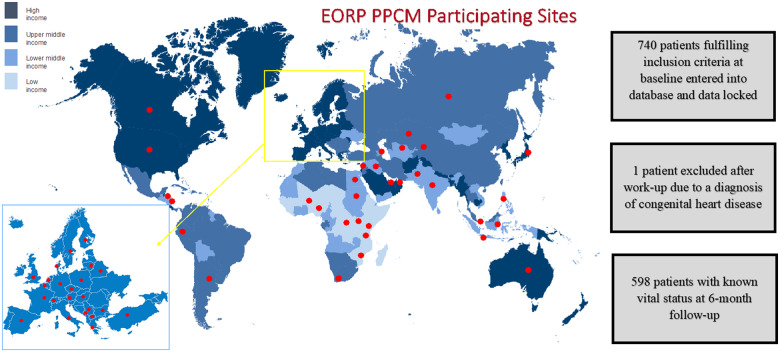
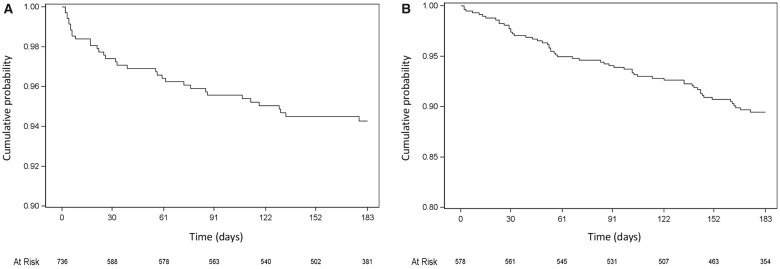
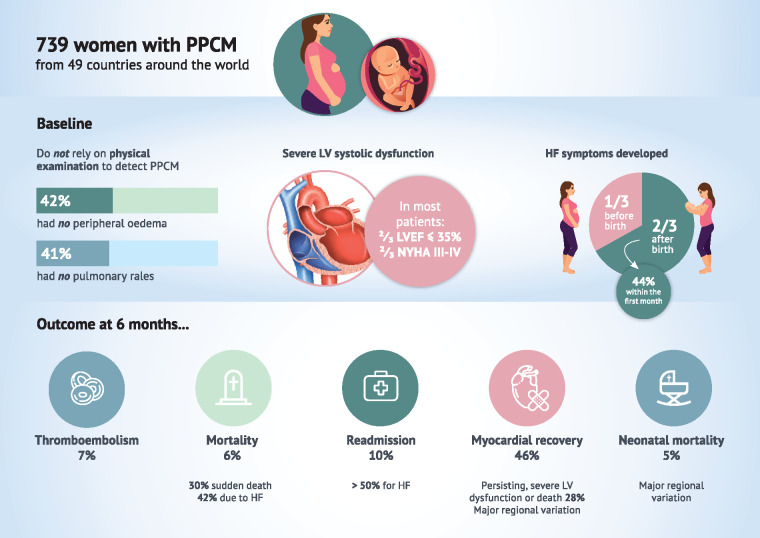
Methods and results: In 2011, >100 national and affiliated member cardiac societies of the European Society of Cardiology (ESC) were contacted to contribute to a global registry on PPCM, under the auspices of the ESC EURObservational Research Programme. These societies were tasked with identifying centres who could participate in this registry. In low-income countries, e.g. Mozambique or Burkina Faso, where there are no national societies due to a shortage of cardiologists, we identified potential participants through abstracts and publications and encouraged participation into the study. Seven hundred and thirty-nine women were enrolled in 49 countries in Europe (33%), Africa (29%), Asia-Pacific (15%), and the Middle East (22%). Mean age was 31 ± 6 years, mean left ventricular ejection fraction (LVEF) was 31 ± 10%, and 10% had a previous pregnancy complicated by PPCM. Symptom-onset occurred most often within 1 month of delivery (44%). At diagnosis, 67% of patients had severe (NYHA III/IV) symptoms and 67% had a LVEF ≤35%. Fifteen percent received bromocriptine with significant regional variation (Europe 15%, Africa 26%, Asia-Pacific 8%, the Middle East 4%, P < 0.001). Follow-up was available for 598 (81%) women. Six-month mortality was 6% overall, lowest in Europe (4%), and highest in the Middle East (10%). Most deaths were due to heart failure (42%) or sudden (30%). Re-admission for any reason occurred in 10% (with just over half of these for heart failure) and thromboembolic events in 7%. Myocardial recovery (LVEF > 50%) occurred only in 46%, most commonly in Asia-Pacific (62%), and least commonly in the Middle East (25%). Neonatal death occurred in 5% with marked regional variation (Europe 2%, the Middle East 9%).
Conclusion: Peripartum cardiomyopathy is a global disease, but clinical presentation and outcomes vary by region. Just under half of women experience myocardial recovery. Peripartum cardiomyopathy is a disease with substantial maternal and neonatal morbidity and mortality.
Keywords: Outcome; Peripartum cardiomyopathy; Registry.
Published on behalf of the European Society of Cardiology. All rights reserved. © The Author(s) 2020. For permissions, please email: journals.permissions@oup.com.
Figures
Comment in
-
Peripartum cardiomyopathy: one disease with many faces.Eur Heart J. 2020 Oct 14;41(39):3798-3800. doi: 10.1093/eurheartj/ehaa564. Eur Heart J. 2020. PMID: 32901264 No abstract available.
References
-
- Sliwa K, Hilfiker-Kleiner D, Petrie MC, Mebazaa A, Pieske B, Buchmann E, Regitz-Zagrosek V, Schaufelberger M, Tavazzi L, van Veldhuisen DJ, Watkins H, Shah AJ, Seferovic PM, Elkayam U, Pankuweit S, Papp Z, Mouquet F, McMurray JJ; Heart Failure Association of the European Society of Cardiology Working Group on Peripartum Cardiomyopathy. Current state of knowledge on aetiology, diagnosis, management, and therapy of peripartum cardiomyopathy: a position statement from the Heart Failure Association of the European Society of Cardiology Working Group on peripartum cardiomyopathy. Eur J Heart Fail 2010;12:767–778. - PubMed
-
- Bauersachs J, König T, van D, Meer P, Petrie MC, Hilfiker-Kleiner D, Mbakwem A, Hamdan R, Jackson AM, Forsyth P, de Boer RA, Mueller C, Lyon AR, Lund LH, Piepoli MF, Heymans S, Chioncel O, Anker SD, Ponikowski P, Seferovic PM, Johnson MR, Mebazaa A, Sliwa K.. Pathophysiology, diagnosis and management of peripartum cardiomyopathy: a position statement from the Heart Failure Association of the European Society of Cardiology Study Group on peripartum cardiomyopathy. Eur J Heart Fail 2019;21:827–843. - PubMed
-
- Blauwet LA, Libhaber E, Forster O, Tibazarwa K, Mebazaa A, Hilfiker-Kleiner D, Sliwa K.. Predictors of outcome in 176 South African patients with peripartum cardiomyopathy. Heart 2013;99:308–313. - PubMed
-
- Haghikia A, Podewski E, Libhaber E, Labidi S, Fischer D, Roentgen P, Tsikas D, Jordan J, Lichtinghagen R, Kaisenberg CS, Struman I, Bovy N, Sliwa K, Bauersachs J, Hilfiker-Kleiner D.. Phenotyping and outcome on contemporary management in a German cohort of patients with peripartum cardiomyopathy. Basic Res Cardiol 2013;108:366. - PMC - PubMed
Publication types
MeSH terms
Grants and funding
LinkOut - more resources
Full Text Sources
Medical
