


Nanoparticles in Agroindustry: Applications, Toxicity, Challenges, and Trends
- PMID: 32842495
- PMCID: PMC7558820
- DOI: 10.3390/nano10091654
Nanoparticles in Agroindustry: Applications, Toxicity, Challenges, and Trends
Abstract
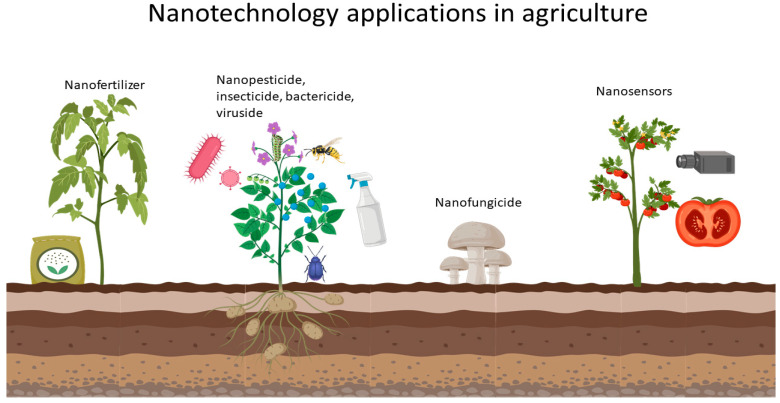
Nanotechnology is a tool that in the last decade has demonstrated multiple applications in several sectors, including agroindustry. There has been an advance in the development of nanoparticulated systems to be used as fertilizers, pesticides, herbicides, sensors, and quality stimulants, among other applications. The nanoencapsulation process not only protects the active ingredient but also can affect the diffusion, interaction, and activity. It is important to evaluate the negative aspects of the use of nanoparticles (NPs) in agriculture. Given the high impact of the nanoparticulated systems in the agro-industrial field, this review aims to address the effects of various nanomaterials on the morphology, metabolomics, and genetic modification of several crops.
Keywords: agriculture; metabolomics; nanoparticles; nanotechnology.
Conflict of interest statement
The authors declare no conflict of interest.
Figures
References
-
- Tripathi D.K., Shweta S., Singh S., Singh S., Pandey R., Singh V.P., Sharma N.C., Prasad S.M., Dubey N.K., Chauhan D.K. An overview on manufactured nanoparticles in plants: Uptake, translocation, accumulation and phytotoxicity. Plant. Physiol. Biochem. 2017;110:2–12. doi: 10.1016/j.plaphy.2016.07.030. - DOI - PubMed
-
- López-Moreno M.L., De La Rosa G., Hernández-Viezcas J.A., Peralta-Videa J.R., Gardea-Torresdey J.L. X-ray absorption spectroscopy (XAS) corroboration of the uptake and storage of CeO2 nanoparticles and assessment of their differential toxicity in four edible plant species. J. Agric. Food Chem. 2010;58:3689–3693. doi: 10.1021/jf904472e. - DOI - PMC - PubMed
Publication types
Grants and funding
LinkOut - more resources
Full Text Sources
