. 2020 Oct;69(10):2064-2074.
doi: 10.2337/dbi20-0004. Epub 2020 Aug 25.

Defining Heterogeneity Among Women With Gestational Diabetes Mellitus

Affiliations

Defining Heterogeneity Among Women With Gestational Diabetes Mellitus

Camille E Powe et al. Diabetes. 2020 Oct.

Abstract

Attention to precision medicine in type 2 diabetes (T2D) has provided two favored approaches to subclassifying affected individuals and parsing heterogeneity apparent in this condition: phenotype-based and genotype-based. Gestational diabetes mellitus (GDM) shares phenotypic characteristics with T2D. However, unlike T2D, GDM emerges in the setting of profound pregnancy-related physiologic changes in glucose metabolism. T2D and GDM also share common genetic architecture, but there are likely to be unique genetic influences on pregnancy glycemic regulation that contribute to GDM. In this Perspective, we describe efforts to decipher heterogeneity in T2D and detail how we and others are applying approaches developed for T2D to the study of heterogeneity in GDM. Emerging results reveal the potential of phenotype- and genotype-based subclassification of GDM to deliver the promise of precision medicine to the obstetric population.


Figures

Figure 1
Figure 1
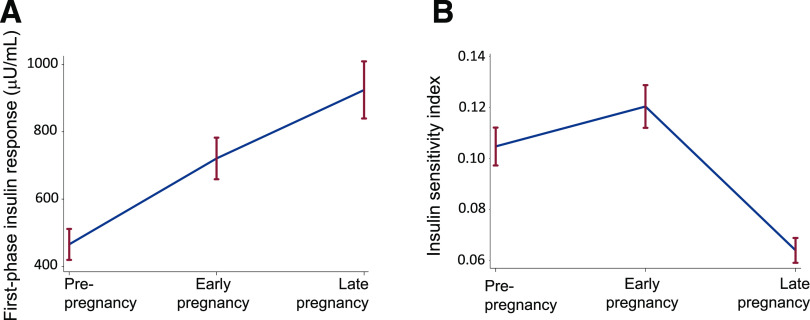
Longitudinal changes in insulin secretion and sensitivity across pregnancy (28). Reproduced with permission from Powe et al. (28). Insulin secretory response (by intravenous glucose tolerance test) and insulin sensitivity (by euglycemic clamp) were assessed in 34 women prior to pregnancy, in early pregnancy (12–14 weeks’ gestation), and in late pregnancy (34–36 weeks’ gestation). Depicted are the mean first-phase insulin response (A) and insulin sensitivity index (B) at the three study time points. Error bars denote SEM for each time point.
Figure 2
Figure 2
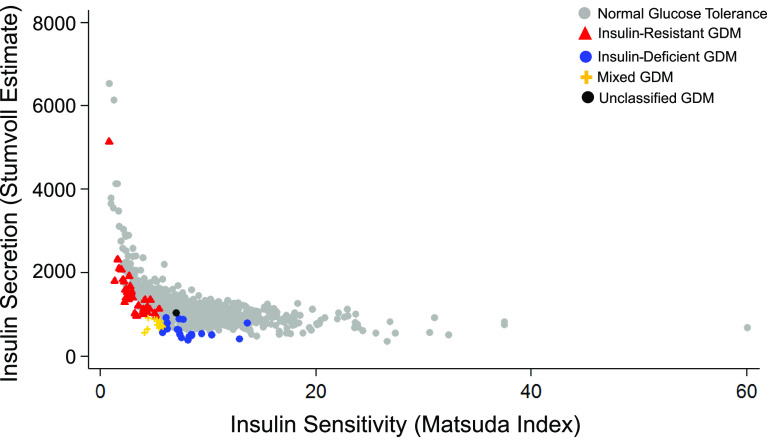
Insulin secretion and sensitivity in women with normal glucose tolerance and GDM physiologic subtypes (10). Figure reproduced from the online supplement of Powe et al. (10). In the Gen3G cohort (N = 809), there were 67 women (8.3%) with GDM. The gray circles represent women with normal glucose tolerance. Based on insulin sensitivity or secretion defects (Matsuda index or Stumvoll first-phase estimate <25th percentile in women with normal glucose tolerance), we classified women with GDM into physiologic subtypes: insulin-resistant GDM (N = 34, 51% of GDM) (red triangles), insulin-deficient GDM (N = 20, 30% of GDM) (blue circles), and mixed GDM (N = 12, 18% of GDM) (gold plus signs). One participant could not be classified because she had neither excess insulin resistance nor evidence of insulin deficiency (N = 1, 1.5% of GDM) (black circle).
Figure 3
Figure 3
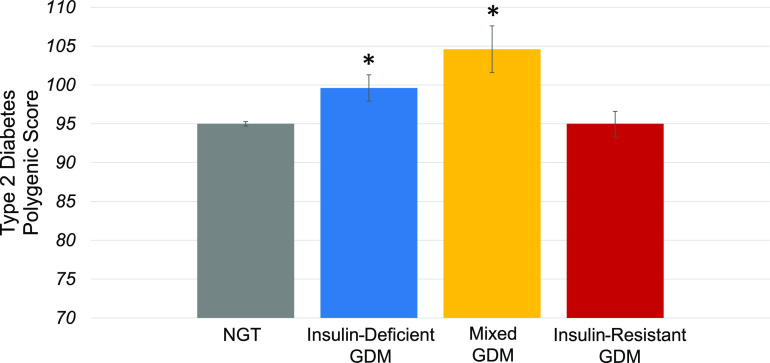
Differences in T2D-associated genetic variant burden across GDM physiologic subtypes (66). In Gen3G cohort participants with genetic information (N = 501), a polygenic score for T2D risk was constructed by aggregating the T2D risk–increasing alleles at 85 loci discovered in previous GWAS (53). Scores were compared across GDM physiologic subtypes (66). The T2D polygenic score was significantly higher in women with insulin-deficient GDM and mixed GDM. The graph depicts mean scores and SD in each group. *Indicates significantly different from women with normal glucose tolerance (NGT).

References

    1. HAPO Study Cooperative Research Group Hyperglycemia and adverse pregnancy outcomes. N Engl J Med 2008;358:1991–2002 - PubMed
    1. Lowe WL Jr, Scholtens DM, Kuang A, et al. ; HAPO Follow-up Study Cooperative Research Group. Hyperglycemia and Adverse Pregnancy Outcome Follow-up Study (HAPO FUS): maternal gestational diabetes and childhood glucose metabolism. Diabetes Care 2019;42:372–380 - PMC - PubMed
    1. Committee on Practice Bulletins—Obstetrics ACOG practice bulletin no. 190: gestational diabetes mellitus. Obstet Gynecol 2018;131:e49–e64 - PubMed
    1. American Diabetes Association 14. Management of diabetes in pregnancy: Standards of Medical Care in Diabetes—2020. Diabetes Care 2020;43(Suppl. 1):S183–S192 - PubMed

    1. Zera CA, Bates DW, Stuebe AM, Ecker JL, Seely EW. Diabetes screening reminder for women with prior gestational diabetes: a randomized controlled trial. Obstet Gynecol 2015;126:109–114 - PMC - PubMed

Publication types