. 2020 Aug 25;10(1):14179.
doi: 10.1038/s41598-020-70864-8.

Immunoinformatic identification of B cell and T cell epitopes in the SARS-CoV-2 proteome

Affiliations

Immunoinformatic identification of B cell and T cell epitopes in the SARS-CoV-2 proteome

Stephen N Crooke et al. Sci Rep. .

Abstract

A novel coronavirus (SARS-CoV-2) emerged from China in late 2019 and rapidly spread across the globe, infecting millions of people and generating societal disruption on a level not seen since the 1918 influenza pandemic. A safe and effective vaccine is desperately needed to prevent the continued spread of SARS-CoV-2; yet, rational vaccine design efforts are currently hampered by the lack of knowledge regarding viral epitopes targeted during an immune response, and the need for more in-depth knowledge on betacoronavirus immunology. To that end, we developed a computational workflow using a series of open-source algorithms and webtools to analyze the proteome of SARS-CoV-2 and identify putative T cell and B cell epitopes. Utilizing a set of stringent selection criteria to filter peptide epitopes, we identified 41 T cell epitopes (5 HLA class I, 36 HLA class II) and 6 B cell epitopes that could serve as promising targets for peptide-based vaccine development against this emerging global pathogen. To our knowledge, this is the first study to comprehensively analyze all 10 (structural, non-structural and accessory) proteins from SARS-CoV-2 using predictive algorithms to identify potential targets for vaccine development.


Conflict of interest statement

Dr. Poland is the chair of a Safety Evaluation Committee for novel investigational vaccine trials being conducted by Merck Research Laboratories. Dr. Poland offers consultative advice on vaccine development to Merck & Co., Medicago, GlaxoSmithKline, Sanofi Pasteur, Emergent Biosolutions, Dynavax, Genentech, Eli Lilly and Company, Janssen Global Services LLC, Kentucky Bioprocessing, and Genevant Sciences, Inc. Drs. Poland, Kennedy, and Ovsyannikova hold patents related to vaccinia, influenza, and measles peptide vaccines. Drs. Poland, Kennedy, and Ovsyannikova have received grant funding from ICW Ventures for preclinical studies on a peptide-based COVID-19 vaccine. Dr. Kennedy has received funding from Merck Research Laboratories to study waning immunity to mumps vaccine. These activities have been reviewed by the Mayo Clinic Conflict of Interest Review Board and are conducted in compliance with Mayo Clinic Conflict of Interest policies. This research has been reviewed by the Mayo Clinic Conflict of Interest Review Board and was conducted in compliance with Mayo Clinic Conflict of Interest policies. All other authors declare no competing financial interests. This research has been reviewed by the Mayo Clinic Conflict of Interest Review Board and was conducted in compliance with Mayo Clinic Conflict of Interest policies.

Figures
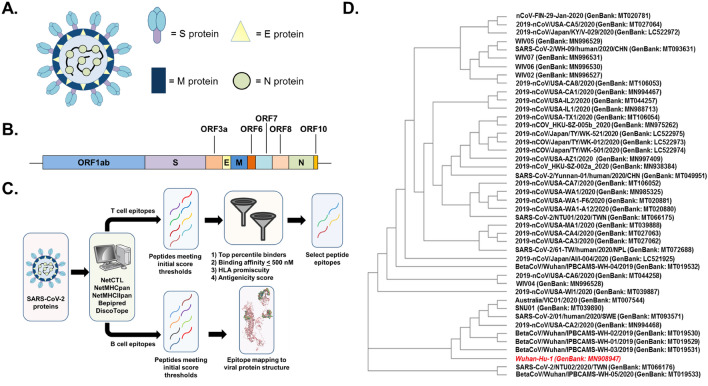
Figure 1
Figure 1
(A) Diagram of SARS-CoV-2 virion structure with the major structural proteins (S, M, N, and E) highlighted. (B) Cartoon representation of the SARS-CoV-2 genome with the 10 major protein-coding regions annotated. The box diagrams are proportional to the protein size. (C) Diagram of peptide identification workflow illustrating the algorithms used,–,–,, and filtering criterion applied to refine peptide selection. (D) Cladogram illustrating the genetic relationship of SARS-CoV-2 isolates. The original viral isolate and consensus sequence (Wuhan-Hu-1) is highlighted in red.
Figure 2
Figure 2
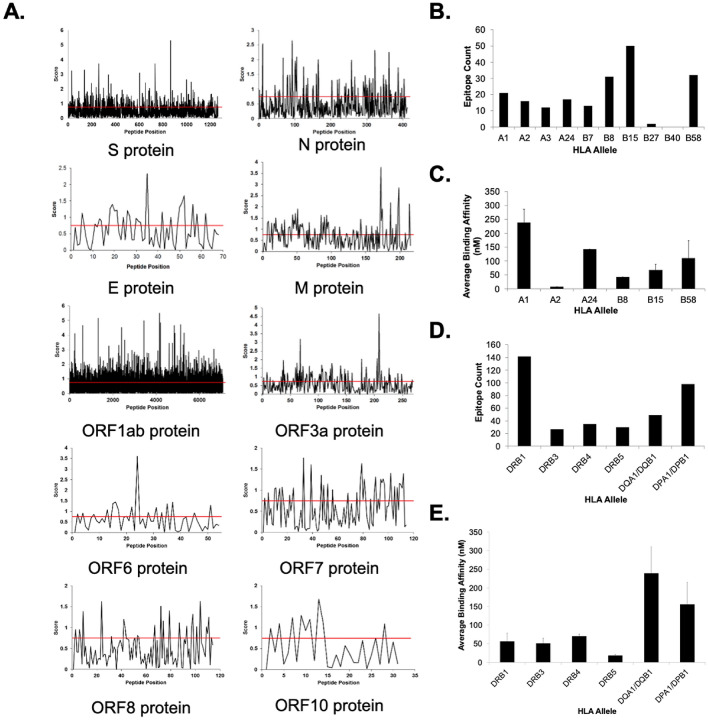
Immunogenicity scoring of peptides in the SARS-CoV-2 proteome with predicted HLA class I and II coverage and binding affinities. (A) Plots illustrating the NetCTL score for each sequential peptide across the entire amino acid sequence for each SARS-CoV-2 protein. Scores presented are the highest score identified across all HLA class I supertypes for each peptide. (B) Total number of predicted peptide epitopes distributed across HLA class I alleles. (C) Average predicted binding affinities by HLA allele for the top candidate class I peptides listed in Table 1. (D) Total number of predicted peptide epitopes distributed across HLA class II alleles. (E) Average predicted binding affinities by HLA allele for the top candidate class II peptides listed in Table 1.
Figure 3
Figure 3
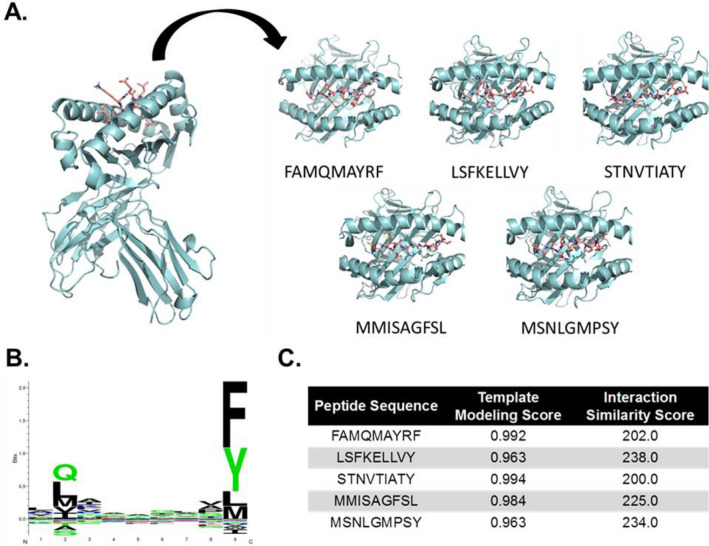
Docking of top predicted HLA class I peptides with a shared HLA molecule. (A) Structural docking model for each indicated peptide with the molecular structure of HLA-B*15:01 (PDB: 3C9N). Individual panels represent top-down views of the peptide binding groove. (B) Binding motif for HLA-B*15:01. (C) Template Modeling and Interaction Similarity scores for the selected peptide docking models shown in panel A,.
Figure 4
Figure 4
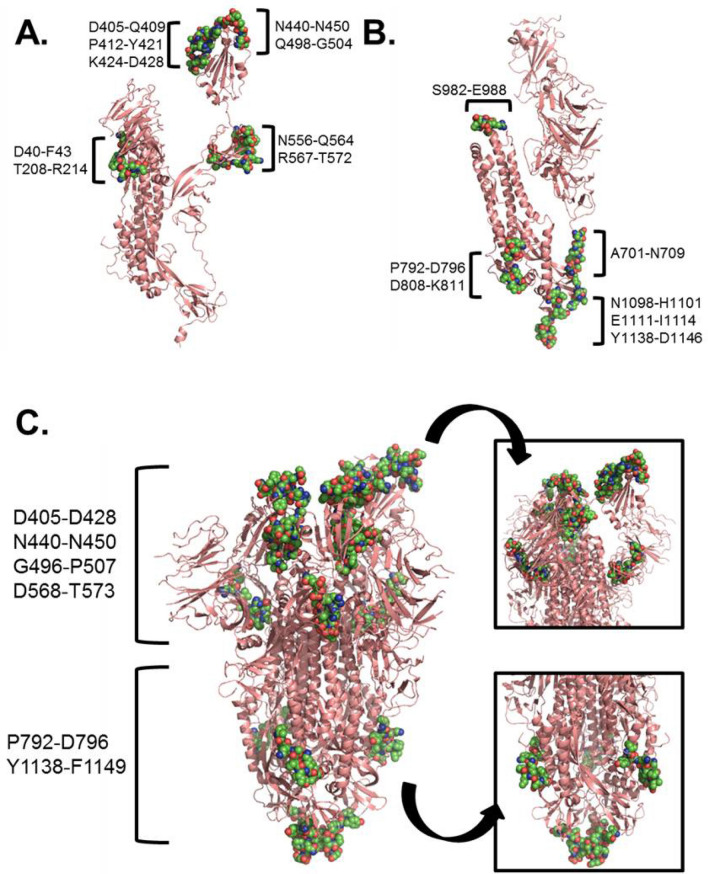
Modeling of predicted B cell epitopes on the crystal structure of the S glycoprotein. Predicted structural epitopes in the S1 domain (A) and S2 domain (B) highlighted on the structure of the S glycoprotein monomer (PDB: 6VSB). (C) Top predicted B cell epitopes identified by both Bepipred and DiscoTope prediction algorithms highlighted on the trimeric structure of the S glycoprotein. Inset panels show the S1 domain (upper) and S2 domain (lower). Predicted epitopes are highlighted as colored atoms (green, blue, red) on the surface of the S protein (salmon).

References

    1. Wu F, et al. A new coronavirus associated with human respiratory disease in China. Nature. 2020;579:265–269. doi: 10.1038/s41586-020-2008-3. - DOI - PMC - PubMed
    1. Chan JF, et al. A familial cluster of pneumonia associated with the 2019 novel coronavirus indicating person-to-person transmission: a study of a family cluster. Lancet. 2020;395:514–523. doi: 10.1016/S0140-6736(20)30154-9. - DOI - PMC - PubMed
    1. Cucinotta D, Vanelli M. WHO declares COVID-19 a pandemic. Acta Biomed. 2020;91:157–160. doi: 10.23750/abm.v91i1.9397. - DOI - PMC - PubMed
    1. Chen N, et al. Epidemiological and clinical characteristics of 99 cases of 2019 novel coronavirus pneumonia in Wuhan, China: a descriptive study. Lancet. 2020;395:507–513. doi: 10.1016/S0140-6736(20)30211-7. - DOI - PMC - PubMed
    1. Wang D, et al. Clinical characteristics of 138 hospitalized patients with 2019 novel coronavirus-infected pneumonia in Wuhan, China. JAMA. 2020;323:1061–1069. doi: 10.1001/jama.2020.1585. - DOI - PMC - PubMed

MeSH terms