. 2020 Aug 25;10(1):14170.
doi: 10.1038/s41598-020-71042-6.

Depletion of senescent-like neuronal cells alleviates cisplatin-induced peripheral neuropathy in mice

Affiliations

Depletion of senescent-like neuronal cells alleviates cisplatin-induced peripheral neuropathy in mice

Scarlett Acklin et al. Sci Rep. .

Abstract

Chemotherapy-induced peripheral neuropathy is among the most common dose-limiting adverse effects of cancer treatment, leading to dose reduction and discontinuation of life-saving chemotherapy and a permanently impaired quality of life for patients. Currently, no effective treatment or prevention is available. Senescence induced during cancer treatment has been shown to promote the adverse effects. Here, we show that cisplatin induces senescent-like neuronal cells in primary culture and in mouse dorsal root ganglia (DRG), as determined by the characteristic senescence markers including senescence-associated beta-galactosidase, accumulation of cytosolic p16INK4A and HMGB1, as well as increased expression of p16Ink4a, p21, and MMP-9. The accumulation of senescent-like neuronal cells in DRG is associated with cisplatin-induced peripheral neuropathy (CIPN) in mice. To determine if depletion of senescent-like neuronal cells may effectively mitigate CIPN, we used a pharmacological 'senolytic' agent, ABT263, which inhibits the anti-apoptotic proteins BCL-2 and BCL-xL and selectively kills senescent cells. Our results demonstrated that clearance of DRG senescent neuronal cells reverses CIPN, suggesting that senescent-like neurons play a role in CIPN pathogenesis. This finding was further validated using transgenic p16-3MR mice, which permit ganciclovir (GCV) to selectively kill senescent cells expressing herpes simplex virus 1 thymidine kinase (HSV-TK). We showed that CIPN was alleviated upon GCV administration to p16-3MR mice. Together, the results suggest that clearance of senescent DRG neuronal cells following platinum-based cancer treatment might be an effective therapy for the debilitating side effect of CIPN.


Conflict of interest statement

J.C. (J Chang), D.Z. and F.X. are inventors of a pending patent application for use of ABT263 and Bcl-xl PROTACs as senolytic agents for the treatment of age-related diseases and chemotherapy-induced peripheral neuropathy. J.C. (J Campisi) and D.Z. are co-founders and stockholders of Unity Biotechnology that develops senolytics to treat age-related diseases. S.A., M.Z., W.D., X.Z., and M.P. declare no competing interests.

Figures
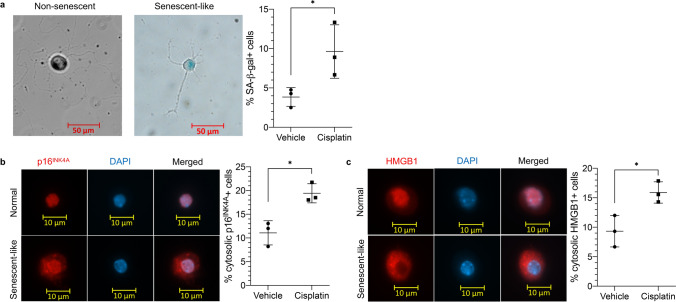
Figure 1
Figure 1
Cisplatin induces a senescence-like response in DRG neurons. (a) Representative images of SA-β-gal stained primary DRG neurons cultured from WT C57BL/6 mice. Percent SA-β-gal positive cells was calculated as the number of neurons with positive SA-β-gal staining divided by the total number of cells left on the coverslip times 100 (n = 3). P = 0.0497. (b) p16INK4A was detected by anti-p16INK4A immunofluorescence (red). Percent cytosolic p16INK4A positive cells was calculated as the number of neurons with cytosolic p16INK4A immunofluorescence, visualized by DAPI nuclei staining (blue), divided by the total number of cells left on the coverslip times 100 (n = 3). P = 0.0113. (c) Visualization of HMGB1 as detected by anti-HMGB1 immunofluorescence (red). Percent cytosolic HMGB1 positive cells was calculated as the number of neurons with cytosolic HMGB1 immunofluorescence divided by the total number of cells left on the coverslip times 100 (n = 3). Data points are mean values ± SEM and were analyzed by two-tailed Student’s t-test.
Figure 2
Figure 2
Cisplatin-induced senescence-like response in DRG neurons is associated with CIPN in murine model. (a) Cisplatin regimen for inducing peripheral neuropathy. (b) Mechanical allodynia measured in wild type (WT) mice by von Frey tests after treatment with 2.3 mg/kg cisplatin (P = 0.0039, 0.0001, and 0.0040). (C) Thermal algesia measured by hot plate tests in WT mice 51 days after cisplatin treatment (P = 0.0012). In the control and cisplatin groups, n = 10 and n = 5, respectively. (d) p16Ink4a (P = 0.0012) and (e) p21 expression (P = 0.0196) in C57BL/6 mice DRG neurons 17 days after cisplatin treatment (n = 3). (a–e) Data points are mean values ± SEM and were analyzed by two-tailed Student’s t-test. (f) Quantification of Mmp-9 mRNA levels following saline treatment or 0 and 10 days after cisplatin treatment (n = 5). P = 0.015 and 0.004. Data points are mean values ± SEM and were analyzed by one-way ANOVA with post-hoc Tukey test.
Figure 3
Figure 3
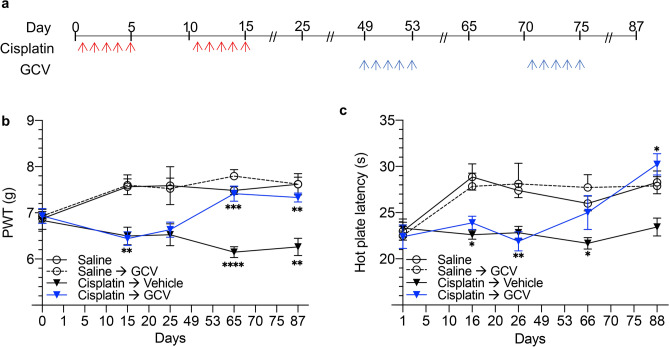
Genetic clearance of senescent cells reverses CIPN in mice. (a) Cisplatin and GCV treatment regimen to induce CIPN and eliminate senescent cells, respectively, in p16-3MR mice. (b, c) Response of p16-3MR mice, which are sensitive to GCV-mediated senescent cell clearance, to (b) mechanical and (c) thermal stimulation before and after cisplatin treatment. Cisplatin-treated mice also underwent senescent cell clearance via GCV treatment. Mechanical sensitivity of cisplatin-treated mice was compared to saline-treated (P = 0.0091, P < 0.0001, and P = 0.0077) and cisplatin-treated mice following senescent cell removal (P = 0.0007 and 0.0052). Thermal sensitivity of cisplatin-treated mice was also compared to saline-treated (P = 0.0323, 0.0084, and 0.0128) and cisplatin-treated mice treated with GCV (P = 0.0255). Data points are mean values ± SEM and were analyzed by two-way ANOVA analysis with post-hoc Tukey test. n = 6.
Figure 4
Figure 4
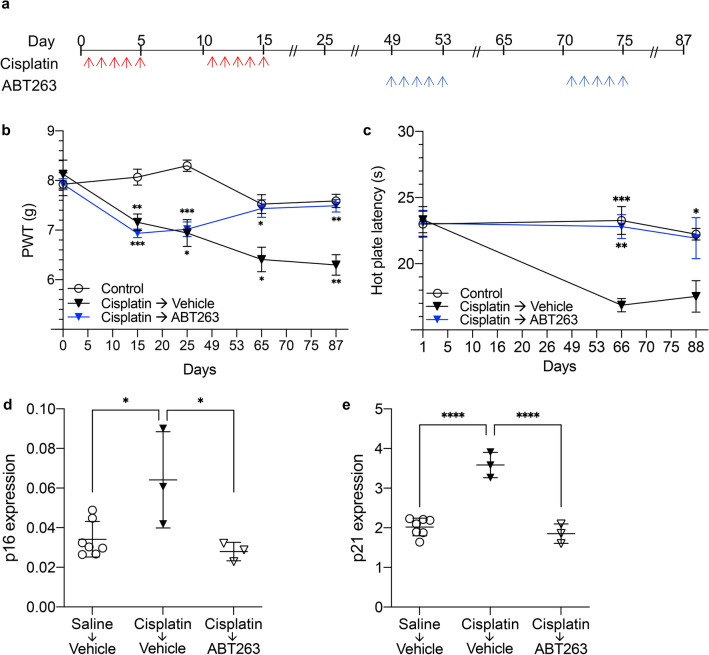
Pharmacological clearance of senescent cells with ABT263 reverses CIPN in mice. (a) Treatment regimen to induce CIPN and then remove senescent cells with ABT263 in C57BL/6 mice. (b) Response of WT mice to mechanical stimulation, as measured by von Frey tests, before and after treatment with 2.3 mg/kg cisplatin (n = 5, P = 0.0067, 0.0103, 0.0153, and 0.0027 on days 15, 25, 65, and 87 for cisplatin-vehicle group and P = 0.0001 and 0.0002 on days 15 and 25 for cisplatin-ABT263 group). Senescent cells were removed in half the cisplatin-treated mice with 50 mg/kg ABT263 (n = 5, P = 0.0271 and 0.0053). Response of the same mice to (c) thermal stimulation, as measured by hot plate tests, was measured after cisplatin ± ABT263 treatment (P = 0.0027 and 0.1266). The control group (n = 10) received saline and was compared to the cisplatin group without ABT263 treatment (P = 0.0004 and 0.0306). (d, e) Senescent cell removal by ABT263 in the DRG of C57BL/6 mice 72 days after cisplatin treatment as shown by (d) p16Ink4a (P = 0.0191 and 0.0171) and (e) p21 expression (P < 0.0001 and < 0.0001). n = 7 or 3. Data points are mean values ± SEM. *P < 0.05, **P < 0.01, ***P < 0.001, and ****P < 0.0001 denote significance levels detected by (b, C) two-way and (d, e) one-way ANOVA with post-hoc Tukey test.

References

    1. Burton AW, Fanciullo GJ, Beasley RD, Fisch MJ. Chronic pain in the cancer survivor: a new frontier. Pain Med. 2007;8:189–198. doi: 10.1111/j.1526-4637.2006.00220.x. - DOI - PubMed
    1. Cioroiu C, Weimer LH. Update on chemotherapy-induced peripheral neuropathy. Curr. Neurol. Neurosci. Rep. 2017;17:47. doi: 10.1007/s11910-017-0757-7. - DOI - PubMed
    1. Han Y, Smith MT. Pathobiology of cancer chemotherapy-induced peripheral neuropathy (CIPN) Front. Pharmacol. 2013;4:156. doi: 10.3389/fphar.2013.00156. - DOI - PMC - PubMed
    1. Kandula T, et al. Neurophysiological and clinical outcomes in chemotherapy-induced neuropathy in cancer. Clin. Neurophysiol. 2017;128:1166–1175. doi: 10.1016/j.clinph.2017.04.009. - DOI - PubMed
    1. Aloe L, Manni L, Properzi F, De Santis S, Fiore M. Evidence that nerve growth factor promotes the recovery of peripheral neuropathy induced in mice by cisplatin: behavioral, structural and biochemical analysis. Auton. Neurosci. 2000;86:84–93. doi: 10.1016/S1566-0702(00)00247-2. - DOI - PubMed

Publication types

MeSH terms