Review
. 2020 Nov;16(11):645-652.
doi: 10.1038/s41582-020-0402-y. Epub 2020 Aug 25.

Lung innervation in the eye of a cytokine storm: neuroimmune interactions and COVID-19

Affiliations
Review

Lung innervation in the eye of a cytokine storm: neuroimmune interactions and COVID-19

Francesco De Virgiliis et al. Nat Rev Neurol. 2020 Nov.

Abstract

COVID-19 is an infectious disease caused by the coronavirus SARS-CoV-2, which was first reported in Wuhan, China, in December 2019 and has caused a global pandemic. Acute respiratory distress syndrome (ARDS) is a common feature of severe forms of COVID-19 and can lead to respiratory failure, especially in older individuals. The increasing recognition of the neurotropic potential of SARS-CoV-2 has sparked interest in the role of the nervous system in respiratory failure in people with COVID-19. However, the neuroimmune interactions in the lung in the context of ARDS are poorly understood. In this Perspectives article, we propose the concept of the neuroimmune unit as a critical determinant of lung function in the context of COVID-19, inflammatory conditions and ageing, focusing particularly on the involvement of the vagus nerve. We discuss approaches such as neurostimulation and pharmacological neuromodulation to reduce tissue inflammation with the aim of preventing respiratory failure.


Conflict of interest statement

The authors declare no competing interests.

Figures
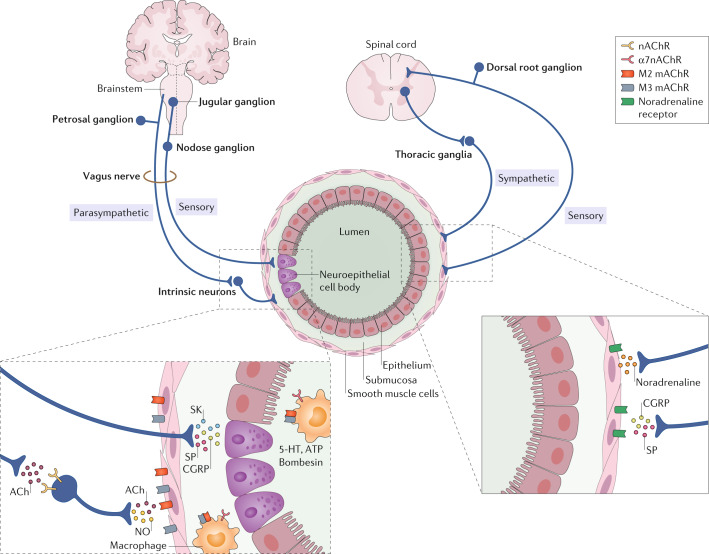
Fig. 1
Fig. 1. Innervation of the respiratory tract.
The vagus nerve originates in the brainstem and provides most of the sensory and all of the parasympathetic nerve fibres that innervate the airways, via the jugular and nodose ganglia (sensory) and petrosal ganglion (parasympathetic). A minority of sensory fibres in the lungs originate in the T1–T6 dorsal root ganglia and run in spinal nerves along with sympathetic fibres originating in the thoracic ganglia. The insets show the principal neurotransmitters originating from the fibres that innervate the airways and the target receptors of these neurotransmitters. 5-HT, 5-hydroxytryptamine; ACh, acetylcholine; CGRP, calcitonin gene-related peptide; mAChR, muscarinic ACh receptor; nAChR, nicotinic ACh receptor; NO, nitric oxide; SK, substance K; SP, substance P.
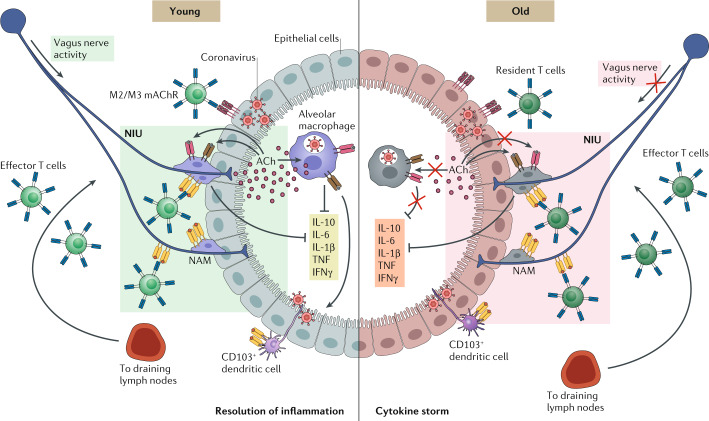
Fig. 2
Fig. 2. The neuroimmune unit.
The diagram depicts the proposed constituents of the neuroimmune unit (NIU) and its age-dependent dysfunctional activation. Vagal fibres innervating the airways are in close contact with nerve- and airway-associated macrophages (NAMs) and communicate with resident macrophages through the release of neurotransmitters, such as acetylcholine (ACh), and neuropeptides. The macrophages, in turn, modulate the innate immune response and dampen inflammation following events such as SARS-CoV-2 infection. Ageing induces a decline in vagal activity and immune surveillance as well as an increase in the production of pro-inflammatory cytokines. Following viral infection, these cytokines are further produced locally by immune cells, but their levels are potentially reduced by vagus nerve activity, leading to resolution of inflammation. With ageing, decreases in vagal immunomodulatory function and the immune cell response to pathogens, combined with increased levels of pro-inflammatory cytokines, could contribute to the induction of a cytokine storm, leading to respiratory failure and death. mAChR, muscarinic ACh receptor; TNF, tumour necrosis factor.
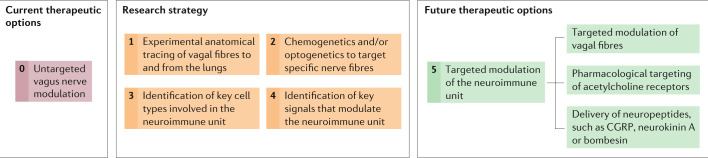
Fig. 3
Fig. 3. Studying the neuroimmune unit: a roadmap.
The diagram depicts a stepwise roadmap to increase our understanding of the neuroimmune unit and the potential discovery of pharmacological, genetic and physiological treatments that could be used in the clinic. CGRP, calcitonin gene-related peptide.

Comment in

References

    1. Huang C, et al. Clinical features of patients infected with 2019 novel coronavirus in Wuhan, China. Lancet. 2020;395:497–506. doi: 10.1016/S0140-6736(20)30183-5. - DOI - PMC - PubMed
    1. Zhou P, et al. A pneumonia outbreak associated with a new coronavirus of probable bat origin. Nature. 2020;579:270–273. - PMC - PubMed
    1. Butowt R, Bilinska K. SARS-CoV-2: olfaction, brain infection, and the urgent need for clinical samples allowing earlier virus detection. ACS Chem. Neurosci. 2020;11:1200–1203. - PubMed
    1. Yin R, et al. Concomitant neurological symptoms observed in a patient diagnosed with coronavirus disease 2019. J. Med. Virol. 2020 doi: 10.1002/jmv.25888. - DOI - PMC - PubMed
    1. Mao L, et al. Neurologic manifestations of hospitalized patients with coronavirus disease 2019 in Wuhan, China. JAMA Neurol. 2020;77:683–690. - PMC - PubMed