


Obesity is common in chronic kidney disease and associates with greater antihypertensive usage and proteinuria: evidence from a cross-sectional study in a tertiary nephrology centre
- PMID: 32845571
- PMCID: PMC7685118
- DOI: 10.1111/cob.12402
Obesity is common in chronic kidney disease and associates with greater antihypertensive usage and proteinuria: evidence from a cross-sectional study in a tertiary nephrology centre
Abstract
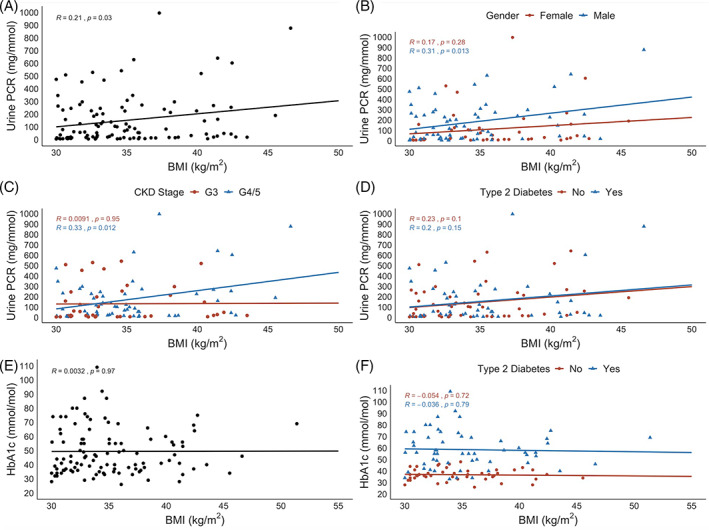
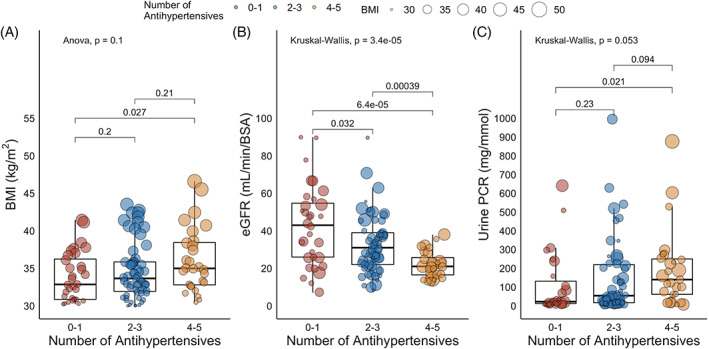
Obesity is a treatable risk factor for chronic kidney disease progression. We audited the reporting of body-mass index in nephrology outpatient clinics to establish the characteristics of individuals with obesity in nephrology practice. Body-mass index, clinical information and biochemical measures were recorded for patients attending clinics between 3rd August, 2018 and 18th January, 2019. Inferential statistics and Pearson correlations were used to investigate relationships between body-mass index, type 2 diabetes, hypertension and proteinuria. Mean ± SD BMI was 28.6 ± 5.8 kg/m2 (n = 374). Overweight and obesity class 1 were more common in males (P = .02). Amongst n = 123 individuals with obesity and chronic kidney disease, mean ± SD age, n (%) female and median[IQR] eGFR were 64.1 ± 14.2 years, 52 (42.3%) and 29.0[20.5] mL/min/BSA, respectively. A positive correlation between increasing body-mass index and proteinuria was observed in such patients (r = 0.21, P = .03), which was stronger in males and those with CKD stages 4 and 5. Mean body-mass index was 2.3 kg/m2 higher in those treated with 4-5 versus 0-1 antihypertensives (P = .03). Amongst n = 59 patients with obesity, chronic kidney disease and type 2 diabetes, 2 (3.5%) and 0 (0%) were prescribed a GLP-1 receptor analogue and SGLT2-inhibitor, respectively. Our data provides a strong rationale not only for measuring body-mass index but also for acting on the information in nephrology practice, although prospective studies are required to guide treatment decisions in people with obesity and chronic kidney disease.
Keywords: chronic kidney disease; diabetes mellitus; diabetic kidney disease; obesity; overweight.
© 2020 The Authors. Clinical Obesity published by John Wiley & Sons Ltd on behalf of World Obesity Federation.
Conflict of interest statement
ClR discloses personal fees outside of the submitted work from Novo Nordisk, GI Dynamics, Eli Lilly, Johnson and Johnson, Sanofi, Aventis, Astra Zeneca, Janssen, Bristol‐Myers Squibb, and Boehringer‐Ingelheim. The authors declare that they have no competing interests.
Figures

References
MeSH terms
Substances
Grants and funding
LinkOut - more resources
Full Text Sources
Medical
Research Materials
Miscellaneous
