


The Role of Chloroplast Gene Expression in Plant Responses to Environmental Stress
- PMID: 32846932
- PMCID: PMC7503970
- DOI: 10.3390/ijms21176082
The Role of Chloroplast Gene Expression in Plant Responses to Environmental Stress
Abstract
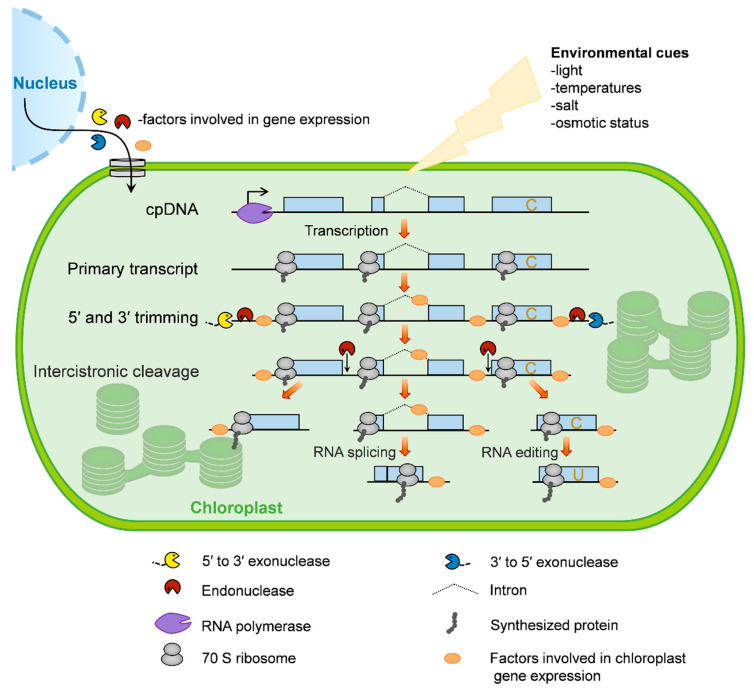
Chloroplasts are plant organelles that carry out photosynthesis, produce various metabolites, and sense changes in the external environment. Given their endosymbiotic origin, chloroplasts have retained independent genomes and gene-expression machinery. Most genes from the prokaryotic ancestors of chloroplasts were transferred into the nucleus over the course of evolution. However, the importance of chloroplast gene expression in environmental stress responses have recently become more apparent. Here, we discuss the emerging roles of the distinct chloroplast gene expression processes in plant responses to environmental stresses. For example, the transcription and translation of psbA play an important role in high-light stress responses. A better understanding of the connection between chloroplast gene expression and environmental stress responses is crucial for breeding stress-tolerant crops better able to cope with the rapidly changing environment.
Keywords: RNA metabolism; chloroplast gene expression; environmental stress response; photosynthesis; transcription; translation.
Conflict of interest statement
The authors declare no conflict of interest.
Figures
References
-
- Wang P., Yang C., Chen H., Luo L., Leng Q., Li S., Han Z., Li X., Song C., Zhang X., et al. Exploring transcription factors reveals crucial members and regulatory networks involved in different abiotic stresses in Brassica napus L. BMC Plant Biol. 2018;18:202. doi: 10.1186/s12870-018-1417-z. - DOI - PMC - PubMed
-
- Wang S., Li Q.P., Wang J., Yan Y., Zhang G.L., Yan Y., Zhang H., Wu J., Chen F., Wang X., et al. YR36/WKS1-mediated phosphorylation of PsbO, an extrinsic member of photosystem II, inhibits photosynthesis and confers stripe rust resistance in wheat. Mol. Plant. 2019;12:1639–1650. doi: 10.1016/j.molp.2019.10.005. - DOI - PubMed
Publication types
MeSH terms
Substances
Grants and funding
LinkOut - more resources
Full Text Sources
