


Lifetime co-occurring psychiatric disorders in newly diagnosed adults with attention deficit hyperactivity disorder (ADHD) or/and autism spectrum disorder (ASD)
- PMID: 32847520
- PMCID: PMC7449076
- DOI: 10.1186/s12888-020-02828-1
Lifetime co-occurring psychiatric disorders in newly diagnosed adults with attention deficit hyperactivity disorder (ADHD) or/and autism spectrum disorder (ASD)
Abstract
Background: Co-occurring psychiatric disorders in adults with Attention Deficit Hyperactivity Disorder (ADHD) and/or Autism Spectrum Disorder (ASD) contribute to the burden of the healthcare and possibly to the delay of diagnosis. Aim of the study was to clinically assess the prevalence and compare lifetime co-occurring psychopathology in a sample of newly diagnosed ADHD and/or ASD adults and discuss the diagnostic challenges they pose.
Methods: The lifetime prevalence rates of ten of the most frequently co-occurring psychiatric diagnoses was registered in 336 adults of normal intelligence who underwent a thorough clinical evaluation for the diagnosis of ADHD and/or ASD for the first time in their lives. Four study groups were formed: the ADHD (n = 151), the ASD (n = 58), the ADHD+ASD (n = 28) and the nonADHD/nonASD (NN) (n = 88) group.
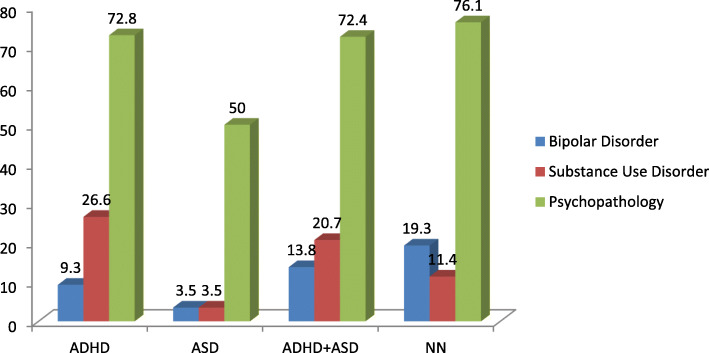
Results: At least one co-occurring psychopathology was found in 72.8% of the ADHD group, in 50% of the ASD group, in 72.4% of the ADHD+ASD group and in 76.1% of the NN group (p = 0.004). In all groups the most frequent psychiatric disorder was depressive disorder. The only significant difference regarding the patterns of psychiatric co-occurrence between the ADHD and the nonADHD groups (ASD and NN groups) was found for SUD (p = 0.001). Also, the proportion of subjects with Bipolar Disorder was significantly greater in the NN group as compared to those with ASD (p = 0.025).
Conclusions: Our results support the high prevalence of co-occurring psychiatric disorders in adults with ADHD and/or ASD with the ASD group presenting the lowest rate. The most marked difference between the ADHD and the nonADHD groups was found for SUD. Moreover, our findings highlight the need for a thorough clinical assessment of all referred patients both in the presence and absence of ADHD and/or ASD.
Keywords: Adults; Attention deficit hyperactivity disorder; Autism Spectrum disorder; Co-occurrence; Lifetime psychiatric disorders.
Conflict of interest statement
The authors declare that they have no competing interests.
Figures
References
-
- Kooij SJ, Bijlenga D, Salerno L, Jaeschke R, Bitter I, Balázs J, et al. Updated European consensus statement on diagnosis and treatment of adult ADHD. Eur Psychiatry. 2019;56:14–34. - PubMed
-
- Baxter AJ, Brugha TS, Erskine HE, Scheurer RW, Vos T, Scott JG. The epidemiology and global burden of autism spectrum disorders. Psychol Med. 2015;45(3):601–613. - PubMed
MeSH terms
LinkOut - more resources
Full Text Sources
Medical
