Review
. 2020 Jul 23:11:1131.
doi: 10.3389/fpls.2020.01131. eCollection 2020.

Geminivirus Resistance: A Minireview

Affiliations
Review

Geminivirus Resistance: A Minireview

Kayla Beam et al. Front Plant Sci. .

Abstract

A continuing challenge to crop production worldwide is the spectrum of diseases caused by geminiviruses, a large family of small circular single-stranded DNA viruses. These viruses are quite diverse, some containing mono- or bi-partite genomes, and infecting a multitude of monocot and dicot plants. There are currently many efforts directed at controlling these diseases. While some of the methods include controlling the insect vector using pesticides or genetic insect resistance (Rodríguez-López et al., 2011), this review will focus on the generation of plants that are resistant to geminiviruses themselves. Genetic resistance was traditionally found by surveying the wild relatives of modern crops for resistance loci; this method is still widely used and successful. However, the quick rate of virus evolution demands a rapid turnover of resistance genes. With better information about virus-host interactions, scientists are now able to target early stages of geminivirus infection in the host, preventing symptom development and viral DNA accumulation.

Keywords: agriculture; geminivirus; genetic engineering; genetic resistance; resistance.


Figures

Figure 1
Figure 1
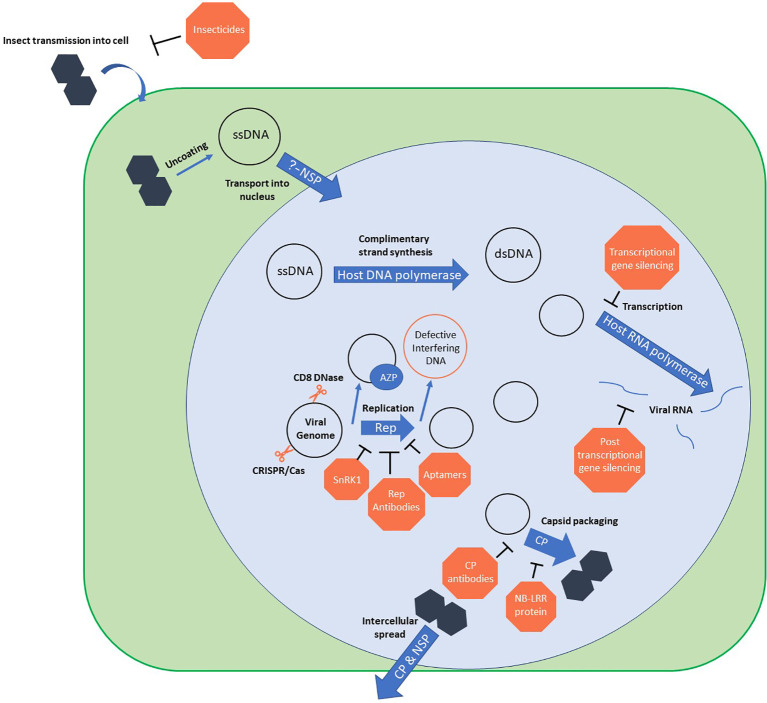
Geminivirus life cycle with points of resistance. Orange blocks show points where known resistance mechanisms interfere with the virus. ssDNA, single stranded DNA; dsDNA, double stranded DNA; NSP, nuclear shuttle protein; AZP, artificial zinc-finger protein; Rep, replication-associated protein; CP, coat protein.

References

    1. Akano A. O., Dixon A. G. O., Mba C., Barrera E., Fregene M. (2002). Genetic Mapping of a Dominant Gene Conferring Resistance to Cassava Mosaic Disease. Theor. Appl. Genet. 105 (4), 521–525. 10.1007/s00122-002-0891-7 - DOI - PubMed
    1. Ali Z., Abulfaraj A., Idris A., Ali S., Tashkandi M., Mahfouz M. M. (2015). CRISPR/Cas9-Mediated Viral Interference in Plants. Genome Biol. 16, 238–248. 10.1186/s13059-015-0799-6 - DOI - PMC - PubMed
    1. Amrao L., Amin I., Shahid M.S., Briddon R. W., Mansoor S. (2010). Cotton Leaf Curl Disease in Resistant Cotton Is Associated with a Single Begomovirus That Lacks an Intact Transcriptional Activator Protein. Virus Res. 152 (1–2), 153–163. 10.1016/j.virusres.2010.06.019 - DOI - PubMed
    1. Anbinder I., Reuveni M., Azari R., Paran I., Nahon S., Shlomo H., et al. (2009). Molecular Dissection of Tomato Leaf Curl Virus Resistance in Tomato Line TY172 Derived from Solanum Peruvianum. Theor. Appl. Genet. 119, 519–530. 10.1007/s00122-009-1060-z - DOI - PubMed
    1. Aragão F. J. L., Nogueira E. O. P. L., Tinoco M. L. P., Faria J. C. (2013). Molecular Characterization of the First Commercial Transgenic Common Bean Immune to the Bean Golden Mosaic Virus. J. Biotechnol. 166 (1–2), 42–50. 10.1016/j.jbiotec.2013.04.009 - DOI - PubMed

LinkOut - more resources