Review
. 2020 Aug 11:8:440.
doi: 10.3389/fped.2020.00440. eCollection 2020.

Dietary Prevention of Atopic March in Pediatric Subjects With Cow's Milk Allergy

Affiliations
Review

Dietary Prevention of Atopic March in Pediatric Subjects With Cow's Milk Allergy

Laura Carucci et al. Front Pediatr. .

Abstract

Cow's milk allergy (CMA) is one of the most prevalent food allergies and the most expensive allergic diseases in the pediatric age. There is no cure for CMA, and actual disease management is based on strict avoidance of cow milk protein-containing foods, access to rescue medication, and use of substitutive formulas. Early-life CMA could be one of the first steps of the "allergic march" (AM), leading to the occurrence of other atopic manifestations later in the life, including asthma and oculorhinitis, with subsequent further increase of costs for health care systems and families of affected children. In the last years, diet is emerged as a relevant strategy to prevent allergic diseases through, at least in part, epigenetic modulation of immune system. We provide an overview of studies that investigate the potential role of different dietary strategies in preventing the AM in pediatric patients with CMA.

Keywords: allergic march; breast milk; epigenetics; food allergy; gut microbiota; infant formula.


Figures

Figure 1
Figure 1
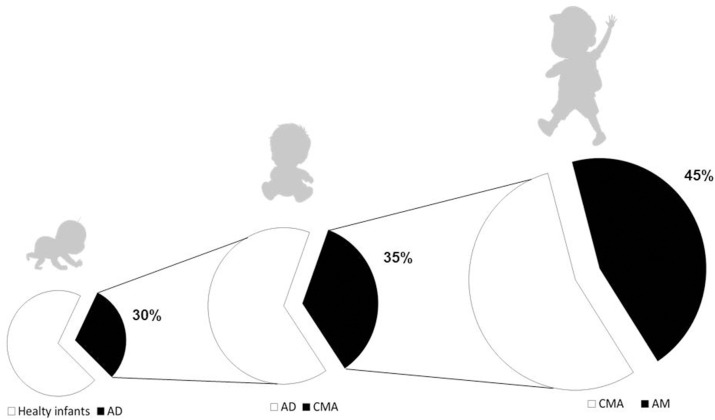
The atopic march in pediatric patients with cow's milk allergy. Atopic dermatitis (AD) is commonly considered the first step of the atopic march (AM), however, AD and cow's milk allergy (CMA) could co-exist, particularly in those with early onset, severe, and persistent atopic eczema. CMA affects about 1/3 of patients with AD. Data from several clinical studies demonstrate that up to 45% of children affected by CMA will develop other atopic manifestations later in the life, also after the immune tolerance acquisition to cow's milk proteins.
Figure 2
Figure 2
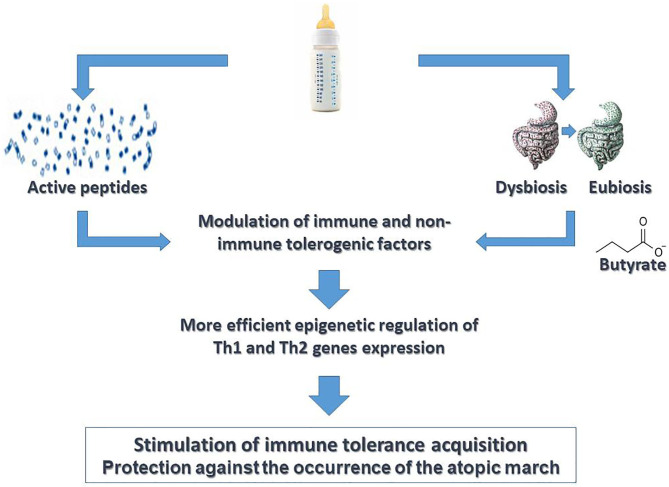
Active diet therapy in pediatric patients with cow's milk allergy. “Active diet therapy” means the possibility to influence the cow's milk allergy (CMA) disease course and to limit the occurrence of other atopic manifestations later in the life. Emerging evidence suggests the importance of formula choice for the management of CMA pediatric patients. It has been demonstrated that the use of extensively hydrolyzed casein formula (EHCF) containing the probiotic L. rhamnosus GG (LGG) could exert a modulation of immune tolerance network mediated by the activity of selected casein hydrolysis-derived peptides and by activity of LGG on gut microbiota structure and function leading to an increased production of the short chain fatty acid butyrate. Several non-immune (gut barrier integrity) and immune (cytokines, immune cells) tolerogenic factors are involved in such modulatory action. Many effects are mediated by epigenetic mechanisms. Altogether these mechanisms are able to stimulate a faster acquisition of immune tolerance to cow's milk peptides and to limit the occurrence of atopic march.
Figure 3
Figure 3
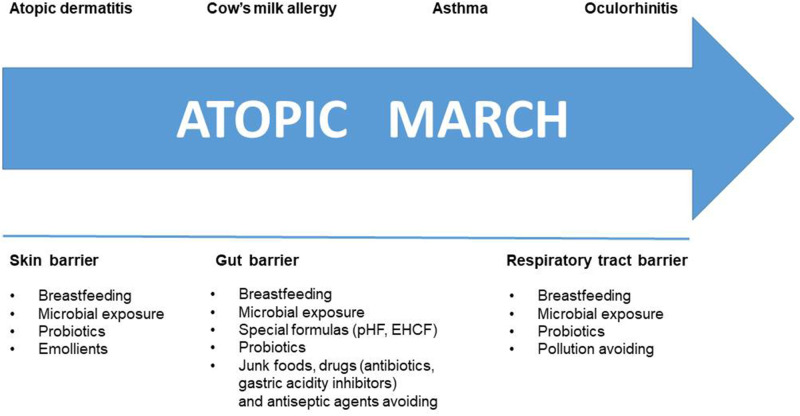
Halting the Atopic March. Several strategies are available to counteract step by step the atopic march. These strategies are targeting the skin, gut, and respiratory tract barrier.

References

    1. Flom JD, Sicherer SH. Epidemiology of cow's milk. Allergy Nutr. (2019) 11:1051 10.3390/nu11051051 - DOI - PMC - PubMed
    1. Berni Canani R, Nocerino R, Terrin G, Di Costanzo M, Cosenza L, Troncone R. Food allergy diagnostic practice in Italian children. J Allergy Clin Immunol. (2012) 129:1423–4. 10.1016/j.jaci.2012.02.044 - DOI - PubMed
    1. Berni Canani R, Nocerino R, Terrin G, Coruzzo A, Cosenza L, Leone L, et al. . Effect of lactobacillus GG on tolerance acquisition in infants with cow's milk allergy: a randomized trial. J Allergy Clin Immunol. (2012) 129:580–2, 582.e1–5. 10.1016/j.jaci.2011.10.004 - DOI - PubMed
    1. Nocerino R, Leone L, Cosenza L, Berni Canani R. Increasing rate of hospitalizations for food-induced anaphylaxis in Italian children: an analysis of the Italian ministry of health database. J Allergy Clin Immunol. (2015) 135:833–5.e3. 10.1016/j.jaci.2014.12.1912 - DOI - PubMed
    1. Berni Canani R, Di Costanzo M, Bedogni G, Amoroso A, Cosenza L, Di Scala C, et al. . Extensively hydrolyzed casein formula containing Lactobacillus rhamnosus GG reduces the occurrence of other allergic manifestations in children with cow's milk allergy: 3-year randomized controlled trial. J Allergy Clin Immunol. (2017) 139:1906–13.e4. 10.1016/j.jaci.2016.10.050 - DOI - PubMed

LinkOut - more resources