


Little to Give, Much to Gain-What Can You Do With a Dried Blood Spot?
- PMID: 32851603
- PMCID: PMC7500853
- DOI: 10.1007/s40572-020-00289-y
Little to Give, Much to Gain-What Can You Do With a Dried Blood Spot?
Abstract
Purpose of review: Technological advances have allowed dried blood spots (DBS) to be utilized for various measurements, helpful in population-based studies. The following is a review of the literature highlighting the advantages and disadvantages of DBS and describing their use in multiple areas of research.
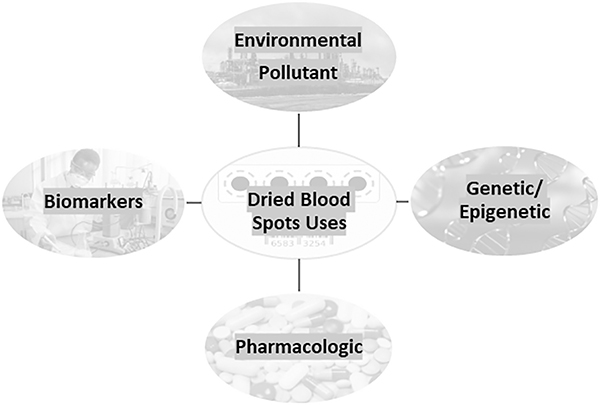
Recent findings: DBS can track pollutant exposure to understand their impact on health. DBS can also be used for (epi-)genetic studies, to measure clinical biomarkers, and to monitor drug adherence. Advantages of DBS include being minimally invasive, requiring low blood volume, and being cost-effective to collect, transport, and store. Disadvantages of DBS include the hematocrit effect, which is related to the viscosity of the blood affecting its spread on to the filter paper, causing a major source of error when assessing concentrations, and the possibility of low DNA volume. Numerous uses for DBS make them an important source of biomaterial but they require additional validation for accuracy and reproducibility.
Keywords: Biomarkers; Blood spots; Environmental; Genetic; Pharmacologic.
Conflict of interest statement
Conflict of Interest
The authors declare no conflicts of interest.
Figures
References
-
- Scriver CC. A simple phenylalanine method for detecting phenylketonuria in large populations of newborn infants, by Robert Guthrie and Ada Susi, Pediatrics, 1963;32:318–343. Pediatrics. 1998;102(1 Pt 2):236–7. - PubMed
Publication types
MeSH terms
Substances
Grants and funding
LinkOut - more resources
Full Text Sources
Research Materials
