


Combination of urease inhibitor and antiseptic inhibits urea decomposition-induced ammonia production by Proteus mirabilis
- PMID: 32851777
- PMCID: PMC7949414
- DOI: 10.1111/iwj.13422
Combination of urease inhibitor and antiseptic inhibits urea decomposition-induced ammonia production by Proteus mirabilis
Abstract
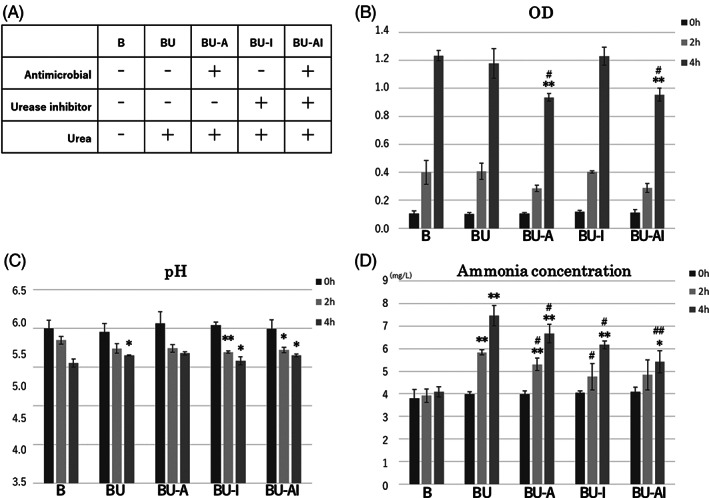
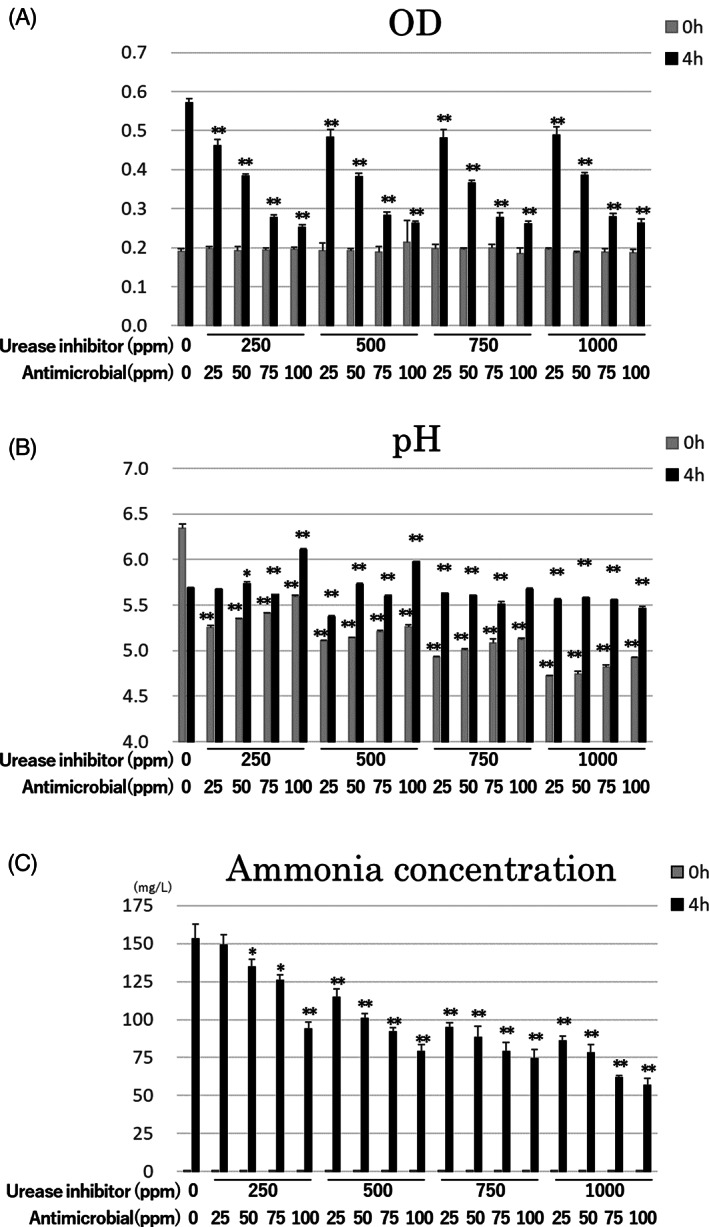
The decomposition of urea into ammonia by urease-producing bacterium shows an elevation in the pH level, which can lead to incontinence-associated dermatitis (IAD). This study aimed to examine the efficacy of a combination of antiseptic and urease inhibitor in inhibiting the decomposition of urea by the urease-producing bacterium Proteus mirabilis. We performed in vitro assays to compare the effects of a combination of antiseptic and urease inhibitor, antiseptic only, urease inhibitor only, and an untreated control with the effects of a urea-containing solution. Cultured P. mirabilis was mixed with urea-containing solution, followed by the addition of antiseptic and/or urease inhibitor. The main outcome used to assess the efficacy of the different treatments was ammonia concentration at 4-hours post-treatment initiation, and multiple comparison analysis was performed using Dunnett's test to compare the results between groups. Ammonia concentrations in samples treated with either antiseptic or urease inhibitor were lower than those in the untreated control, while the combination of antiseptic and urease inhibitor resulted in decreased ammonia concentrations compared with either treatment alone. Therefore, the application of both urease inhibitor and antiseptic is more effective for the inhibition of urea decomposition by urease-producing bacteria. Novel preventive strategies using these reagents may be effective for preventing IAD.
Keywords: ammonia; incontinence-associated dermatitis; microbiology; urea; urease.
© 2020 Medicalhelplines.com Inc and John Wiley & Sons Ltd.
Conflict of interest statement
The reagents of artificial urine, urease inhibitor, and antiseptic were generously provided by Daio Paper Corporation, Tokyo, Japan. The company also lent the device used for the measurement of ammonia concentration. Conducting the study and writing of the article were carried out without financial support from any company. One of the authors (Takeo Minematsu) belongs to the department sponsored by Saraya Cooperation, Osaka, Japan. The company had no role on the study concept, design, data collection and analysis, and manuscript drafting.
Figures
References
-
- Bliss DZ, Savik K, Harms S, Fan Q, Wyman JF. Prevalence and correlates of perineal dermatitis in nursing home residents. Nurs Res. 2006;55(4):243‐251. - PubMed
-
- Farage MA, Miller KW, Elsner P, Maibach HI. Structural characteristics of the aging skin: a review. Cutan Ocul Toxicol. 2007;26(4):343‐357. - PubMed
-
- Gray M, Bliss DZ, Doughty DB, Ermer‐Seltun J, Kennedy‐Evans KL, Palmer MH. Incontinence‐associated dermatitis: a consensus. J Wound Ostomy Cont Nurs. 2007;34(1):45‐54. quiz 55–6. - PubMed
-
- Kon Y, Ichikawa‐Shigeta Y, Iuchi T, et al. Effects of a skin barrier cream on management of incontinence‐associated dermatitis in older women. J Wound Ostomy Cont Nurs. 2017;44(5):481‐486. - PubMed
MeSH terms
Substances
Grants and funding
LinkOut - more resources
Full Text Sources
Other Literature Sources
