


Has resourcing of non-governmental harm-reduction organizations in Ukraine improved HIV prevention and treatment outcomes for people who inject drugs? Findings from multiple bio-behavioural surveys
- PMID: 32851812
- PMCID: PMC7450208
- DOI: 10.1002/jia2.25608
Has resourcing of non-governmental harm-reduction organizations in Ukraine improved HIV prevention and treatment outcomes for people who inject drugs? Findings from multiple bio-behavioural surveys
Abstract
Introduction: People who inject drugs (PWID) in Ukraine have high prevalences of HIV and hepatitis C (HCV). Since the turn of the century, various organizations have funded non-governmental organizations (NGOs) in Ukraine to provide PWID with needles and syringes, condoms, HIV and HCV testing, and improve linkage to opioid agonist therapy (OAT) and HIV treatment. We investigated whether contact with these NGOs was associated with improved HIV prevention and treatment outcomes among PWID.
Methods: Five rounds of respondent-driven sampled integrated bio-behavioural survey data (2009 [N = 3962], 2011 [N = 9069], 2013 [N = 9502], 2015 [N = 9405], and 2017 [N = 10076]) among PWID in Ukraine (including HIV/HCV testing and questionnaires) were analysed using mixed-effect logistic regression models (mixed-effects: city, year). These regression models assessed associations between being an NGO client and various behavioural, OAT, HIV testing and HIV treatment outcomes, adjusting for demographic characteristics (age, gender, lifetime imprisonment, registration in a drug abuse clinic, education level). We also assessed associations between being an NGO client and being HIV positive or HCV positive, likewise adjusting for demographic characteristics (as above).
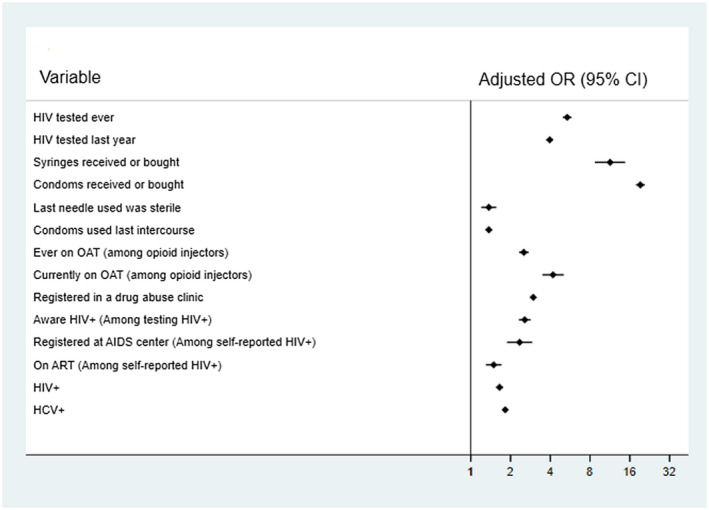
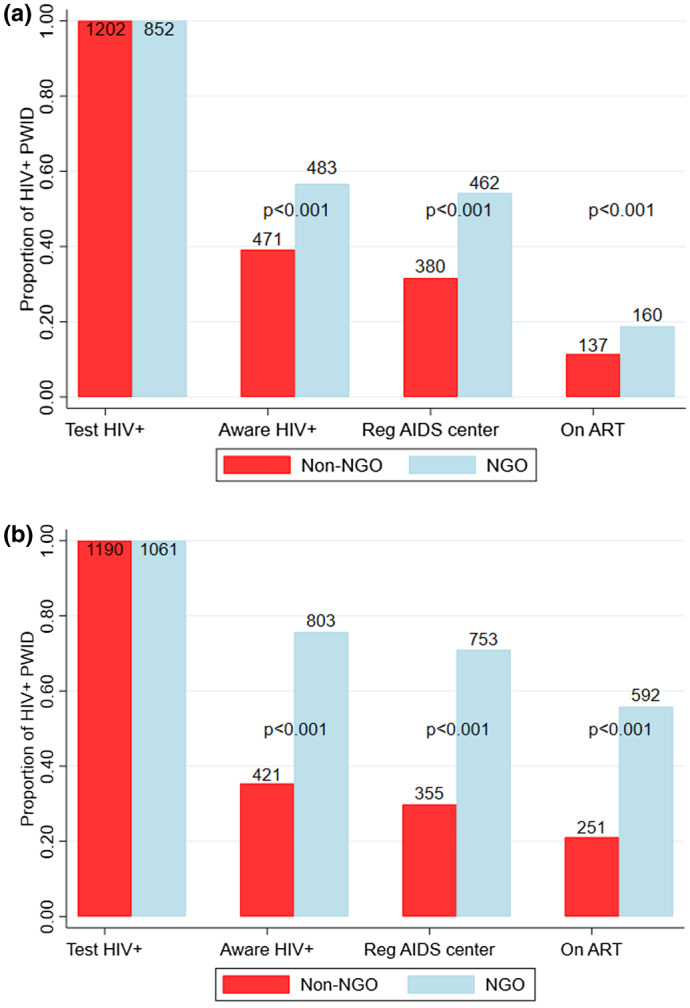
Results: NGO clients were more likely to have received HIV testing ever (adjusted odds ratio [aOR] 5.37, 95% confidence interval [95% CI]: 4.97 to 5.80) or in the last year (aOR 3.37, 95% CI: 3.20 to 3.54), to have used condoms at last sexual intercourse (aOR 1.37, 95% CI: 1.30 to 1.44) and sterile needles at last injection (aOR 1.37, 95% CI: 1.20 to 1.56), to be currently (aOR 4.19, 95% CI: 3.48 to 5.05) or ever (aOR 2.52, 95% CI: 2.32 to 2.74) on OAT, and to have received syringes (aOR 109.89, 95% CI: 99.26 to 121.66) or condoms (aOR 54.39, 95% CI: 50.17 to 58.96) in the last year. PWID who were HIV positive (aOR 1.40, 95% CI: 1.33 to 1.48) or HCV positive (aOR 1.57, 95% CI: 1.49 to 1.65) were more likely to have contact with NGOs, with HIV positive PWID in contact with NGOs being more likely to be registered at AIDS centres (aOR 2.34, 95% CI: 1.88 to 2.92) and to be on antiretroviral therapy (aOR 1.60, 95% CI: 1.40 to 1.83).
Conclusions: Contact with PWID targeted NGOs in Ukraine is associated with consistently better preventive, HIV testing and HIV treatment outcomes, suggesting a beneficial impact of harm reduction NGO programming.
Keywords: HIV; NGO; Ukraine; harm reduction; hepatitis C virus; prevention.
© 2020 The Authors. Journal of the International AIDS Society published by John Wiley & Sons Ltd on behalf of the International AIDS Society.
Figures
References
-
- Degenhardt L, Peacock A, Colledge S, Leung J, Grebely J, Vickerman P, et al. Global prevalence of injecting drug use and sociodemographic characteristics and prevalence of HIV, HBV, and HCV in people who inject drugs: a multistage systematic review. Lancet Glob Health. 2017;5(12):E1192–207. - PMC - PubMed
-
- Degenhardt L, Charlson F, Stanaway J, Lamey S, Alexander LT, Hickman M, et al. Estimating the burden of disease attributable to injecting drug use as a risk factor for HIV, hepatitis C, and hepatitis B: findings from the Global Burden of Disease Study 2013. Lancet Infect Dis. 2016;16(12):1385–98. - PubMed
-
- UNAIDS . Global AIDS update 2016. 2016.
Publication types
MeSH terms
Substances
Grants and funding
LinkOut - more resources
Full Text Sources
Medical
