Review
. 2021 Jan;41(1):72-135.
doi: 10.1002/med.21724. Epub 2020 Aug 27.

The recent outbreaks of human coronaviruses: A medicinal chemistry perspective

Affiliations
Review

The recent outbreaks of human coronaviruses: A medicinal chemistry perspective

Thanigaimalai Pillaiyar et al. Med Res Rev. 2021 Jan.

Abstract

Coronaviruses (CoVs) infect both humans and animals. In humans, CoVs can cause respiratory, kidney, heart, brain, and intestinal infections that can range from mild to lethal. Since the start of the 21st century, three β-coronaviruses have crossed the species barrier to infect humans: severe-acute respiratory syndrome (SARS)-CoV-1, Middle East respiratory syndrome (MERS)-CoV, and SARS-CoV-2 (2019-nCoV). These viruses are dangerous and can easily be transmitted from human to human. Therefore, the development of anticoronaviral therapies is urgently needed. However, to date, no approved vaccines or drugs against CoV infections are available. In this review, we focus on the medicinal chemistry efforts toward the development of antiviral agents against SARS-CoV-1, MERS-CoV, SARS-CoV-2, targeting biochemical events important for viral replication and its life cycle. These targets include the spike glycoprotein and its host-receptors for viral entry, proteases that are essential for cleaving polyproteins to produce functional proteins, and RNA-dependent RNA polymerase for viral RNA replication.

Keywords: COVID-19; MERS-CoV; SARS-CoV-1; SARS-CoV-2; antivirals; human coronavirus; main protease inhibitors.


Conflict of interest statement

The authors declare there is no conflict of interest.

Figures
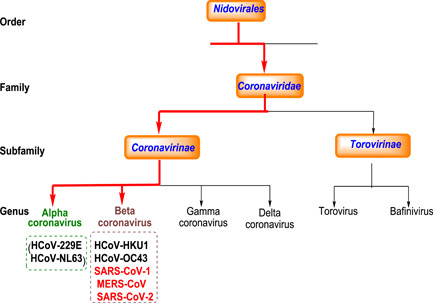
Figure 1
Figure 1
Schematic representation of the taxonomy of Coronaviridae (according to the International Committee on Taxonomy of Viruses). The seven human‐infecting coronaviruses belong to the α‐ or β‐coronavirus genus (highly infectious pathogens are highlighted red) [Color figure can be viewed at wileyonlinelibrary.com]
Figure 2
Figure 2
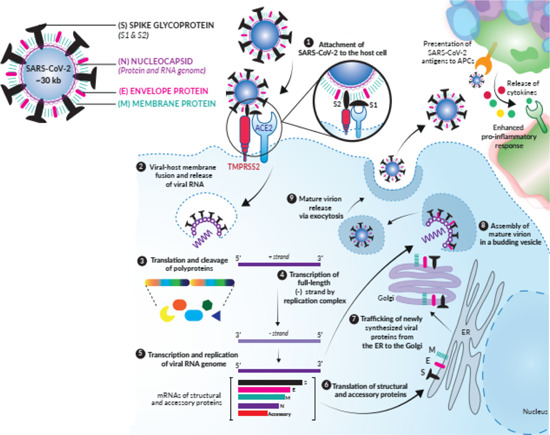
Infection cycle of coronaviruses, for example, SARS‐CoV‐2. The figure was adapted with permission from Invivogen (https://www.invivogen.com/spotlight-covid-19-infection). SARS‐CoV‐2, severe acute respiratory syndrome coronavirus 2 [Color figure can be viewed at wileyonlinelibrary.com]
Figure 3
Figure 3
Comparison of the SARS‐CoV‐2 S and SARS‐CoV‐1 S structures: ribbon diagrams of the (A) SARS‐CoV‐2 S and (D) SARS‐CoV‐1 S [PDB 6NB6] ectodomain cryo‐EM structures. S1 subunits of (B) SARS‐CoV‐2 S and (E) SARS‐CoV‐1 S. S2 subunits of (C) SARS‐CoV‐2 S and (F) SARS‐CoV‐1 S. cryo‐EM, cryogenic electron microscopy; SARS‐CoV‐2, severe acute respiratory syndrome coronavirus 2 [Color figure can be viewed at wileyonlinelibrary.com]
Figure 4
Figure 4
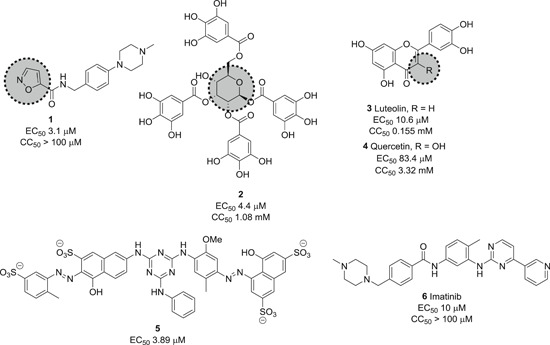
Inhibitors targeting the receptor‐binding domain
Figure 5
Figure 5
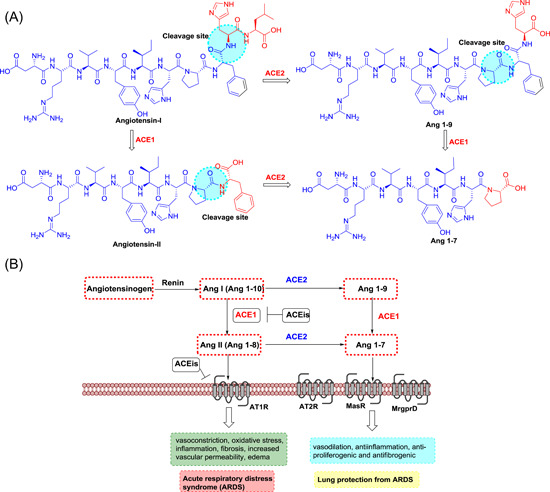
The roles of ACE1 and 2 in the renin‐angiotensin system. A, Chemical structures of angiotensin‐related peptides and B, Schematic diagram of roles of ACE1 and 2 in renin‐angiotensin system. ACE, angiotensin‐converting enzyme [Color figure can be viewed at wileyonlinelibrary.com]
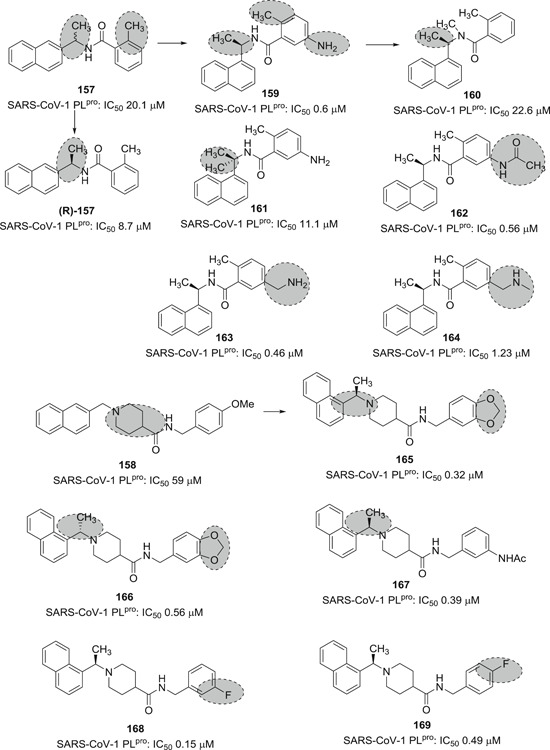
Figure 6
Figure 6
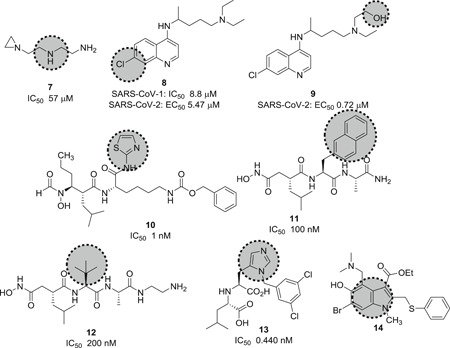
Inhibitors for SARS‐CoV‐1 and 2 targeting ACE2. ACE, angiotensin‐converting enzyme; SARS‐CoV, severe acute respiratory syndrome coronavirus
Figure 7
Figure 7
Neurotransmitter inhibitors targeting clathrin/nonclathrin pathways
Figure 8
Figure 8
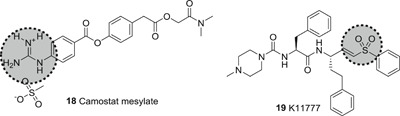
Inhibitors targeting TMPRSS2. TMPRSS, transmembrane serine protease
Figure 9
Figure 9
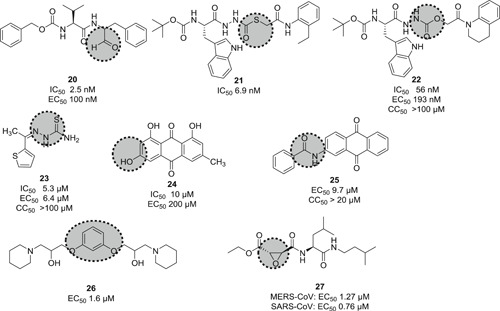
Cathepsin L inhibitors with antiviral activity
Figure 10
Figure 10
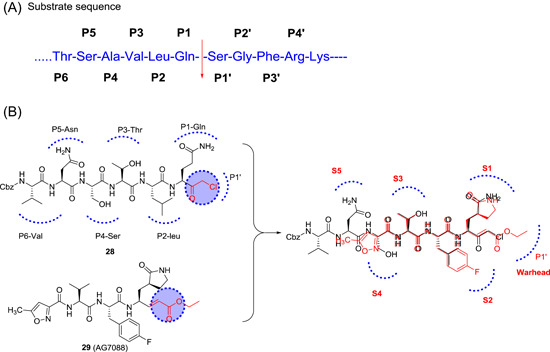
A, SARS‐CoV‐1 Mpro partial substrate sequence. B, (Overlay) structures of SARS‐CoV Mpro inhibitors. Mpro, main protease; SARS‐CoV, severe acute respiratory syndrome coronavirus [Color figure can be viewed at wileyonlinelibrary.com]
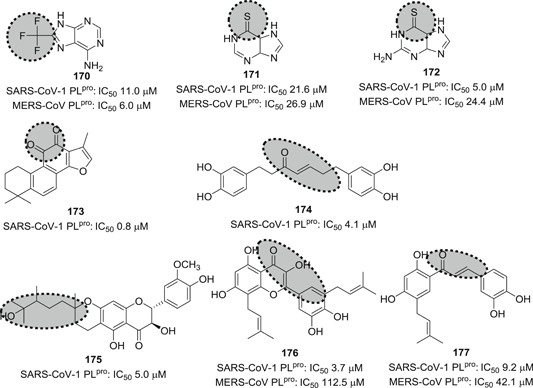
Figure 11
Figure 11
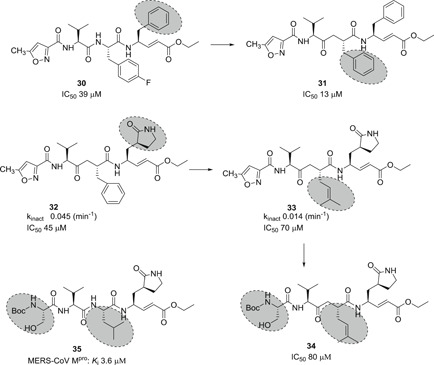
SARS‐CoV Mpro inhibitors containing Michael acceptor as a warhead group. Mpro, main protease; SARS‐CoV, severe acute respiratory syndrome coronavirus
Figure 12
Figure 12
Broad‐spectral antiviral compounds containing a Michael acceptor
Figure 13
Figure 13
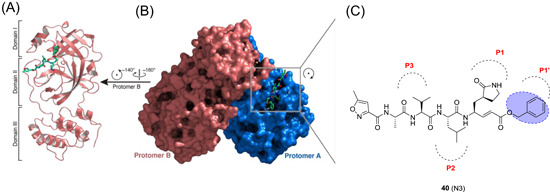
The crystal structure of COVID‐19 virus Mpro in complex with N3. (A) Representation of the dimeric Mpro‐inhibitor complex. (B) Surface representation of the homodimer of Mpro. Protomer A (blue), protomer B (salmon), compound N3 is presented as green sticks. (C) Schematic view of compound N3 (40) in the substrate‐binding pocket. Mpro, main protease [Color figure can be viewed at wileyonlinelibrary.com]
Figure 14
Figure 14
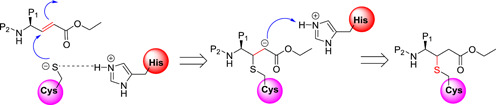
Mechanism of inhibitors with Michael acceptor group [Color figure can be viewed at wileyonlinelibrary.com]
Figure 15
Figure 15
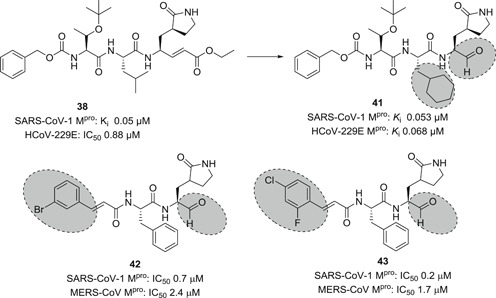
SARS‐CoV‐1 and MERS‐CoV Mpro inhibitors with peptide aldehyde functionality. Mpro, main protease; SARS‐CoV, severe acute respiratory syndrome coronavirus
Figure 16
Figure 16
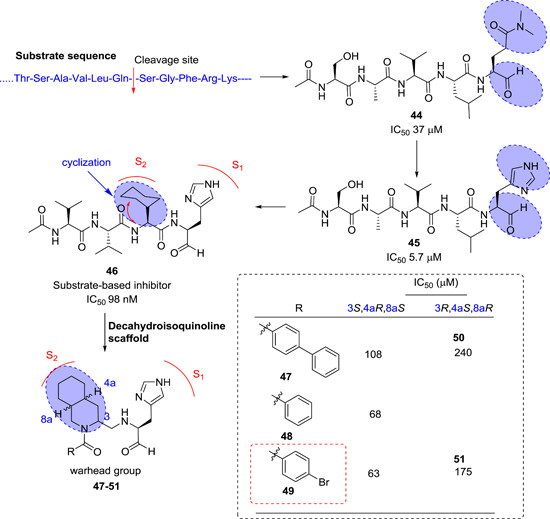
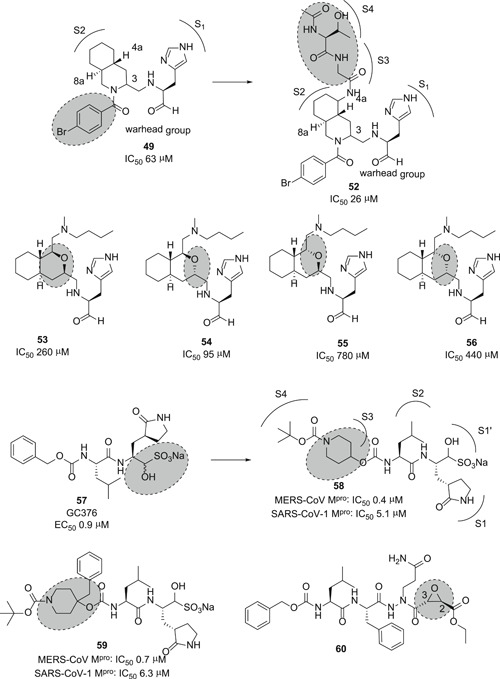
Peptide inhibitors containing cyclohexyl and decahydroisoquinoline groups [Color figure can be viewed at wileyonlinelibrary.com]
Figure 17
Figure 17
Inhibitors with aldehyde, aldehyde bisulfite adduct, and epoxide warhead group
Figure 18
Figure 18
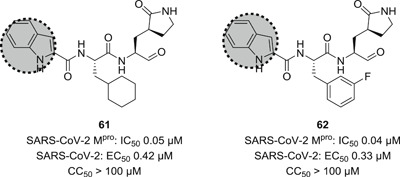
Peptidomimetic SARS‐CoV‐2 Mpro inhibitors with P3‐indole moiety. Mpro, main protease; SARS‐CoV, severe acute respiratory syndrome coronavirus
Figure 19
Figure 19
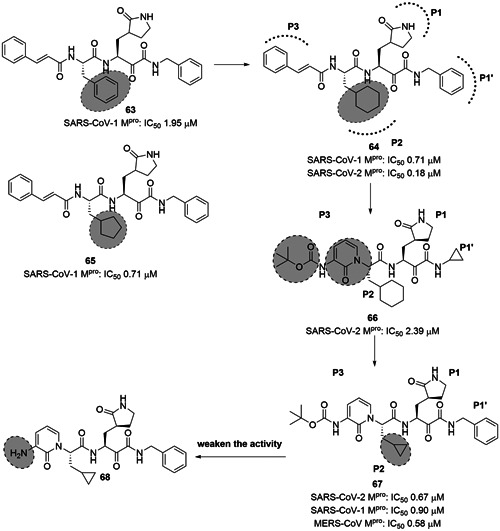
Ketoamide inhibitors targeting SARS‐CoV‐2 Mpro. Mpro, main protease; SARS‐CoV, severe acute respiratory syndrome coronavirus
Figure 20
Figure 20
Crystal structure of SARS‐CoV‐2 Mpro. Mpro, main protease; SARS‐CoV, severe acute respiratory syndrome coronavirus [Color figure can be viewed at wileyonlinelibrary.com]
Figure 21
Figure 21
Crystal structure of 67 with SARS‐CoV‐2 Mpro. Mpro, main protease; SARS‐CoV, severe acute respiratory syndrome coronavirus [Color figure can be viewed at wileyonlinelibrary.com]
Figure 22
Figure 22
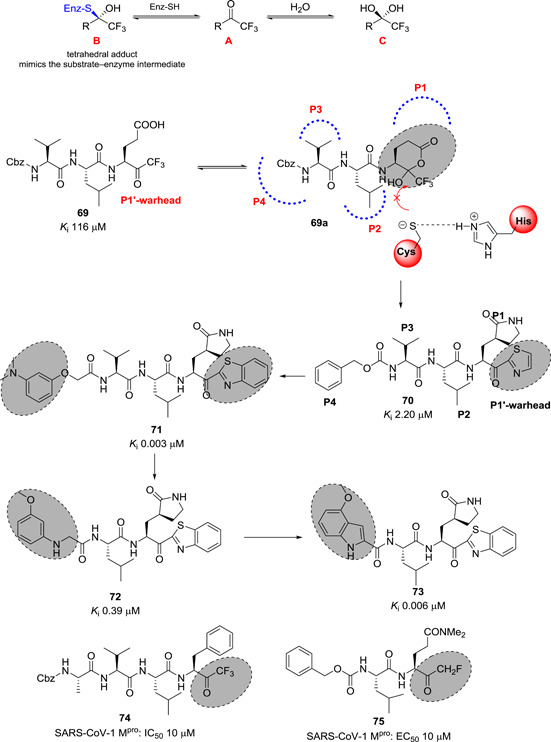
Peptide inhibitors containing electrophilic ketone warheads [Color figure can be viewed at wileyonlinelibrary.com]
Figure 23
Figure 23
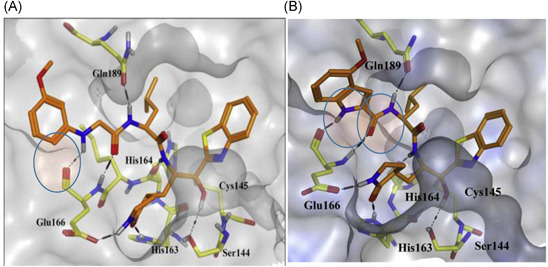
(A) Docking poses of 72 and (B) 73 with SARS‐CoV‐1 Mpro. Mpro, main protease; SARS‐CoV, severe acute respiratory syndrome coronavirus [Color figure can be viewed at wileyonlinelibrary.com]
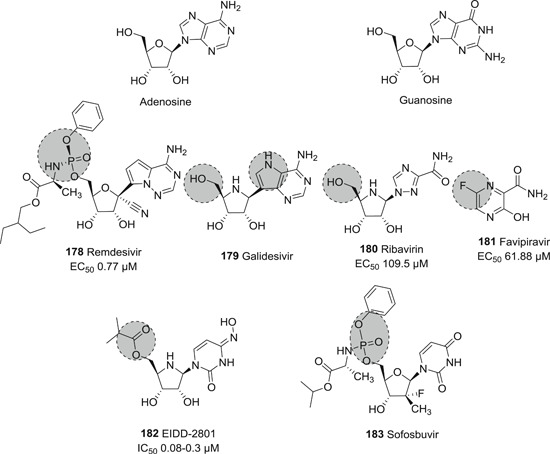
Figure 24
Figure 24
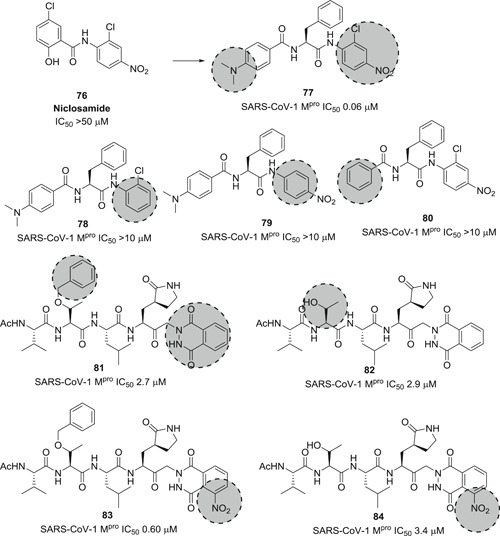
Small peptide anilides and ketoglutamide tripeptides as SARS‐CoV‐1 inhibitors. SARS‐CoV, severe acute respiratory syndrome coronavirus
Figure 25
Figure 25
SARS‐CoV‐1 Mpro inhibitors derived from HIV proteases inhibitors. HIV, human immunodeficiency virus; Mpro, main protease; SARS‐CoV, severe acute respiratory syndrome coronavirus
Figure 26
Figure 26
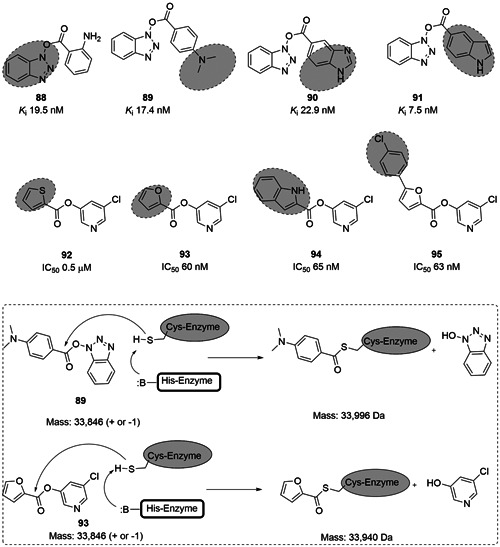
Active esters as SARS‐CoV‐1 Mpro inhibitors. Mpro, main protease; SARS‐CoV, severe acute respiratory syndrome coronavirus
Figure 27
Figure 27
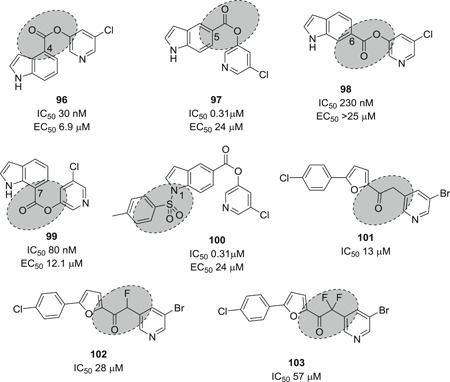
SAR of halopyridinyl indole carboxylates as SARS‐CoV‐1 Mpro inhibitors. Mpro, main protease; SARS‐CoV, severe acute respiratory syndrome coronavirus
Figure 28
Figure 28
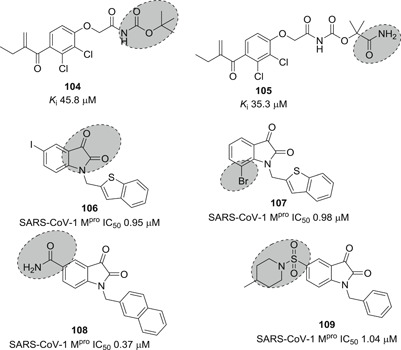
Etacrynic acid and isatin derivatives as SARS‐CoV‐1 Mpro inhibitors. Mpro, main protease; SARS‐CoV, severe acute respiratory syndrome coronavirus
Figure 29
Figure 29
Pyrazoles and pyrimidines as SARS‐CoV‐1 Mpro inhibitors. Mpro, main protease; SARS‐CoV, severe acute respiratory syndrome coronavirus
Figure 30
Figure 30
Simple dipeptide derivatives as SARS‐CoV‐1 Mpro inhibitors. Mpro, main protease; SARS‐CoV, severe acute respiratory syndrome coronavirus
Figure 31
Figure 31
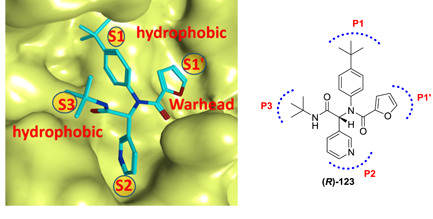
The X‐ray crystal structure of 123 bound to the binding pocket of SARS‐CoV‐1 Mpro (PDB ID: 3V3M). Pockets S1'–S3 are highlighted. Mpro, main protease; SARS‐CoV, severe acute respiratory syndrome coronavirus [Color figure can be viewed at wileyonlinelibrary.com]
Figure 32
Figure 32
SARS‐CoV‐1 Mpro inhibitors containing the benzotriazole scaffold. Mpro, main protease; SARS‐CoV, severe acute respiratory syndrome coronavirus
Figure 33
Figure 33
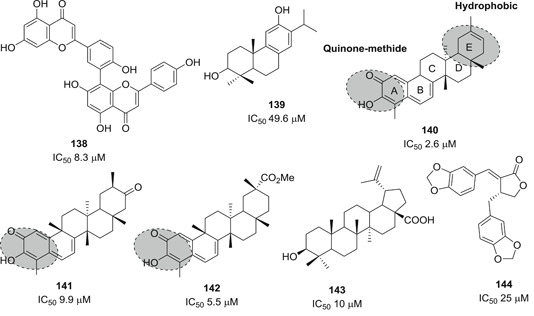
Flavone and terpenoid derivatives with inhibitory activity against SARS‐CoV‐1 3CLpro. 3CLpro, 3C‐like protease; SARS‐CoV, severe acute respiratory syndrome coronavirus
Figure 34
Figure 34
Structure of SARS‐CoV‐1 Mpro inhibitors 145149. Mpro, main protease; SARS‐CoV, severe acute respiratory syndrome coronavirus
Figure 35
Figure 35
Covalent bond inhibitors of Mpro. Mpro, main protease
Figure 36
Figure 36
SARS‐CoV‐1 PLpro inhibitors based on naphthalene scaffold. PLpro, papain‐like protease; SARS‐CoV, severe acute respiratory syndrome coronavirus
Figure 37
Figure 37
Broad spectral PLpro inhibitors from different sources. PLpro, papain‐like protease; SARS‐CoV, severe acute respiratory syndrome coronavirus
Figure 38
Figure 38
Nucleoside analogs with inhibition activity against SARS‐CoV‐2 RdRP (adenosine, guanosine, and sofosbuvir are included for comparison). RdRP, RNA‐dependent RNA polymerase; SARS‐CoV, severe acute respiratory syndrome coronavirus
Figure 39
Figure 39
Selected structures of drugs suitable for repositioning against SARS‐CoV‐1 and 2. SARS‐CoV, severe acute respiratory syndrome coronavirus
Figure 40
Figure 40
Drugs repurposed for MERS‐ and SARS‐CoV infections. MERS, Middle East respiratory syndrome; SARS‐CoV, severe acute respiratory syndrome coronavirus

References

    1. Pillaiyar T, Meenakshisundaram S, Manickam M. Recent discovery and development of inhibitors targeting coronaviruses. Drug Discov Today 2020;25(4):668‐688. - PMC - PubMed
    1. Pillaiyar T, Manickam M, Namasivayam V, Hayashi Y., Jung S.H. An overview of severe acute respiratory syndrome‐coronavirus (SARS‐CoV) 3CL protease inhibitors: peptidomimetics and small molecule chemotherapy. J Med Chem. 2016;59(14):6595‐6628. - PMC - PubMed
    1. Pillaiyar T, Manickam M, Jung SH. Middle East respiratory syndrome‐coronavirus (MERS‐CoV): an updated overview and pharmacotherapeutics. Med Chem 2015;5(8):361‐372.
    1. de Groot RJ, et al. Family Coronaviridae. In: King AMQ, ed. Ninth Report of the International Committee on Taxonomy of Viruses. Oxford: Elsevier; 2011:806‐828.
    1. Geller C, Varbanov M, Duval RE. Human coronaviruses: insights into environmental resistance and its influence on the development of new antiseptic strategies. Viruses 2012;4(11):3044‐3068. - PMC - PubMed

Publication types

Substances