


Effectiveness of a Daily Rounding Checklist on Processes of Care and Outcomes in Diverse Pediatric Intensive Care Units Across the World
- PMID: 32853362
- PMCID: PMC8488874
- DOI: 10.1093/tropej/fmaa058
Effectiveness of a Daily Rounding Checklist on Processes of Care and Outcomes in Diverse Pediatric Intensive Care Units Across the World
Erratum in
-
Correction to: Effectiveness of a Daily Rounding Checklist on Processes of Care and Outcomes in Diverse Pediatric Intensive Care Units Across the World.J Trop Pediatr. 2022 Jun 6;68(4):fmac051. doi: 10.1093/tropej/fmac051. J Trop Pediatr. 2022. PMID: 35762536 Free PMC article. No abstract available.
Abstract
Background: Implementation of checklists has been shown to be effective in improving patient safety. This study aims to evaluate the effectiveness of implementation of a checklist for daily care processes into clinical practice of pediatric intensive care units (PICUs) with limited resources.
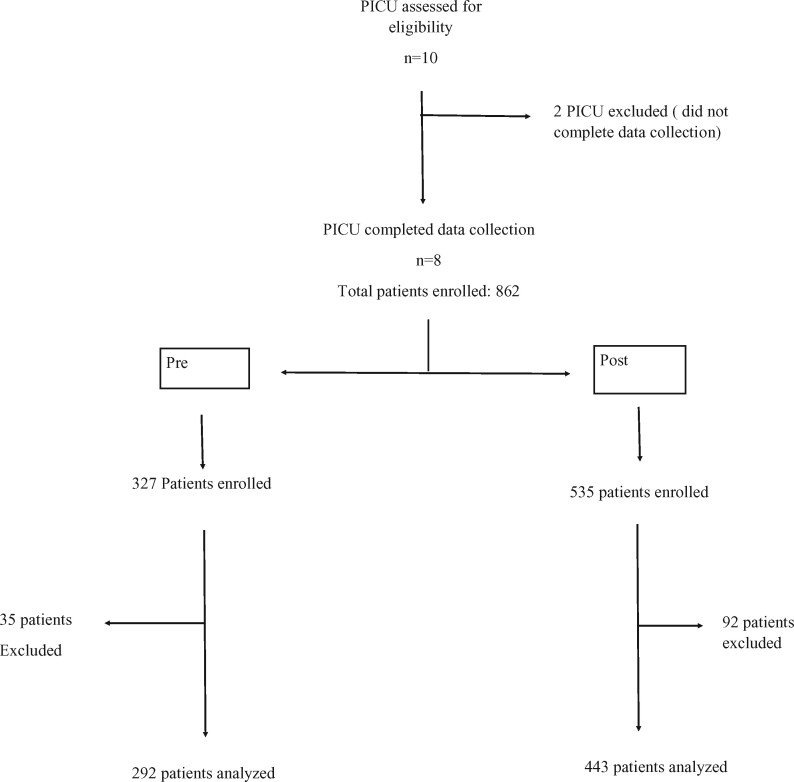
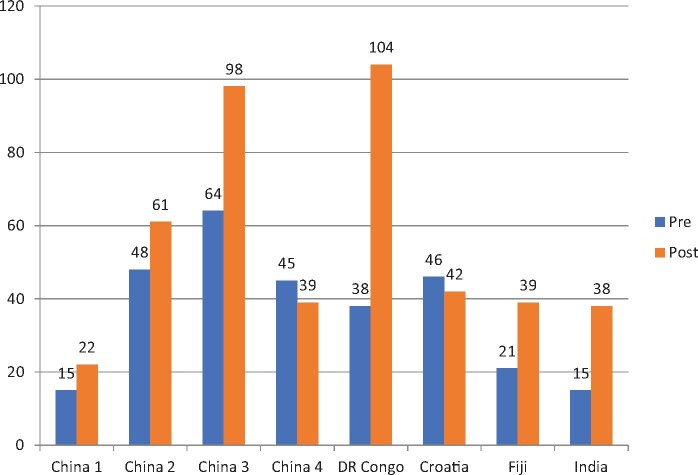
Methods: Prospective before-after study in eight PICUs from China, Congo, Croatia, Fiji, and India after implementation of a daily checklist into the ICU rounds.
Results: Seven hundred and thirty-five patients from eight centers were enrolled between 2015 and 2017. Baseline stage had 292 patients and post-implementation 443. The ICU length of stay post-implementation decreased significantly [9.4 (4-15.5) vs. 7.3 (3.4-13.4) days, p = 0.01], with a nominal improvement in the hospital length of stay [15.4 (8.4-25) vs. 12.6 (7.5-24.4) days, p = 0.055]. The hospital mortality and ICU mortality between baseline group and post-implementation group did not show a significant difference, 14.4% vs. 11.3%; p = 0.22 for each. There was a variable impact of checklist implementation on adherence to various processes of care recommendations. A decreased exposure in days was noticed for; mechanical ventilation from 42.6% to 33.8%, p < 0.01; central line from 31.3% to 25.3%, p < 0.01; and urinary catheter from 30.6% to 24.4%, p < 0.01. Although there was an increased utilization of antimicrobials (89.9-93.2%, p < 0.01).
Conclusions: Checklists for the treatment of acute illness and injury in the PICU setting marginally impacted the outcome and processes of care. The intervention led to increasing adherence with guidelines in multiple ICU processes and led to decreased length of stay.
Keywords: LMIC; checklists; critical care; patient safety; pediatric; quality improvement.
© The Author(s) [2020]. Published by Oxford University Press. All rights reserved. For permissions, please email: journals.permissions@oup.com.
Conflict of interest statement
R.K. and O.G. have a financial conflict of interest related to adult ICU checklist software applications licensed to Ambient Clinical Analytics Inc. The related research has been reviewed by the Mayo Clinic Conflict of Interest Review Board and is being conducted in compliance with Mayo Clinic Conflict of Interest policies.
Figures
References
-
- Riviello ED, Letchford S, Achieng L, et al. Critical care in resource-poor settings: lessons learned and future directions. Crit Care Med 2011;39:860–7. - PubMed
-
- Murthy S, Adhikari NK.. Global health care of the critically ill in low-resource settings. Ann Am Thorac Soc 2013;10:509–13. - PubMed
-
- Lipkus IM. Numeric, verbal, and visual formats of conveying health risks: suggested best practices and future recommendations. Med Decis Making 2007;27:696–713. - PubMed
Publication types
MeSH terms
Grants and funding
LinkOut - more resources
Full Text Sources
