


Immune dysregulation and multisystem inflammatory syndrome in children (MIS-C) in individuals with haploinsufficiency of SOCS1
- PMID: 32853638
- PMCID: PMC7445138
- DOI: 10.1016/j.jaci.2020.07.033
Immune dysregulation and multisystem inflammatory syndrome in children (MIS-C) in individuals with haploinsufficiency of SOCS1
Abstract
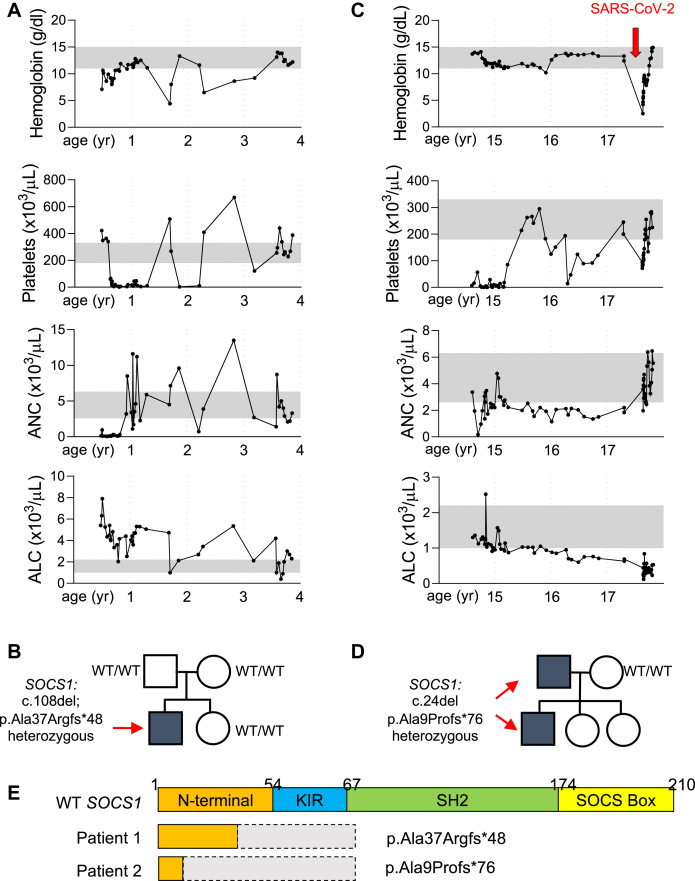
Background: We studied 2 unrelated patients with immune thrombocytopenia and autoimmune hemolytic anemia in the setting of acute infections. One patient developed multisystem inflammatory syndrome in children in the setting of a severe acute respiratory syndrome coronavirus 2 infection.
Objectives: We sought to identify the mechanisms underlying the development of infection-driven autoimmune cytopenias.
Methods: Whole-exome sequencing was performed on both patients, and the impact of the identified variants was validated by functional assays using the patients' PBMCs.
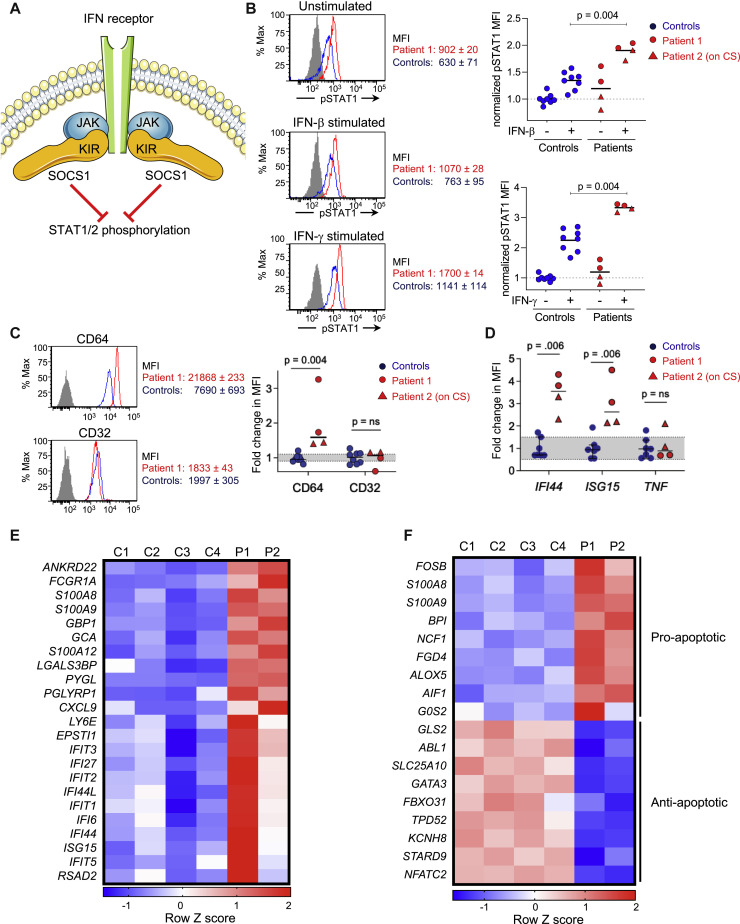
Results: Each patient was found to have a unique heterozygous truncation variant in suppressor of cytokine signaling 1 (SOCS1). SOCS1 is an essential negative regulator of type I and type II IFN signaling. The patients' PBMCs showed increased levels of signal transducer and activator of transcription 1 phosphorylation and a transcriptional signature characterized by increased expression of type I and type II IFN-stimulated genes and proapoptotic genes. The enhanced IFN signature exhibited by the patients' unstimulated PBMCs parallels the hyperinflammatory state associated with multisystem inflammatory syndrome in children, suggesting the contributions of SOCS1 in regulating the inflammatory response characteristic of multisystem inflammatory syndrome in children.
Conclusions: Heterozygous loss-of-function SOCS1 mutations are associated with enhanced IFN signaling and increased immune cell activation, thereby predisposing to infection-associated autoimmune cytopenias.
Keywords: COVID-19; Evans syndrome; MIS-C; SARS-CoV-2; SOCS1; autoimmune hemolytic anemia; immune thrombocytopenia.
Copyright © 2020 American Academy of Allergy, Asthma & Immunology. Published by Elsevier Inc. All rights reserved.
Figures
References
-
- Alexander W.S., Starr R., Fenner J.E., Scott C.L., Handman E., Sprigg N.S. SOCS1 is a critical inhibitor of interferon γ signaling and prevents the potentially fatal neonatal actions of this cytokine. Cell. 1999;98:597–608. - PubMed
-
- Fenner J.E., Starr R., Cornish A.L., Zhang J.-G., Metcalf D., Schreiber R.D. Suppressor of cytokine signaling 1 regulates the immune response to infection by a unique inhibition of type I interferon activity. Nat Immunol. 2006;7:33–39. - PubMed
-
- Fujimoto M. Inadequate induction of suppressor of cytokine signaling-1 causes systemic autoimmune diseases. Int Immunol. 2004;16:303–314. - PubMed
Publication types
MeSH terms
Substances
Supplementary concepts
Grants and funding
LinkOut - more resources
Full Text Sources
Molecular Biology Databases
Research Materials
Miscellaneous
