. 2020 Aug 25;9(9):248.
doi: 10.3390/biology9090248.

The Phytochemical, Antifungal, and First Report of the Antiviral Properties of Egyptian Haplophyllum tuberculatum Extract

Affiliations

The Phytochemical, Antifungal, and First Report of the Antiviral Properties of Egyptian Haplophyllum tuberculatum Extract

Ahmed Abdelkhalek et al. Biology (Basel). .

Abstract

In this study, ethanol whole plant extract (WPE) of Haplophyllum tuberculatum was characterized and tested for its antifungal and antiviral activities against Fusarium culmorum, Rhizoctonia solani and tobacco mosaic virus (TMV). High Performance Liquid Chromatography (HPLC) analysis showed that the main phytochemical constituents of H. tuberculatum WPE were resveratrol (5178.58 mg/kg), kaempferol (1735.23 mg/kg), myricetin (561.18 mg/kg), rutin (487.04 mg/kg), quercetin (401.04 mg/kg), and rosmarinic acid (387.33 mg/kg). By increasing H. tuberculatum WPE at concentrations of 1%, 2%, and 3%, all of the fungal isolates were suppressed compared to the two positive and negative controls. Under greenhouse conditions, WPE-treated Chenopodium amaranticolor plants strongly inhibited TMV infection and significantly reduced TMV accumulation levels when compared to non-treated plants. Moreover, the induction of systemic resistance with significant increases in the transcriptional levels of the pathogenesis-related protein-1 (PR-1), chalcone synthase (CHS), and hydroxycinnamoyl-CoA quinate transferase (HQT) genes for treated plants were noticed at 3 and 5 days post-inoculation (dpi) for both assays. To the best of our knowledge, this is the first reported observation of the antiviral activity of H. tuberculatum extract against plant viral infections. Finally, the results obtained suggest that H. tuberculatum WPE can be considered a promising source of both antifungal and antiviral substances for practical use and for developing plant-derived compounds for the effective management of plant diseases.

Keywords: HPLC analysis; Haplophyllum tuberculatum; antifungal property; antiviral activity; phytochemical analysis; tobacco mosaic virus.


Conflict of interest statement

The authors declare no conflict of interest.

Figures
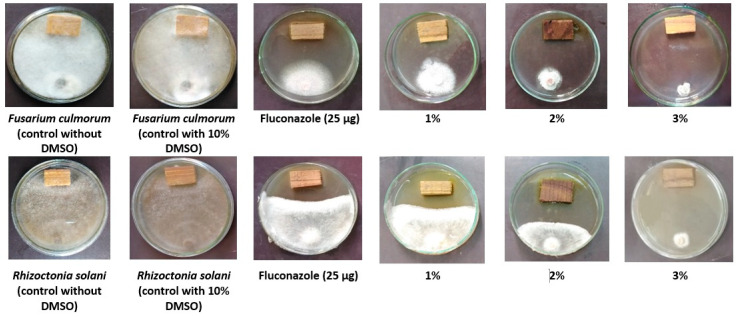
Figure 1
Figure 1
Visual observation of the antifungal property of Haplophyllum tuberculatum whole plant extract (WPE) against Fusarium culmorum and Rhizoctonia solani.
Figure 2
Figure 2
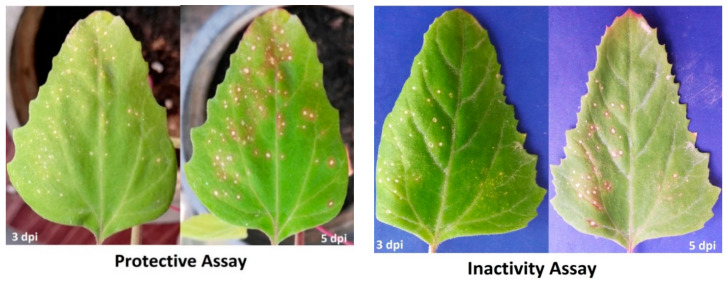
A photograph showing the disease symptoms on Chenopodium amaranticolor leaves infected with tobacco mosaic virus (TMV) at 3 and 5 days post-inoculation (dpi) of the protective activity and inactivity of H. tuberculatum whole plant extract (WPE) (200 μg/mL). The left-hand sides of the leaves were inoculated with TMV without any treatment, while the right-hand sides of the leaves were treated with WPE.
Figure 3
Figure 3
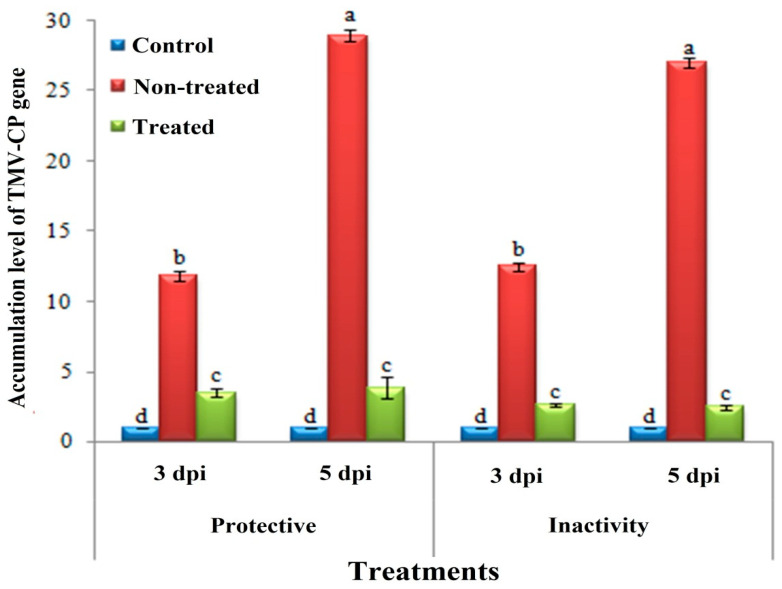
A histogram showing the accumulation levels of the TMV-CP gene at 3 and 5 days dpi with the protective activity and inactivity of H. tuberculatum WPE treatments (200 μg/mL). Control = mock-treated plants; non-treated = plants inoculated with TMV only without any treatment; treated = plants treated with WPE, 24 h before inoculation of TMV for the protective assay and 24 h after inoculation of TMV for the inactivity assay. Columns represent a mean value from three biological replicates and the bars indicate the standard deviation (SD). Significant differences between samples were determined by one-way analysis of variance (ANOVA) using CoStat software. Means were separated by the least significant difference (LSD) test at p ≤ 0.05 and indicated by lowercase letters. Columns with the same letter do not differ significantly.
Figure 4
Figure 4
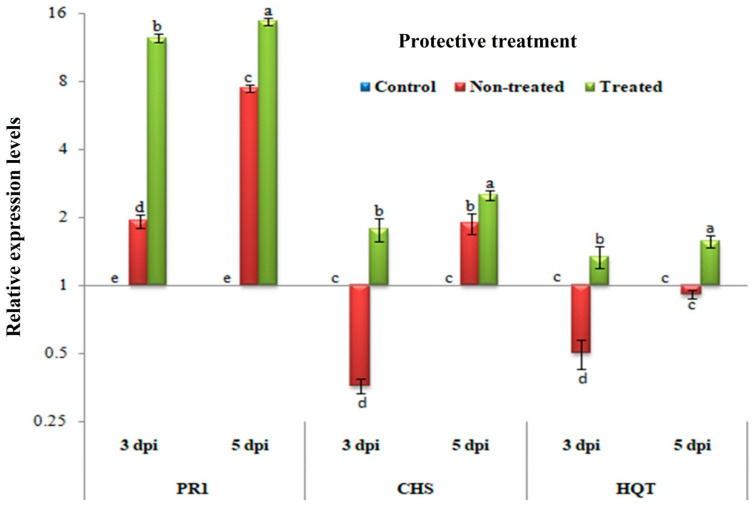
A histogram showing the relative expression levels of the PR-1, CHS, and HQT genes at 3 and 5 dpi of H. tuberculatum WPE treatments (200 μg/mL) in the protective activity assay. Control = mock-treated plants; non-treated = plants inoculated with TMV only without any treatment; treated = plants treated with H. tuberculatum WPE, 24 h before inoculation of TMV for the protective assay and 24 h after inoculation of TMV for the inactivity assay. Columns represent the mean value from three biological replicates and the bars indicate SD. Significant differences between samples were determined by one-way ANOVA using CoStat software. Means were separated by the LSD test at p ≤ 0.05 and indicated by lowercase letters. Columns with the same letter do not differ significantly.
Figure 5
Figure 5
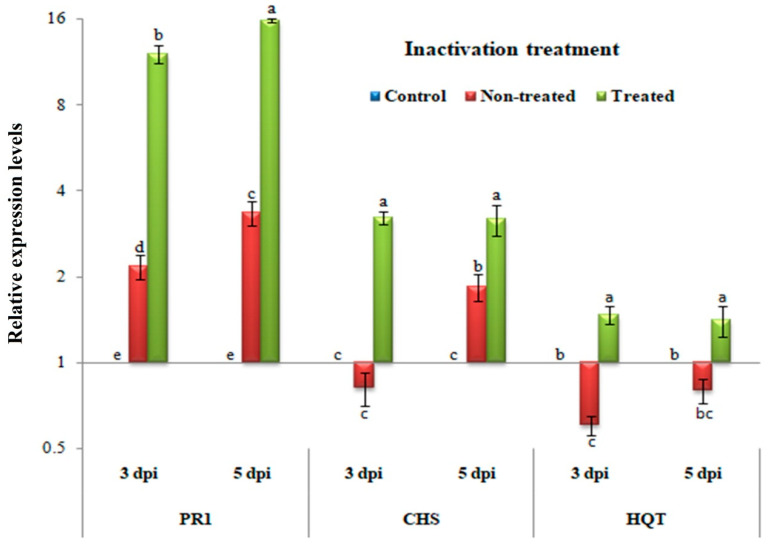
A histogram showing the relative expression levels of the PR-1, CHS, and HQT genes at 3 and 5 dpi of H. tuberculatum WPE treatments (200 μg/mL) in the inactivity assay. Control = mock-treated plants; non-treated = plants inoculated with TMV only without any treatment; treated = plants treated with H. tuberculatum WPE, 24 h before inoculation of TMV for the protective assay and 24 h after inoculation of TMV for the inactivity assay. Columns represent a mean value from three biological replicates and bars indicate SD. Significant differences between samples were determined by one-way ANOVA using CoStat software. Means were separated by the LSD test at p ≤ 0.05 and indicated by lowercase letters. Columns with the same letter do not differ significantly.

References

    1. Al-Muniri R.M.S., Hossain M.A. Evaluation of antioxidant and cytotoxic activities of different extracts of folk medicinal plant Hapllophyllum tuberculatum. Egypt. J. Basic Appl. Sci. 2017;4:101–106. doi: 10.1016/j.ejbas.2017.04.003. - DOI
    1. Abdelkhalek A., Ismail I.A., Dessoky E.S., El-Hallous E.I., Hafez E. A tomato kinesin-like protein is associated with Tobacco mosaic virus infection. Biotechnol. Biotechnol. Equip. 2019;33:1424–1433. doi: 10.1080/13102818.2019.1673207. - DOI
    1. Bazzini A.A., Hopp H.E., Beachy R.N., Asurmendi S. Infection and coaccumulation of Tobacco mosaic virus proteins alter microRNA levels, correlating with symptom and plant development. Proc. Natl. Acad. Sci. USA. 2007;104:12157–12162. doi: 10.1073/pnas.0705114104. - DOI - PMC - PubMed
    1. Abdelkhalek A. Expression of tomato pathogenesis related genes in response to Tobacco mosaic virus. J. Anim. Plant Sci. 2019;29:1596–1602.
    1. Scholthof K.G., Adkins S., Czosnek H., Palukaitis P., Jacquot E., Hohn T., Hohn B., Saunders K., Candresse T., Ahlquist P. Top 10 plant viruses in molecular plant pathology. Mol. Plant Pathol. 2011;12:938–954. doi: 10.1111/j.1364-3703.2011.00752.x. - DOI - PMC - PubMed