


Salmonella enterica serovar Typhimurium inhibits the innate immune response and promotes apoptosis in a ribosomal/TRP53-dependent manner in swine neutrophils
- PMID: 32854785
- PMCID: PMC7450969
- DOI: 10.1186/s13567-020-00828-3
Salmonella enterica serovar Typhimurium inhibits the innate immune response and promotes apoptosis in a ribosomal/TRP53-dependent manner in swine neutrophils
Abstract
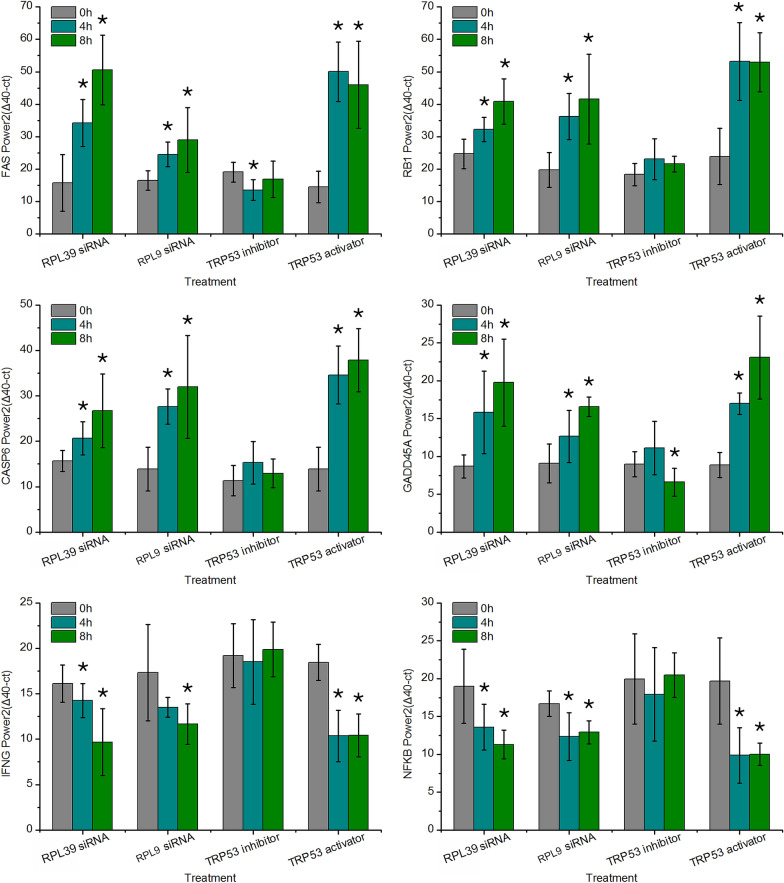
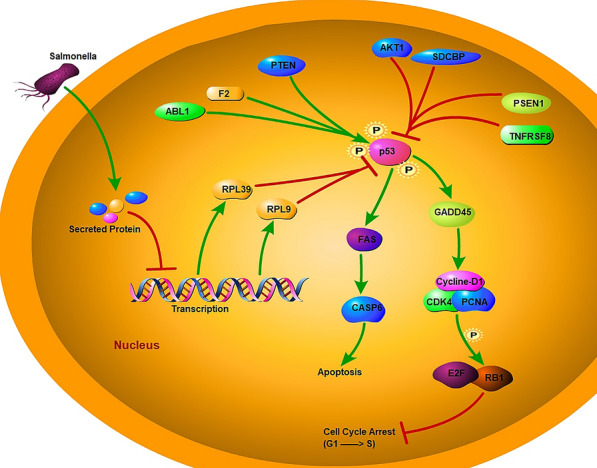
Neutrophils are the first barriers for resisting the invasion, proliferation, and damage caused by Salmonella Typhimurium. However, the mechanisms that control this resistance are not completely understood. In this study, we established an in vitro Salmonella infection model in porcine neutrophils, and analyzed the cellular transcriptome by deep sequencing and flow cytometry. The results showed that ribosomal gene transcription was inhibited, and two of these genes, RPL39 and RPL9, were related to TRP53 activation. Furthermore, several important innate immunity genes were also inhibited. Knock-down of RPL39 and RPL9 by siRNA caused an approximate fourfold up-regulation of TRP53. Knock-down of RPL39 and RPL9 also resulted in a significant down-regulation of IFNG and TNF, indicating an inhibition of the innate immune response. Silencing of RPL39 and RPL9 also resulted in the up-regulation of FAS, RB1, CASP6, and GADD45A, which play roles in cell cycle arrest and apoptosis. Neutrophils were either first treated with RPL39 siRNA, RPL9 siRNA, TRP53 activator, or TRP53 inhibitor, and then infected with Salmonella. Knock-down of RPL39 and RPL9, or treatment with TRP53 activator, can increase the intracellular proliferation of Salmonella in neutrophils. We speculate that much of the Salmonella virulence can be attributed to the enhancement of cell cycle arrest and the inhibition of the innate immune response, which allows the bacteria to successfully proliferate intracellularly.
Keywords: RPL39; RPL9; Salmonella; TRP53; deep-sequencing; neutrophils; porcine.
Conflict of interest statement
The authors certify that they have no affiliations with or involvement in any organization or entity with any financial interest or non-financial interest in the subject matter or materials discussed in this manuscript. The authors declare that they have no competing interests.
Figures
References
-
- Hendriksen RS, Vieira AR, Karlsmose S, Lo Fo Wong DM, Jensen AB, Wegener HC, Aarestrup FM. Global monitoring of Salmonella serovar distribution from the World Health Organization Global Foodborne Infections Network Country Data Bank: results of quality assured laboratories from 2001 to 2007. Foodborne Pathog Dis. 2011;8:887–900. doi: 10.1089/fpd.2010.0787. - DOI - PubMed
-
- Bearson SM, Allen HK, Bearson BL, Looft T, Brunelle BW, Kich JD, Tuggle CK, Bayles DO, Alt D, Levine UY, Stanton TB. Profiling the gastrointestinal microbiota in response to Salmonella: low versus high Salmonella shedding in the natural porcine host. Infect Genet Evol. 2013;16:330–340. doi: 10.1016/j.meegid.2013.03.022. - DOI - PubMed
MeSH terms
Grants and funding
- 31902231/National Natural Science Foundation of China
- 31402055/National Natural Science Foundation of China
- 2019110/College Students' Innovation and Entrepreneurship Training Program of Yangtze University
- Q20171305/Science and Technology Research Project of Department of Education of Hubei Province
- 2015cqr12/Yangtze Youth Talents Fund
LinkOut - more resources
Full Text Sources
Molecular Biology Databases
Research Materials
Miscellaneous
