Review
. 2020:155:141-168.
doi: 10.1016/bs.irn.2020.02.003. Epub 2020 Aug 11.

Ketotherapeutics for neurodegenerative diseases

Affiliations
Review

Ketotherapeutics for neurodegenerative diseases

Nicholas G Norwitz et al. Int Rev Neurobiol. 2020.

Abstract

Alzheimer's disease (AD) and Parkinson's disease (PD) are, respectively, the most prevalent and fastest growing neurodegenerative diseases worldwide. The former is primarily characterized by memory loss and the latter by the motor symptoms of tremor and bradykinesia. Both AD and PD are progressive diseases that share several key underlying mitochondrial, inflammatory, and other metabolic pathologies. This review will detail how these pathologies intersect with ketone body metabolism and signaling, and how ketone bodies, particularly d-β-hydroxybutyrate (βHB), may serve as a potential adjunctive nutritional therapy for two of the world's most devastating conditions.

Keywords: Alzheimer's disease; Inflammation; Insulin; Ketone bodies; Ketone ester; Microglia; Mitochondria; Oxidative stress; Parkinson's disease; d-β-hydroxybutyrate.


Figures

Fig. 1
Fig. 1
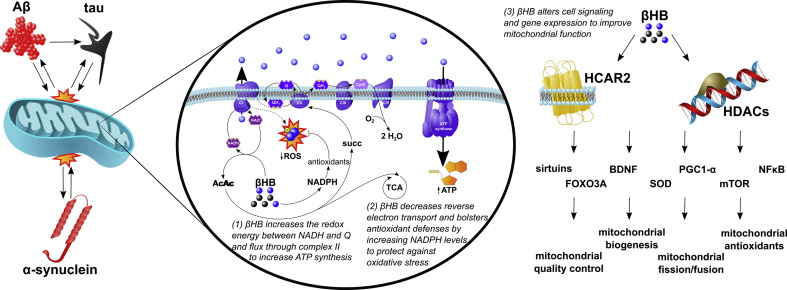
Neurodegenerative pathology, mitochondrial dysfunction, and βHB: The amyloid (Aβ) and tau pathologies of Alzheimer's disease and the α-synuclein pathology of Parkinson's disease are in positive feedback with mitochondrial dysfunction. Mitochondrial dysfunction is characterized by (i) the underproduction of ATP and (ii) overproduction of reactive oxygen species (ROS). βHB can improve mitochondrial function through three mechanisms: (1) βHB catabolism decreases the NAD+/NADH ratio and increases the Q/QH2 ratio to increase the redox span of the electron transport chain and, thereby, increase the generation of ATP. In addition, the rate limiting step of βHB catabolism generates succinate, an oxidative fuel for complex II that bypasses the complex I blockade present in Parkinson's disease to further increase ATP production in this condition. (2) By increasing the Q/QH2 ratio and levels of NADPH, βHB catabolism decreases the generation of ROS by reverse electron transport (dashed arrow) and bolsters antioxidant defenses. (3) βHB is also a signaling molecule that binds to its own G-protein coupled hydroxycarboxylic acid receptor 2 (HCAR2) and inhibits histone deacetylases (HDACs), both widely expressed throughout the brain, to regulate a wide variety of critical enzymes, transcription factors, and cofactors and, thereby, improve mitochondrial function.
Fig. 2
Fig. 2
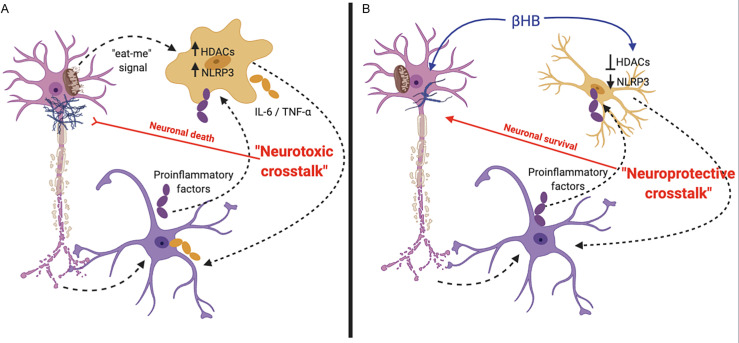
Anti-inflammatory role of βHB in neurodegenerative diseases: (A) Neurodegeneration induces the A1 proinflammatory astrocyte (purple cell) response and triggers microglia-mediated (orange cell) phagocytosis. Transcription and release of proinflammatory factors increase the HDAC- and NLRP3-mediated inflammatory responses in glia, promoting neuronal (pink cell) death by neurotoxic cross-talk between proinflammatory microglia and astrocytes. (B) βHB may decrease inflammation signaling, in part, by inhibiting HDACs and impairing NLRP3 inflammasome formation.
Fig. 3
Fig. 3
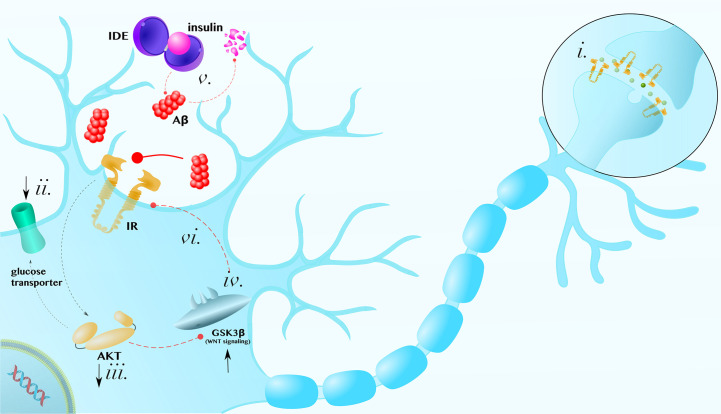
Insulin in the brain: (i) Insulin receptors (IR) are enriched at synapses, where they regulate neurotransmitter release and the localization of receptors. (ii) Insulin resistance decreases glucose transporters in the membrane, (iii) leads to the inhibition of downstream proteins, like AKT, (iv) and induces neurotoxic anti-WNT GSK3β activity. (v) Hyperinsulinemia prevents Aβ degradation by insulin degrading enzyme (IDE), establishing a positive feedback loop. (vi) Furthermore, GSK3β activity, which is antagonistic to neuroprotective WNT signaling, also inhibits insulin signaling. The figure is meant to be representative, not comprehensive, regarding the mechanisms by which insulin resistance can contribute to the degeneration of neurons.

References

    1. Alam Q., Alam M.Z., Mushtaq G., Damanhouri G.A., Rasool M., Kamal M.A. Inflammatory process in Alzheimer's and Parkinson's diseases: Central role of cytokines. Current Pharmaceutical Design. 2016;22(5):541–548. doi: 10.2174/1381612822666151125000300. - DOI - PubMed
    1. Andersen J.V., Christensen S.K., Aldana B.I., Nissen J.D., Tanila K., Waagepetersen H.S. Alterations in cerebral cortical glucose and glutamine metabolism precedes amyloid plaques in the APPswe/PSEN1dE9 mouse model of Alzheimer's disease. Neurochemical Research. 2017;42:1589–1598. doi: 10.1007/s11064-016-2070-2. - DOI - PubMed
    1. Arnold S.E. Brain insulin resistance in type 2 diabetes and Alzheimer disease: Concepts and conundrums. Nature Reviews Neurology. 2018;14:168–181. doi: 10.1038/nrneurol.2017.185. Nature Publishing Group. - DOI - PMC - PubMed
    1. Avgerinos K.I. Medium chain triglycerides induce mild ketosis and may improve cognition in Alzheimer's disease. A systematic review and meta-analysis of human studies. Ageing Research Reviews. 2019;58:101001. doi: 10.1016/j.arr.2019.101001. - DOI - PMC - PubMed
    1. Bachiller S., Jiménez-Ferrer I., Paulus A., Yang Y., Swanberg M., Deierborg T. Microglia in neurological diseases: A road map to brain-disease dependent-inflammatory response. Frontiers in Cellular Neuroscience. 2018;12:488. doi: 10.3389/fncel.2018.00488. - DOI - PMC - PubMed

Further reading

    1. Arcuri C., Mecca C., Bianchi R., Giambanco I., Donato R. The pathophysiological role of microglia in dynamic surveillance, phagocytosis and structural remodeling of the developing CNS. Frontiers in Molecular Neuroscience. 2017;10:191. doi: 10.3389/fnmol.2017.00191. - DOI - PMC - PubMed
    1. Chriett S., Dąbek A., Wojtala M., Vidal H., Balcerczyk A., Pirola L. Prominent action of butyrate over β-hydroxybutyrate as histone deacetylase inhibitor, transcriptional modulator and anti-inflammatory molecule. Scientific Reports. 2019;9(1):1–14. doi: 10.1038/s41598-018-36941-9. - DOI - PMC - PubMed
    1. Das T., Hoarau J.J., Jaffar Bandjee M.C., Maquart M., Gasque P. Multifaceted innate immune responses engaged by astrocytes, microglia and resident dendritic cells against Chikungunya neuroinfection. The Journal of General Virology. 2015;96(Pt. 2):294–310. doi: 10.1099/vir.0.071175-0. - DOI - PubMed
    1. Deora V., Albornoz E.A., Zhu K., Woodruff T.M., Gordon R. The ketone body β-hydroxybutyrate does not inhibit synuclein mediated inflammasome activation in microglia. Journal of Neuroimmune Pharmacology: The Official Journal of the Society on NeuroImmune Pharmacology. 2017;12(4):568–574. doi: 10.1007/s11481-017-9754-5. - DOI - PubMed
    1. Lenz K.M., Nelson L.H. Microglia and beyond: Innate immune cells as regulators of brain development and behavioral function. Frontiers in Immunology. 2018;9:698. doi: 10.3389/fimmu.2018.00698. - DOI - PMC - PubMed