


Arthroscopic partial meniscectomy for a degenerative meniscus tear: a 5 year follow-up of the placebo-surgery controlled FIDELITY (Finnish Degenerative Meniscus Lesion Study) trial
- PMID: 32855201
- PMCID: PMC7606577
- DOI: 10.1136/bjsports-2020-102813
Arthroscopic partial meniscectomy for a degenerative meniscus tear: a 5 year follow-up of the placebo-surgery controlled FIDELITY (Finnish Degenerative Meniscus Lesion Study) trial
Abstract
Objectives: To assess the long-term effects of arthroscopic partial meniscectomy (APM) on the development of radiographic knee osteoarthritis, and on knee symptoms and function, at 5 years follow-up.
Design: Multicentre, randomised, participant- and outcome assessor-blinded, placebo-surgery controlled trial.
Setting: Orthopaedic departments in five public hospitals in Finland.
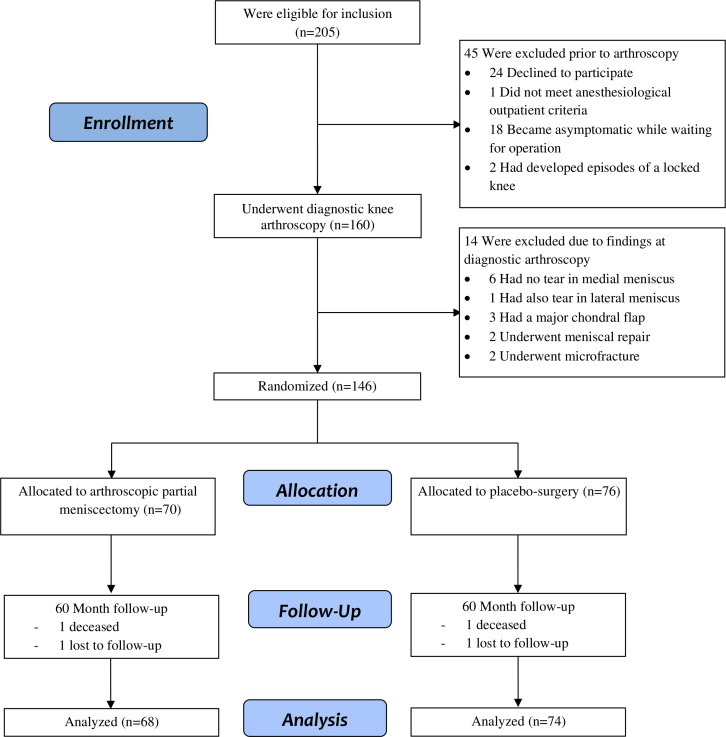
Participants: 146 adults, mean age 52 years (range 35-65 years), with knee symptoms consistent with degenerative medial meniscus tear verified by MRI scan and arthroscopically, and no clinical signs of knee osteoarthritis were randomised.
Interventions: APM or placebo surgery (diagnostic knee arthroscopy).
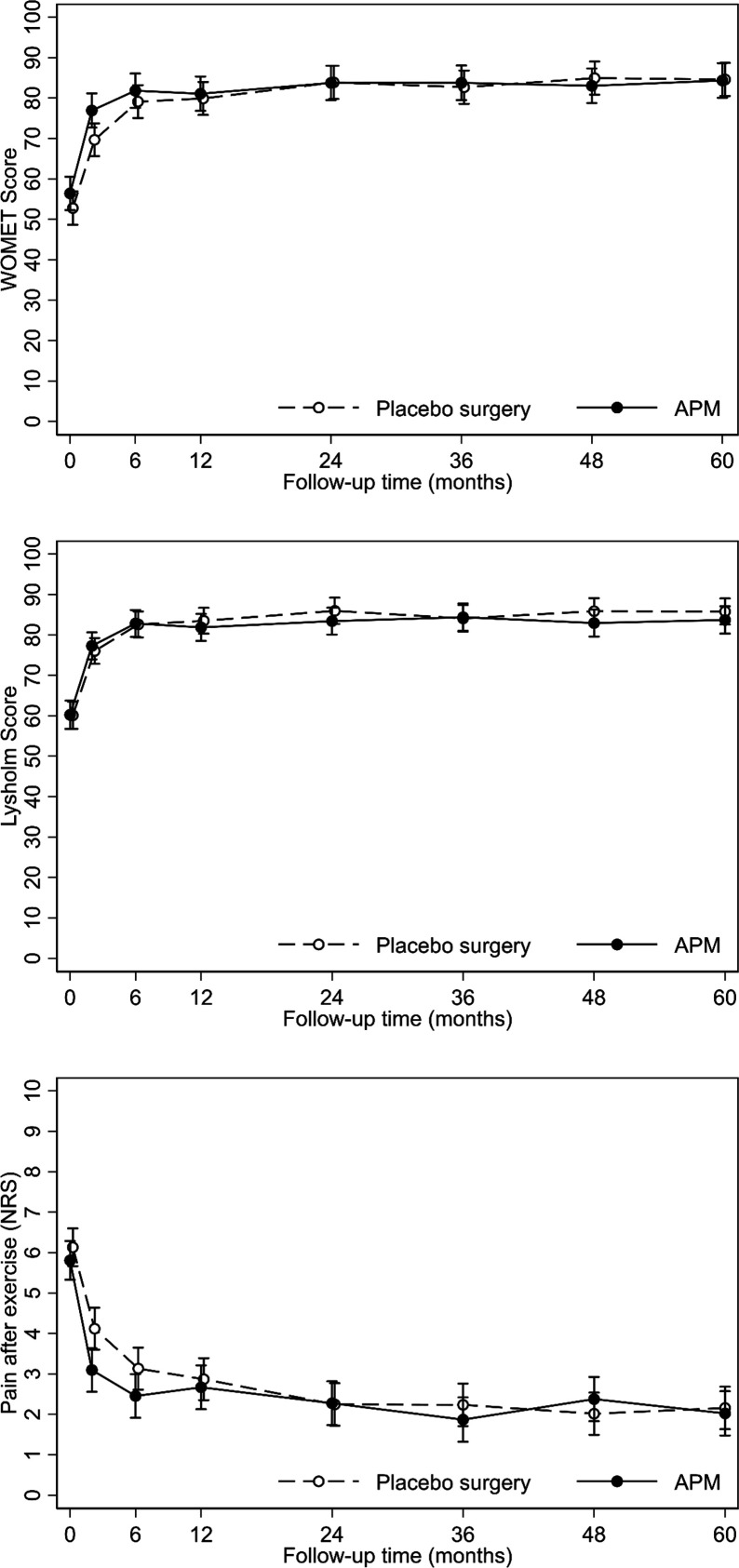
Main outcome measures: We used two indices of radiographic knee osteoarthritis (increase in Kellgren and Lawrence grade ≥1, and increase in Osteoarthritis Research Society International (OARSI) atlas radiographic joint space narrowing and osteophyte sum score, respectively), and three validated patient-relevant measures of knee symptoms and function (Western Ontario Meniscal Evaluation Tool (WOMET), Lysholm, and knee pain after exercise using a numerical rating scale).
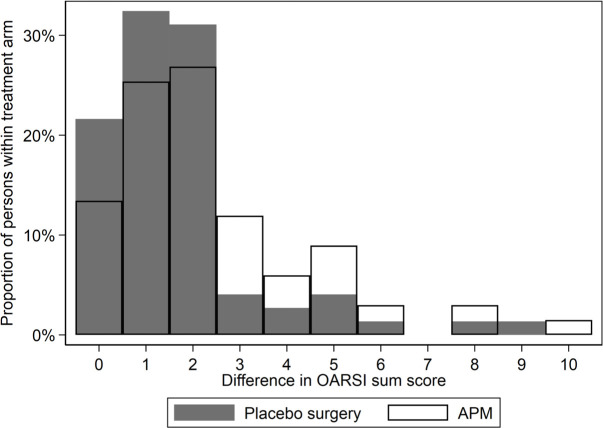
Results: There was a consistent, slightly greater risk for progression of radiographic knee osteoarthritis in the APM group as compared with the placebo surgery group (adjusted absolute risk difference in increase in Kellgren-Lawrence grade ≥1 of 13%, 95% CI -2% to 28%; adjusted absolute mean difference in OARSI sum score 0.7, 95% CI 0.1 to 1.3). There were no relevant between-group differences in the three patient-reported outcomes: adjusted absolute mean differences (APM vs placebo surgery), -1.7 (95% CI -7.7 to 4.3) in WOMET, -2.1 (95% CI -6.8 to 2.6) in Lysholm knee score, and -0.04 (95% CI -0.81 to 0.72) in knee pain after exercise, respectively. The corresponding adjusted absolute risk difference in the presence of mechanical symptoms was 18% (95% CI 5% to 31%); there were more symptoms reported in the APM group. All other secondary outcomes comparisons were similar.
Conclusions: APM was associated with a slightly increased risk of developing radiographic knee osteoarthritis and no concomitant benefit in patient-relevant outcomes, at 5 years after surgery.
Trial registration: ClinicalTrials.gov (NCT01052233 and NCT00549172).
Keywords: meniscus; osteoarthritis.
© Author(s) (or their employer(s)) 2020. Re-use permitted under CC BY. Published by BMJ.
Conflict of interest statement
Competing interests: All authors have completed the ICMJE uniform disclosure form at www.icmje.org/coi_disclosure.pdf and declare: no support from any organisation for the submitted work; no financial relationships with any organisations that might have an interest in the submitted work in the previous 3 years; no other relationships or activities that could appear to have influenced the submitted work.
Figures
Comment in
-
Arthroscopic partial meniscectomy for degenerative meniscus tears in middle age patients: why surgeons should change their approach.Br J Sports Med. 2020 Nov;54(22):1311-1312. doi: 10.1136/bjsports-2020-103330. Epub 2020 Sep 24. Br J Sports Med. 2020. PMID: 32972980 No abstract available.
References
-
- Hall MJ, Schwartzman A, Zhang J, et al. . Ambulatory surgery data from hospitals and ambulatory surgery centers: United States, 2010. Natl Health Stat Report 2017;102:1–15. - PubMed
-
- Abram SGF, Judge A, Beard DJ, et al. . Temporal trends and regional variation in the rate of arthroscopic knee surgery in England: analysis of over 1.7 million procedures between 1997 and 2017. Has practice changed in response to new evidence? Br J Sports Med 2019;53:1533–8. 10.1136/bjsports-2018-099414 - DOI - PubMed
Publication types
MeSH terms
Associated data
LinkOut - more resources
Full Text Sources
Medical
