Decline in stroke alerts and hospitalisations during the COVID-19 pandemic
- PMID: 32855352
- PMCID: PMC7453762
- DOI: 10.1136/svn-2020-000441
Decline in stroke alerts and hospitalisations during the COVID-19 pandemic
Abstract
Introduction: Patients with stroke-like symptoms may be underutilising emergency medical services and avoiding hospitalisation during the COVID-19 pandemic. We investigated a decline in admissions for stroke and transient ischaemic attack (TIA) and emergency department (ED) stroke alert activations.
Methods: We retrospectively compiled total weekly hospital admissions for stroke and TIA between 31 December 2018 and 21 April 2019 versus 30 December 2019 and 19 April 2020 at five US tertiary academic comprehensive stroke centres in cities with early COVID-19 outbreaks in Boston, New York City, Providence and Seattle. We collected available data on ED stroke alerts, stroke severity using the National Institutes of Health Stroke Scale (NIHSS) and time from symptom onset to hospital arrival.
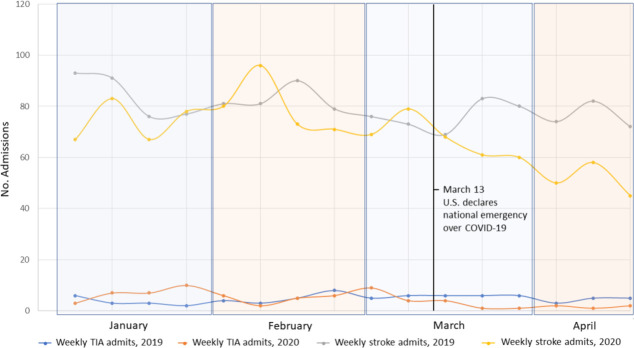
Results: Compared with 31 December 2018 to 21 April 2019, a decline in stroke/TIA admissions and ED stroke alerts occurred during 30 December 2019 to 19 April 2020 (p trend <0.001 for each). The declines coincided with state stay-at-home recommendations in late March. The greatest decline in hospital admissions was observed between 23 March and 19 April 2020, with a 31% decline compared with the corresponding weeks in 2019. Three of the five centres with 2019 and 2020 stroke alert data had a 46% decline in ED stroke alerts in late March and April 2020, compared with 2019. Median baseline NIHSS during these 4 weeks was 10 in 2020 and 7 in 2019. There was no difference in time from symptom onset to hospital arrival.
Conclusion: At these five large academic US hospitals, admissions for stroke and TIA declined during the COVID-19 pandemic. There was a trend for fewer ED stroke alerts at three of the five centres with available 2019 and 2020 data. Acute stroke therapies are time-sensitive, so decreased healthcare access or utilisation may lead to more disabling or fatal strokes, or more severe non-neurological complications related to stroke. Our findings underscore the indirect effects of this pandemic. Public health officials, hospital systems and healthcare providers must continue to encourage patients with stroke to seek acute care during this crisis.
Keywords: infection; stroke.
© Author(s) (or their employer(s)) 2020. Re-use permitted under CC BY-NC. No commercial re-use. See rights and permissions. Published by BMJ.
Conflict of interest statement
Competing interests: None declared.
Figures

Comment in
-
Letter to Editor: Collateral damage: impact of COVID-19 on stroke care in three downtown Los Angeles Community Hospitals.Acta Neurol Belg. 2022 Apr;122(2):541-543. doi: 10.1007/s13760-021-01615-3. Epub 2021 Mar 2. Acta Neurol Belg. 2022. PMID: 33651302 Free PMC article. No abstract available.
References
Publication types
MeSH terms
Grants and funding
LinkOut - more resources
Full Text Sources
Medical
Miscellaneous