. 2018 Summer:28:3-12.
doi: 10.1016/j.ddmod.2019.08.005. Epub 2019 Aug 29.

Model systems for the study of how symbiotic associations between animals and extracellular bacterial partners are established and maintained

Affiliations

Model systems for the study of how symbiotic associations between animals and extracellular bacterial partners are established and maintained

Eric J Koch et al. Drug Discov Today Dis Models. 2018 Summer.

Abstract

This contribution describes the current state of experimental model development and use as a strategy for gaining insight into the form and function of certain types of host-microbe associations. Development of quality models for the study of symbiotic systems will be critical not only to facilitate an understanding of mechanisms underlying symbiosis, but also for providing insights into how drug development can promote healthy animal-microbe interactions as well as the treatment of pathogenic infections. Because of the growing awareness over the last decade of the importance of symbiosis in biology, a number of model systems has emerged to examine how these partnerships are maintained within and across generations of the host. The focus here will be upon host-bacterial symbiotic systems that, as in humans, (i) are acquired from the environment each generation, or horizontally transmitted, and (ii) are defined by interactions at the interface of their cellular boundaries, i.e., extracellular symbiotic associations. As with the use of models in other fields of biology where complexity is daunting (e.g., developmental biology or brain circuitry), each model has its strengths and weaknesses, i.e., no one model system will provide easy access to all the questions defining what is conserved in cell-cell interactions in symbiosis and what creates diversity within such partnerships. Rather, as discussed here, the more models explored, the richer our understanding of these associations is likely to be.

Keywords: extracellular microbial partners; horizontally transmitted symbioses.


Figures
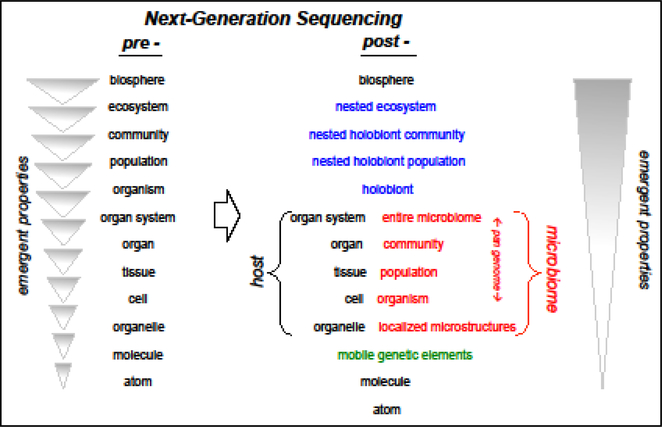
Fig. 1.
Fig. 1.. The larger arena in which model systems of symbiosis are developing.
A growing recognition of the complexity of symbiotic systems drives a conceptual change in our view of the hierarchy of life, one that reflects the nested nature of biological systems. Left: Before next-generation sequencing (‘pre-’), the increasing complexity of the hierarchical organization of biological systems was presumed to be one dimensional, with ‘emergent properties’ arising with each successive level of organization. The lack of continuity between levels (discrete triangles) represents the tendency for the field to be in sub-disciplinary silos focused on one or a few levels. Right: New data (‘post-’) have revealed a more complex hierarchy that incorporates the inherent nesting of the macro- and microbial worlds; blue, synthetic levels that represent the nesting of each successive level of the hierarchy; red, microbial elements that join with corresponding host levels to create the holobiont; green, a proposed additional level. While more complex, this view of the hierarchy could render predictions between levels more approachable, and lead to development of a more integrated view of the biosphere, represented by the single image of emergent properties.
Fig. 2.
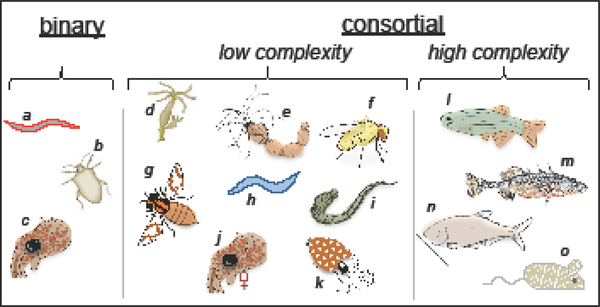
Fig. 2.. Some experimental models of extracellular, environmentally acquired, animal symbioses.
Living with a single animal host species -Left: the binary symbioses, one principal bacterial phylotype in a specific organ [hostsa, nematode Steindernema carpocapsae; b, stink bug, various species; c, bobtail squid, Euprymna scolopes. Middle: low complexity consortial symbioses, with only a few to dozens of phylotypes [hosts – d, Hydra spp.; e, starlet sea anemone, Nematostella vectensis; f, fruit fly, Drosophila melanogaster; g, honey bee, Apis mellifera; h, nematode, Caenorhaditis elegans; i, leech, Hirudo verbana; j, female bobtail squid, Euprymna scolopes; k, cuttlefish, Sepia officianalis.] Right: high complexity consortial symbioses, with hundreds to thousands of phylotypes [hosts l, zebrafish, Danio rerio; m, three- spine stickleback, Gasterosteus aculeatus; n, blind cavefish, Astyanax mexicanus; o, mouse, Mus musculus.

References

    1. McFall-Ngai M et al. (2013) Animals in a bacterial world, a new imperative for the life sciences. Proc. Natl. Acad. Sci. U. S. A 110, 3229–3236, doi: 10.1073/pnas.1218525110. - DOI - PMC - PubMed
    1. Bordenstein SR and Theis KR (2015) Host biology in light of the microbiome: ten principles of holobionts and hologenomes. PLoS Biol. 13, e1002226, doi: 10.1371/journal.pbio.1002226. - DOI - PMC - PubMed
    1. Morris JJ (2018) What is the hologenome concept of evolution? F1000Res. doi: 10.12688/f1000research.14385.1. eCollection 2018. - DOI - PMC - PubMed
    1. Lozupone CA, et al. (2012) Diversity, stability and resilience of the human gut microbiota. Nature 489, 220–230, doi: 10.1038/nature11550. - DOI - PMC - PubMed
    1. Pakkenberg B et al. (2003) Aging and the human neocortex. Exp. Gerontol 38, 95–99. - PubMed

LinkOut - more resources