. 2020 Oct;127(10):1399-1407.
doi: 10.1007/s00702-020-02244-5. Epub 2020 Aug 28.

Hedonicity in functional motor disorders: a chemosensory study assessing taste

Affiliations

Hedonicity in functional motor disorders: a chemosensory study assessing taste

Maria Paola Cecchini et al. J Neural Transm (Vienna). 2020 Oct.

Abstract

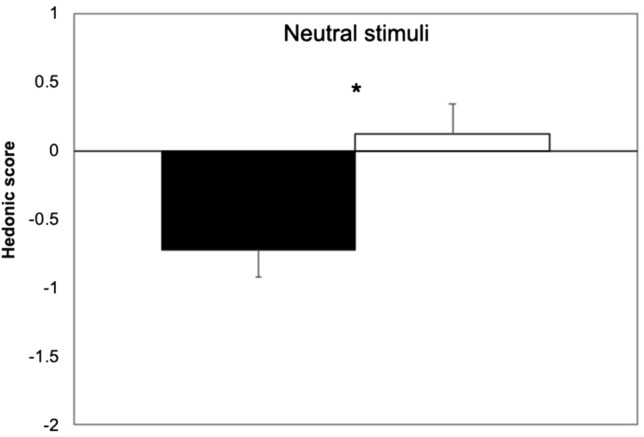
The aim of this study was to explore hedonicity to basic tastes in patients with functional motor disorders (FMDs) that are often associated with impairment in emotional processing. We recruited 20 FMD patients and 24 healthy subjects, matched for age and sex. Subjects were asked to rate the hedonic sensation (i.e., pleasant, neutral, and unpleasant) on a - 10 to +10 scale to the four basic tastes (sweet, sour, salty, and bitter) at different concentrations, and neutral stimuli (i.e., no taste stimulation) by means of the Taste Strips Test. Anxiety, depression, and alexithymia were assessed. FMD patients rated the highest concentration of sweet taste (6.7 ± 2.6) as significantly more pleasant than controls (4.7 ± 2.5, p = 0.03), and the neutral stimuli significantly more unpleasant (patients: - 0.7 ± 0.4, controls: 0.1 ± 0.4, p = 0.013). Hedonic ratings were not correlated to anxiety, depression, or alexithymia scores. Hedonic response to taste is altered in FMD patients. This preliminary finding might result from abnormal interaction between sensory processing and emotional valence.

Keywords: Functional motor disorders (FMD); Hedonicity; Taste.


Conflict of interest statement

The authors declare that they have no conflict of interest.

Figures
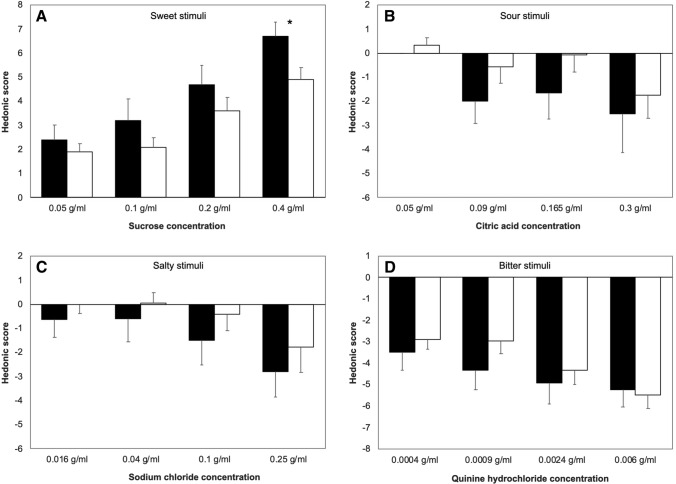
Fig. 1
Fig. 1
Hedonic score to sweet (panel a), sour (panel b), salty (panel c), and bitter (panel d) taste stimuli in patients (closed boxes) and controls (open boxes). *Marks p < 0.05. Vertical error bars equal 1 SEM
Fig. 2
Fig. 2
Hedonic score to neutral taste stimuli in patients (closed boxes) and controls (open boxes). *Marks p < 0.05. Vertical error bars equal 1 SEM

References

    1. Ajmani GS, Suh HH, Wroblewski KE, et al. Smoking and olfactory dysfunction: a systematic literature review and meta-analysis. Laryngoscope. 2017;127:1753–1761. doi: 10.1002/lary.26558. - DOI - PMC - PubMed
    1. Aybek S, Nicholson TR, O’Daly O, et al. Emotion-motion interactions in conversion disorder: an fMRI study. PLoS ONE. 2015;10:1–11. doi: 10.1371/journal.pone.0123273. - DOI - PMC - PubMed
    1. Bagby RM, Parker JDA, Taylor GJ. The twenty-item Toronto Alexithymia scale-I. Item selection and cross-validation of the factor structure. J Psychosom Res. 1994;38:23–32. doi: 10.1016/0022-3999(94)90005-1. - DOI - PubMed
    1. Beauchamp GK. Why do we like sweet taste: a bitter tale? Physiol Behav. 2016;164:432–437. doi: 10.1016/j.physbeh.2016.05.007. - DOI - PMC - PubMed
    1. Beyeler A, Chang CJ, Silvestre M, et al. Organization of valence-encoding and projection-defined neurons in the basolateral amygdala. Cell Rep. 2018;22:905–918. doi: 10.1016/j.celrep.2017.12.097. - DOI - PMC - PubMed

Publication types