Circulating Insulin-Like Growth Factor-1 and Risk of Total and 19 Site-Specific Cancers: Cohort Study Analyses from the UK Biobank
- PMID: 32856611
- PMCID: PMC7642199
- DOI: 10.1158/1055-9965.EPI-20-0743
Circulating Insulin-Like Growth Factor-1 and Risk of Total and 19 Site-Specific Cancers: Cohort Study Analyses from the UK Biobank
Abstract
Background: Insulin-like growth factor-1 (IGF-1) has been implicated in several malignancies, but few studies have examined multiple cancers simultaneously. We sought to conduct systematic assessments of the association between IGF-1 and cancer risk.
Methods: We conducted a prospective analysis between IGF-1 and incident total and 19 site-specific cancers among 412,645 individuals enrolled in the UK Biobank with follow-up to 2016. IGF-1 was measured using blood samples provided at the baseline examination. HR and 95% confidence interval (CI) were calculated with multivariable-adjusted Cox models with IGF-1 modeled both in sex-specific quintiles and continuously.
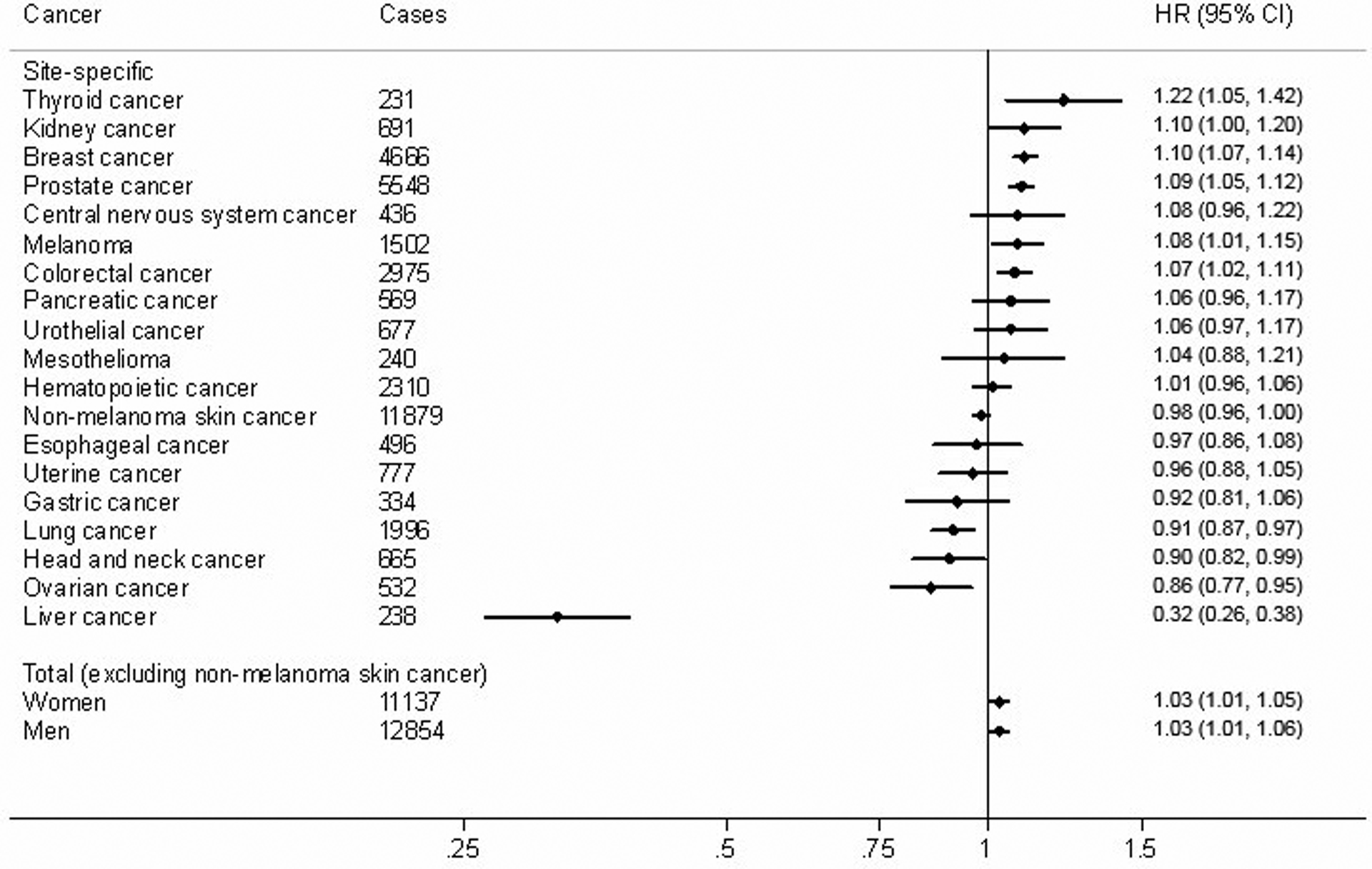
Results: Participants were followed for a median of 7.2 years. We observed positive associations between circulating IGF-1 and overall cancer risk for both men (HR = 1.03 per 5-nmol/L increment in IGF-1; 95% CI, 1.01-1.06) and women (HR = 1.03; 95% CI, 1.01-1.06). For specific sites, we observed positive associations for breast (HR = 1.10; 95% CI, 1.07-1.14), prostate (1.09; 95% CI, 1.05-1.12), colorectum (1.07; 95% CI, 1.02-1.11), melanoma (1.08; 95% CI, 1.01-1.15), kidney (1.10; 95% CI, 1.00-1.20), and thyroid (1.22; 95% CI, 1.05-1.42) and inverse associations for lung (0.91; 95% CI, 0.86-0.96), ovaries (0.86; 95% CI, 0.77-0.95), head and neck (0.90; 95% CI, 0.82-0.99), and liver (0.32; 95% CI, 0.26-0.38). The inverse association between IGF-1 and lung cancer was observed only in ever-smokers (HRever-smoker = 0.88 vs. HRnever-smoker = 1.14; Pinteraction = 0.0005). Analyses comparing extreme quintiles were consistent.
Conclusions: IGF-1 is modestly associated with increased risk of total cancer in both men and women but demonstrated divergent associations for site-specific cancers.
Impact: Our study suggests that IGF-1 could serve as a target for cancer prevention or treatment.
©2020 American Association for Cancer Research.
Conflict of interest statement
Figures
References
-
- Endogenous H, Breast Cancer Collaborative G, Key TJ, Appleby PN, Reeves GK, Roddam AW. Insulin-like growth factor 1 (IGF1), IGF binding protein 3 (IGFBP3), and breast cancer risk: pooled individual data analysis of 17 prospective studies. Lancet Oncol 2010;11(6):530–42 doi 10.1016/S1470-2045(10)70095-4. - DOI - PMC - PubMed
Publication types
MeSH terms
Substances
Grants and funding
LinkOut - more resources
Full Text Sources
Medical
Miscellaneous