


A new genetic locus for self-compatibility in the outcrossing grass species perennial ryegrass (Lolium perenne)
- PMID: 32856713
- PMCID: PMC8103805
- DOI: 10.1093/aob/mcaa140
A new genetic locus for self-compatibility in the outcrossing grass species perennial ryegrass (Lolium perenne)
Abstract
Background: Self-incompatibility (SI) is a physiological mechanism that many flowering plants employ to prevent self-fertilization and maintain heterozygosity. In the grass family this is known to be controlled by a two locus (S-Z) system; however, the SI system is intrinsically leaky. Modifier genes of both the S and Z loci and a further locus, T, are known to override SI leading to self-fertilization and self-seed production. This has implications for the ecological and evolutionary success as well as the commercial breeding of grasses. Here we report a study where the genetic control of self-compatibility (SC) was determined from the results of self-pollinating an F2 population of perennial ryegrass from two independently derived inbred lines produced by single-seed descent.
Methods: In vitro self-pollinations of 73 fertile plants were analysed. A genetic association analysis was made with a panel of 1863 single-nucleotide polymorphism (SNP) markers, generated through genotype-by-sequencing methodology. Markers were placed on a recombination map of seven linkage groups (LGs) created using Joinmap v.5. The seed set on self- and open-pollinated inflorescences was determined on 143 plants, including the 73 plants analysed for self-pollination response.
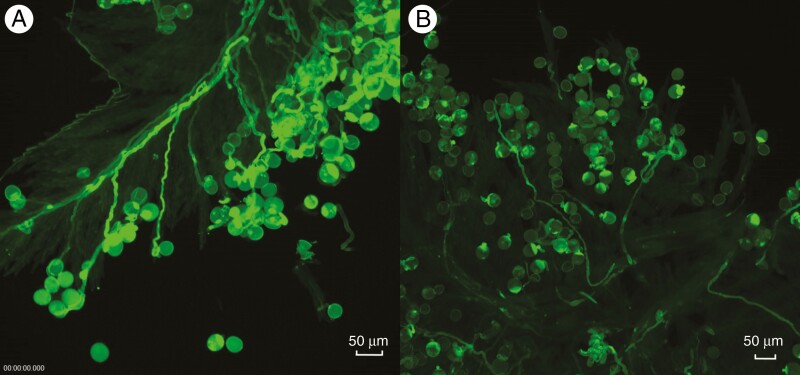
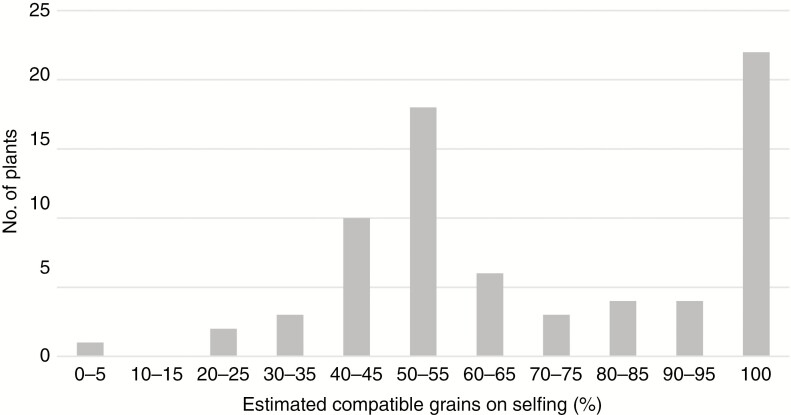
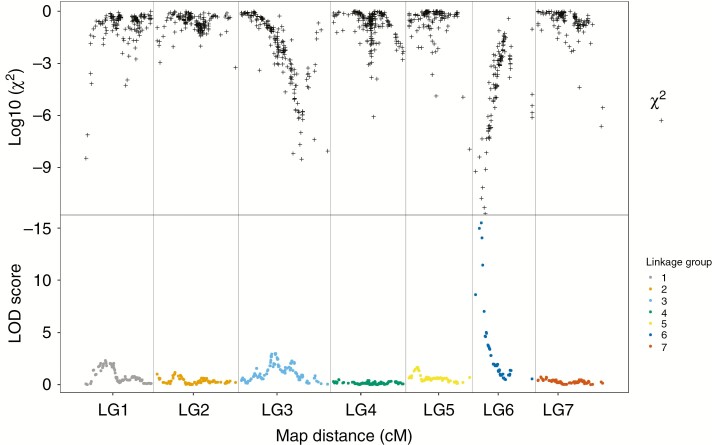
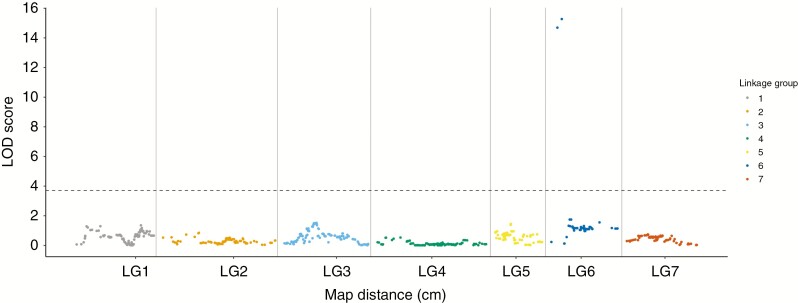
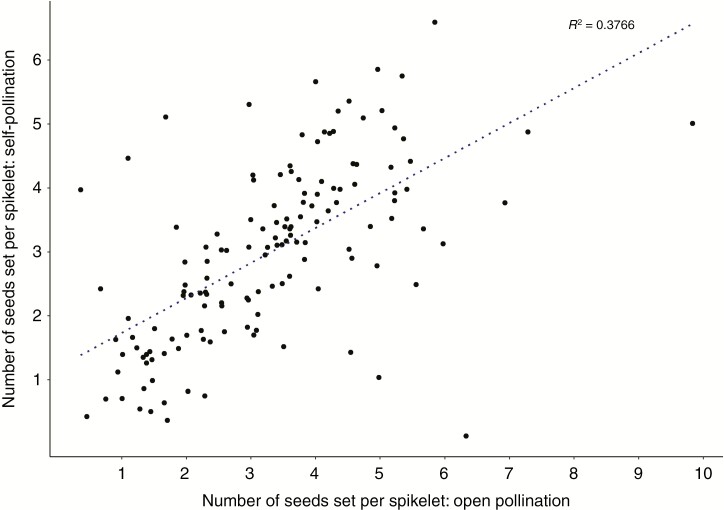
Key results: Self-pollinations revealed a bimodal distribution of percentage SC with peaks at 50 and 100 %. A single quantitative trait locus (QTL) was identified with peak association for marker 6S14665z17875_11873 that mapped to LG 6. Peak position was associated with maximum marker segregation distortion. The self-compatible plants were equally fecund after self- and open pollination.
Conclusions: This is the first report in the Poaceae family of an SC locus located on LG 6. This new SC QTL discovery, as well as indicating the complex nature of the pollen-stigma recognition process and its evolutionary significance, provides an additional source of SC for breeding perennial ryegrass.
Keywords: Genetic linkage map; Poaceae; genotyping by sequencing; heterosis; inbreeding; quantitative trait locus; reproductive assurance; self-incompatibility; single-nucleotide polymorphism.
© The Author(s) 2020. Published by Oxford University Press on behalf of the Annals of Botany Company.
Figures
Comment in
-
Genomic regulation of plant mating systems: flexibility and adaptative potential. A commentary on: 'A new genetic locus for self-compatibility in the outcrossing grass species perennial ryegrass (Lolium perenne)'.Ann Bot. 2021 May 7;127(6):iv-vi. doi: 10.1093/aob/mcab024. Ann Bot. 2021. PMID: 33754631 Free PMC article.
References
-
- Anhalt UCM, Heslop-Harrison PJ, Byrne S, Guillard A, Barth S. 2008. Segregation distortion in Lolium: evidence for genetic effects. Theoretical and Applied Genetics 117: 297–306. - PubMed
-
- Arias Aguirre A, Studer B, Do Canto J, Frei U, Lubberstedt T. 2013. Mapping a new source of self-fertility in perennial ryegrass (Lolium perenne L.). Plant Breeding and Biotechnology 1: 385–395.
-
- Bechsgaard J, Bataillon T, Schierup MH. 2004. Uneven segregation of sporophytic self-incompatibility alleles in Arabidopsis lyrata. Journal of Evolutionary Biology 17: 554–561. - PubMed
-
- Beddows AR. 1967. Lolium perenne L. Journal of Ecology 55: 567–587.
-
- Blanco-Pastor JL, Manel S, BarreP, et al. 2019. Pleistocene climate changes, and not agricultural spread, accounts for range expansion and admixture in the dominant grassland species Lolium perenne L. Journal of Biogeography 46: 1451–1465.
Publication types
MeSH terms
Grants and funding
LinkOut - more resources
Full Text Sources
Miscellaneous
