. 2020 Sep;95(9):1989-1999.
doi: 10.1016/j.mayocp.2020.06.018. Epub 2020 Jul 19.

Targeting TMPRSS2 in SARS-CoV-2 Infection

Affiliations

Targeting TMPRSS2 in SARS-CoV-2 Infection

Linda B Baughn et al. Mayo Clin Proc. 2020 Sep.

Abstract

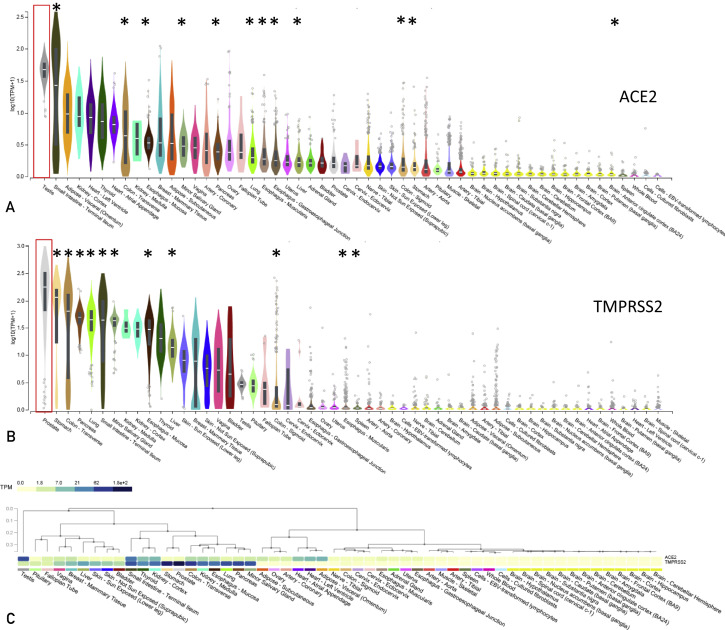
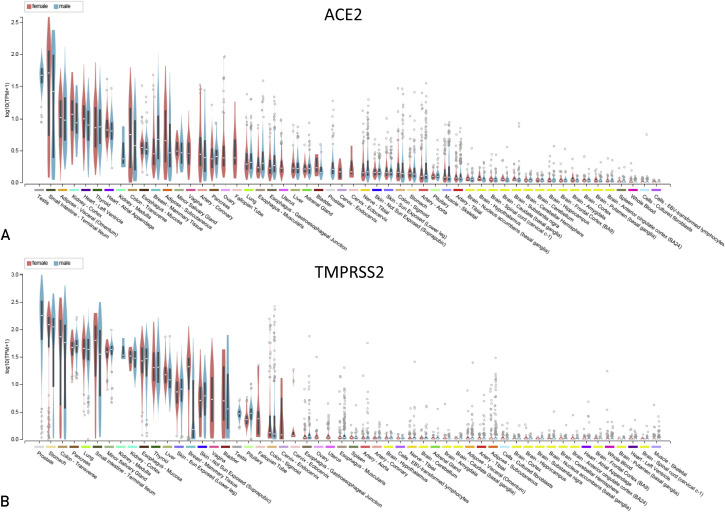
Severe acute respiratory syndrome-coronavirus 2 (SARS-CoV-2) has rapidly caused a global pandemic associated with a novel respiratory infection: coronavirus disease-19 (COVID-19). Angiotensin-converting enzyme-2 (ACE2) is necessary to facilitate SARS-CoV-2 infection, but-owing to its essential metabolic roles-it may be difficult to target it in therapies. Transmembrane protease serine 2 (TMPRSS2), which interacts with ACE2, may be a better candidate for targeted therapies. Using publicly available expression data, we show that both ACE2 and TMPRSS2 are expressed in many host tissues, including lung. The highest expression of ACE2 is found in the testes, whereas the prostate displays the highest expression of TMPRSS2. Given the increased severity of disease among older men with SARS-CoV-2 infection, we address the potential roles of ACE2 and TMPRSS2 in their contribution to the sex differences in severity of disease. We show that expression levels of ACE2 and TMPRSS2 are overall comparable between men and women in multiple tissues, suggesting that differences in the expression levels of TMPRSS2 and ACE2 in the lung and other non-sex-specific tissues may not explain the gender disparities in severity of SARS CoV-2. However, given their instrumental roles for SARS-CoV-2 infection and their pleiotropic expression, targeting the activity and expression levels of TMPRSS2 is a rational approach to treat COVID-19.


Figures

Figure 1
Figure 1
ACE2 and TMPRSS2 gene expression data. The data were obtained directly from the Genotype-Tissue Expression (GTEx) Project (https://gtexportal.org). Samples were sorted based on the median expression on a log scale using transcripts per million (TPM) unit. ACE2 (A) and TMPRSS2 (B) expression from all tissue samples available were plotted using the box plots available from the GTExPortal website with plots shown as median and 25th and 75th percentiles and dots displayed as outliers if they are above or below 1.5 times the interquartile range. Red boxes show the testes and prostate expression of ACE2 and TMPRSS2, respectively. Tissues associated with common COVID-19 symptoms are marked with an asterisk∗. In (C), a comparison of ACE2 and TMPRSS2 expression using GTEX tool multiGeneQueryPage.
Figure 2
Figure 2
Sex differences in TMPRSS2 and ACE2 expression data. The data were obtained directly from the Genotype-Tissue Expression (GTEx) Project (https://gtexportal.org). Female subjects (pink) and male subjects (blue) were arranged based on sorting using the median expression on a log scale using transcripts per million (TPM) unit. TMPRSS2 (A) or ACE2 (B) expression from all tissues available were plotted using the box plots available from the GTExPortal website with plots shown as median and 25th and 75th percentiles with dots displayed as outliers if they are above or below 1.5 times the interquartile range.
Figure 3
Figure 3
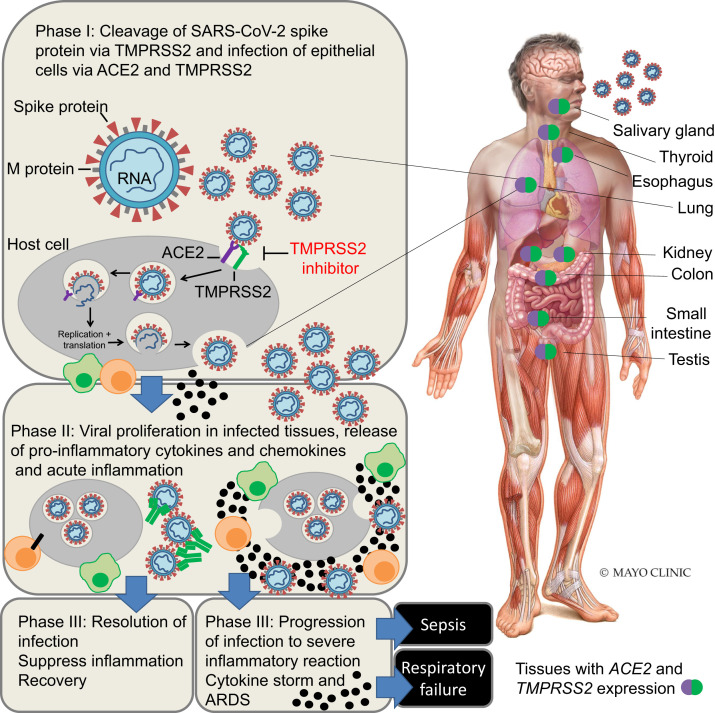
Schematic of SARS-CoV-2 infection of host tissue and disease pathogenesis. SARS-CoV-2 infects host cells (primarily epithelial cells) that express the host receptor, ACE2 and TMPRSS2, resulting in phase I of infection. In phase II, viral proliferation occurs in infected cells and this results in a local immune response, release of cytokines and chemokines (black circles), attraction of macrophages (green cell) and T cells (orange cell) to infected cells, and activation of further adaptive immune responses. In most cases, there is a healthy immune response, and infected cells are eliminated and further viral infection can be blocked by neutralizing antibodies (green). In this phase III of infection, there is a reduction of virus spread, resolution of infection, suppression of inflammation with limited tissue injury, and eventual recovery. However, in some cases of phase III of infection, the viral infection may lead to increased production of proinflammatory cytokines, resulting in a cytokine storm, causing multiorgan damage and acute respiratory distress syndrome (ARDS).
Figure 4
Figure 4
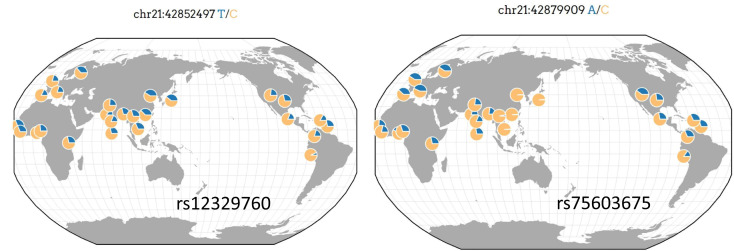
Allele frequency of 2 missense variants rs12329760 and rs75603675 in TMPRSS2 gene. The allele frequencies were calculated using the Geography of Genetic Variants Browser. Genomic positions in GRCh37.

References

    1. Huang C., Wang Y., Li X. Clinical features of patients infected with 2019 novel coronavirus in Wuhan, China. Lancet. 2020;395(10223):497–506. - PMC - PubMed
    1. Wang C., Horby P.W., Hayden F.G., Gao G.F. A novel coronavirus outbreak of global health concern. Lancet. 2020;395(10223):470–473. - PMC - PubMed
    1. Zhu N., Zhang D., Wang W. A novel coronavirus from patients with pneumonia in China, 2019. N Engl J Med. 2020;382:727–733. - PMC - PubMed
    1. Dong E., Du H., Gardner L. An interactive web-based dashboard to track COVID-19 in real time. Lancet Infect Dis. 2020;20(5):533–534. - PMC - PubMed
    1. Zhou P., Yang X.L., Wang X.G. A pneumonia outbreak associated with a new coronavirus of probable bat origin. Nature. 2020;579(7798):270–273. - PMC - PubMed