Review
. 2020 Nov:75:109761.
doi: 10.1016/j.cellsig.2020.109761. Epub 2020 Aug 28.

The multifaceted role of plasminogen in inflammation

Affiliations
Review

The multifaceted role of plasminogen in inflammation

Beate Heissig et al. Cell Signal. 2020 Nov.

Abstract

A fine-tuned activation and deactivation of proteases and their inhibitors are involved in the execution of the inflammatory response. The zymogen/proenzyme plasminogen is converted to the serine protease plasmin, a key fibrinolytic factor by plasminogen activators including tissue-type plasminogen activator (tPA). Plasmin is part of an intricate protease network controlling proteins of initial hemostasis/coagulation, fibrinolytic and complement system. Activation of these protease cascades is required to mount a proper inflammatory response. Although best known for its ability to dissolve clots and cleave fibrin, recent studies point to the importance of fibrin-independent functions of plasmin during acute inflammation and inflammation resolution. In this review, we provide an up-to-date overview of the current knowledge of the enzymatic and cytokine-like effects of tPA and describe the role of tPA and plasminogen receptors in the regulation of the inflammatory response with emphasis on the cytokine storm syndrome such as observed during coronavirus disease 2019 or macrophage activation syndrome. We discuss tPA as a modulator of Toll like receptor signaling, plasmin as an activator of NFkB signaling, and summarize recent studies on the role of plasminogen receptors as controllers of the macrophage conversion into the M2 type and as mediators of efferocytosis during inflammation resolution.

Keywords: COVID-19; Coagulation; Complement; Cytokine; Cytokine storm syndrome; DIC; LRP1; Macrophage activation syndrome; Matrix metalloproteinase; NFkB; PAR; Plasmin; Plasminogen; Plasminogen receptor; Toll like recepotor; tPA.


Figures

Unlabelled Image
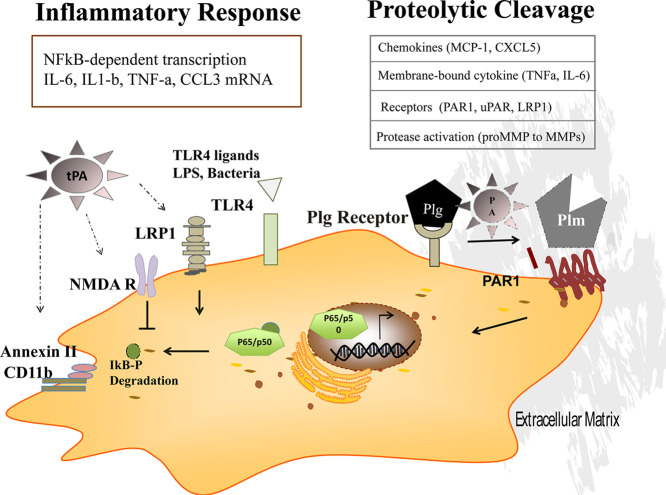
Graphical abstract
Fig. 1
Fig. 1
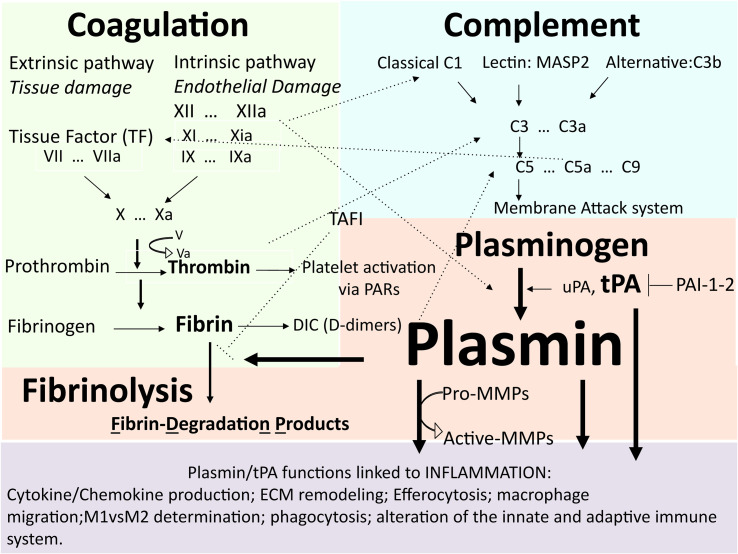
The inflammatory response: when the fibrinolytic system, coagulation, and the complement system talk to each other. Factors of the coagulation, complement, and fibrinolytic system interact. The imbalance of these proteins can be the cause or the reason for thrombosis and inflammation. During inflammation, tissue damage inflicted by microbes or non-microbial stressors activates the coagulation system. Thrombin generates fibrin and enhances platelet activation and their growth factor release through protease activated receptors (PARs). Tissue-type plasminogen activator (tPA) and urokinase plasminogen activator (uPA) activate the inactive proenzyme/zymogen plasminogen (Plg) into active plasmin (Plm). Plasminogen activators are inhibited by plasminogen activator inhibitor-1, −2 (PAI-1, PAI-2), and protein C inhibitor (PCI). Plm functions include its ability to activate complement C3a and C5a, degrade fibrin into fibrinogen degradation products leading to fibrin fragments like the D-dimers, convert the proenzymes of matrix metalloproteinases (MMPs) to their active forms, regulate extracellular matrix (ECM) turnover (remodeling), and contribute to inflammation resolution (efferocytosis, M1 to M2 switch).
Fig. 2
Fig. 2
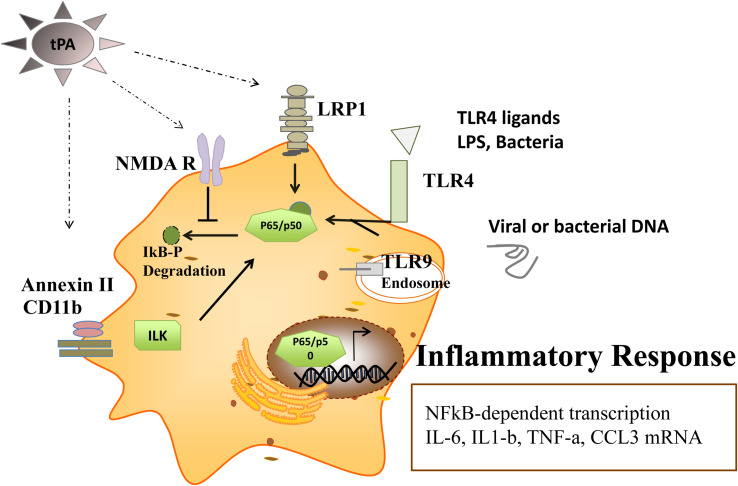
Receptor-mediated tPA signaling modulates the TLR-induced inflammatory response. TLR stimulation by bacterial LPS (TLR4) or viral or bacterial DNA/RNA (TLR9) induces transcription factor NFkB signaling in macrophages. NFkB translocation into the nucleus promotes the transcription of inflammatory response genes like interleukin-6, IL-1b, TNFa, chemokines like IP-10, MCP1 (CCL2), and MIP1 (CCL3). tPA can modify the TLR-mediated inflammatory response in a manner dependent on its interaction with tPA-associated receptors like low-density lipoprotein receptor-related protein-1 (LRP1) or the N-methyl-D-aspartic acid receptor (NMDA R), or AnnexinII/11b complex.
Fig. 3
Fig. 3
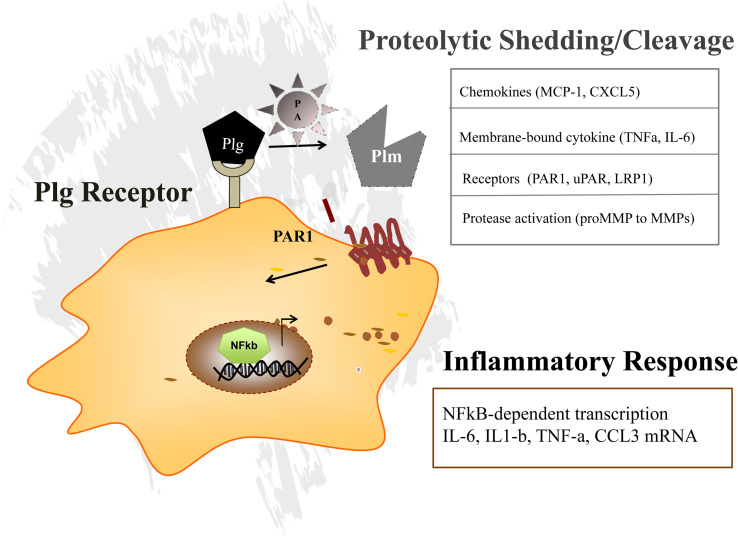
Plasminogen receptors localize plasmin generation to the pericellular space, thereby promoting signaling receptor shedding (e.g. PAR1). Plg receptors present Plg and enhance plasminogen activator (PA) mediated pericellular plasmin (Plm) generation. The proteolytic activity of Plm is required to activate PAR1 signaling or for shedding or cleavage of other proteases (MMPs) as well as in signaling by other molecules like cytokines or cellular receptors.

References

    1. Chen L., Deng H., Cui H., Fang J., Zuo Z., Deng J., Li Y., Wang X., Zhao L. Oncotarget. 2017;9:7204–7218. - PMC - PubMed
    1. Hosoya S., Ohbayashi E., Matsushima K., Takeuchi H., Yamazaki M., Shibata Y., Abiko Y. J. Endod. 1998;24:331–334. - PubMed
    1. Heissig B., Eiamboonsert S., Salama Y., Shimazu H., Dhahri D., Munakata S., Tashiro Y., Hattori K. Adv. Drug Deliv. Rev. 2016;99:172–179. - PubMed
    1. Levi M. Int. J. Lab. Hematol. 2018;40(Suppl. 1):15–20. - PubMed
    1. Renné T., Stavrou E.X. Front. Immunol. 2019;10 - PMC - PubMed

Publication types

MeSH terms

LinkOut - more resources