


Early life exposure to per- and polyfluoroalkyl substances (PFAS) and latent health outcomes: A review including the placenta as a target tissue and possible driver of peri- and postnatal effects
- PMID: 32861749
- PMCID: PMC7530144
- DOI: 10.1016/j.tox.2020.152565
Early life exposure to per- and polyfluoroalkyl substances (PFAS) and latent health outcomes: A review including the placenta as a target tissue and possible driver of peri- and postnatal effects
Abstract
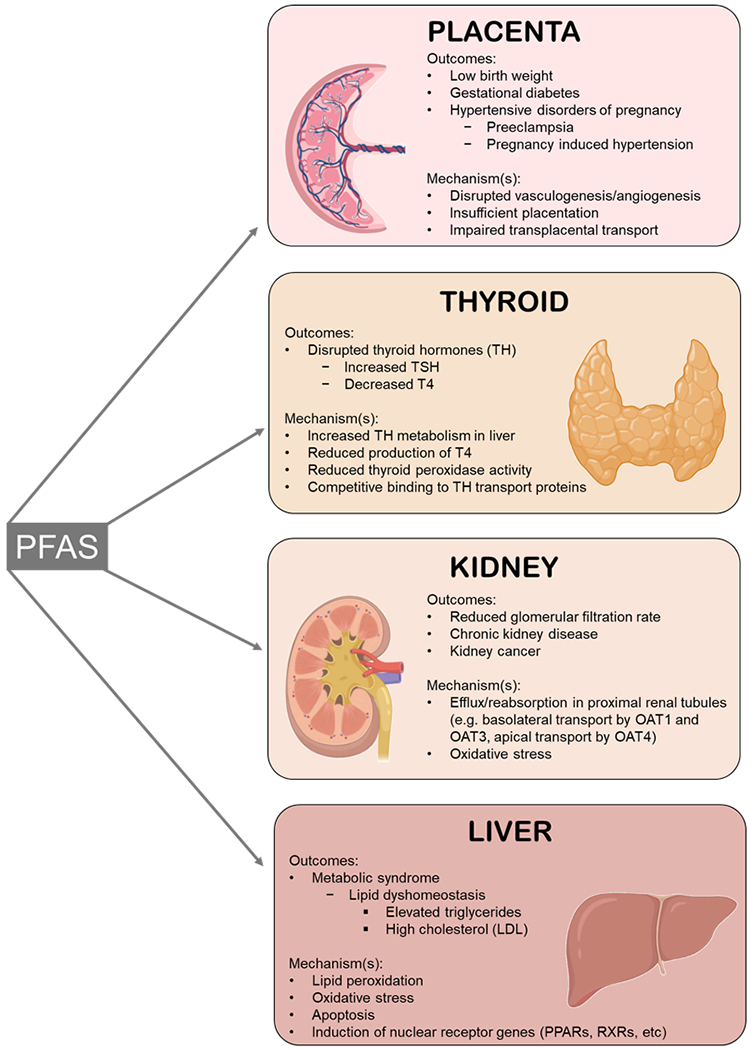
Per- and polyfluoroalkyl substances (PFAS) are ubiquitous drinking water contaminants of concern due to mounting evidence implicating adverse health outcomes associated with exposure, including reduced kidney function, metabolic syndrome, thyroid disruption, and adverse pregnancy outcomes. PFAS have been produced in the U.S. since the 1940s and now encompass a growing chemical family comprised of diverse chemical moieties, yet the toxicological effects have been studied for relatively few compounds. Critically, exposures to some PFAS in utero are associated with adverse outcomes for both mother and offspring, such as hypertensive disorders of pregnancy (HDP), including preeclampsia, and low birth weight. Given the relationship between HDP, placental dysfunction, adverse health outcomes, and increased risk for chronic diseases in adulthood, the role of both developmental and lifelong exposure to PFAS likely contributes to disease risk in complex ways. Here, evidence for the role of some PFAS in disrupted thyroid function, kidney disease, and metabolic syndrome is synthesized with an emphasis on the placenta as a critical yet understudied target of PFAS and programming agent of adult disease. Future research efforts must continue to fill the knowledge gap between placental susceptibility to environmental exposures like PFAS, subsequent perinatal health risks for both mother and child, and latent health effects in adult offspring.
Copyright © 2020 Elsevier B.V. All rights reserved.
Conflict of interest statement
Declaration of interests
The authors declare that they have no known competing financial interests or personal relationships that could have appeared to influence the work reported in this paper.
Figures
References
-
- 3M 2000. 26-week capsule toxicity study with perfluorooctane sulfonic acid potassium salt (PFOS; T-6295) in cynomolgus monkeys. Administrative Record AR226-0145. URL: https://www.documentcloud.org/documents/4346742-US00004524.html
-
- 822-R-16-005 US EPA. 2016. Drinking water health advisory for perfluorooctanoic acid (pfoa). URL: https://www.epa.gov/sites/production/files/2016-05/documents/pfoa_health...
-
- Abbott BD, Wood CR, Watkins AM, Tatum-Gibbs K, Das KP, Lau C. 2012. Effects of perfluorooctanoic acid (pfoa) on expression of peroxisome proliferator-activated receptors (ppar) and nuclear receptor-regulated genes in fetal and postnatal cd-1 mouse tissues. Reproductive Toxicology 33:491–505. - PubMed
-
- Agency for Toxic Substances and Disease Registry (ATSDR). 2015. Toxicological profile for perfluoroalkyls. Atlanta, GA: Agency for Toxic Substances and Disease Registry, U.S. Department of Health and Human Services, Public Health Service; URL: https://www.atsdr.cdc.gov/toxprofiles/tp.asp?id=1117&tid=237 [acessed July 7, 2019].
-
- Agency for Toxic Substances and Disease Registry (ATSDR). 2017. Perfluoroalkyl and polyfluoroalkyl substances (pfas) in the u.s. population. URL: https://www.atsdr.cdc.gov/pfas/pfas-in-population.html [accessed July 7, 2019].
Publication types
MeSH terms
Substances
Grants and funding
LinkOut - more resources
Full Text Sources
Other Literature Sources
Miscellaneous
