Review
. 2021 Feb;12(1):1-14.
doi: 10.1007/s12975-020-00841-w. Epub 2020 Aug 29.

Neurogenesis After Stroke: A Therapeutic Perspective

Affiliations
Review

Neurogenesis After Stroke: A Therapeutic Perspective

Abir A Rahman et al. Transl Stroke Res. 2021 Feb.

Abstract

Stroke is a major cause of death and disability worldwide. Yet therapeutic strategies available to treat stroke are very limited. There is an urgent need to develop novel therapeutics that can effectively facilitate functional recovery. The injury that results from stroke is known to induce neurogenesis in penumbra of the infarct region. There is considerable interest in harnessing this response for therapeutic purposes. This review summarizes what is currently known about stroke-induced neurogenesis and the factors that have been identified to regulate it. Additionally, some key studies in this field have been highlighted and their implications on future of stroke therapy have been discussed. There is a complex interplay between neuroinflammation and neurogenesis that dictates stroke outcome and possibly recovery. This highlights the need for a better understanding of the neuroinflammatory process and how it affects neurogenesis, as well as the need to identify new mechanisms and potential modulators. Neuroinflammatory processes and their impact on post-stroke repair have therefore also been discussed.

Keywords: Cytokines; Neurogenesis; Neuroinflammation; Stroke; Stroke therapy.


Conflict of interest statement

The authors declare that they have no conflict of interest.

Figures
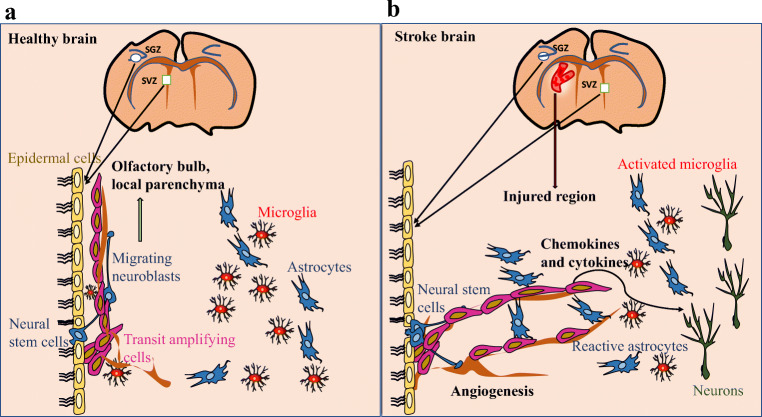
Fig. 1
Fig. 1
Schematic representation of adult neurogenesis in rodents. a Healthy brains: Neural stem cells proliferate from the SVZ and SGZ form neuroblasts that migrate to the olfactory bulb and local parenchyma. b Stroke brains: There is pronounced loss of striatal and cortical neurons, giving rise to increased proliferation of progenitors. The neuroblasts formed before and after the stroke migrate to the site of injury, influenced by chemokines and cytokines secreted by resident and activated microglia, reactive astrocytes, etc. The neuroblasts then differentiate into newborn neurons coupled with angiogenesis at the site of injury, giving rise to mature neurons

References

    1. Ojaghihaghighi S, Vahdati SS, Mikaeilpour A, Ramouz A. Comparison of neurological clinical manifestation in patients with hemorrhagic and ischemic stroke. World J Emerg Med. 2017;8(1):34–38. doi: 10.5847/wjem.j.1920-8642.2017.01.006. - DOI - PMC - PubMed
    1. Jayaraj RL, Azimullah S, Beiram R, Jalal FY, Rosenberg GA. Neuroinflammation: friend and foe for ischemic stroke. J Neuroinflammation. 2019;16(1):142. doi: 10.1186/s12974-019-1516-2. - DOI - PMC - PubMed
    1. Prabhakaran S, Ruff I, Bernstein RA. Acute stroke intervention: a systematic review. JAMA. 2015;313(14):1451–1462. doi: 10.1001/jama.2015.3058. - DOI - PubMed
    1. Dorado L, Millan M, Davalos A. Reperfusion therapies for acute ischemic stroke: an update. Curr Cardiol Rev. 2014;10(4):327–335. doi: 10.2174/1573403x10666140320144637. - DOI - PMC - PubMed
    1. Fan L, Zhang CJ, Zhu L, Chen J, Zhang Z, Liu P, Cao X, Meng H, Xu Y. FasL-PDPK1 pathway promotes the cytotoxicity of CD8(+) T cells during ischemic stroke. Transl Stroke Res. 2020;11:747–761. doi: 10.1007/s12975-019-00749-0. - DOI - PubMed

Publication types

Substances
