


Genetic Endowments and Wealth Inequality
- PMID: 32863431
- PMCID: PMC7448697
- DOI: 10.1086/705415
Genetic Endowments and Wealth Inequality
Abstract
We show that genetic endowments linked to educational attainment strongly and robustly predict wealth at retirement. The estimated relationship is not fully explained by flexibly controlling for education and labor income. We therefore investigate a host of additional mechanisms that could account for the gene-wealth gradient, including inheritances, mortality, risk preferences, portfolio decisions, beliefs about the probabilities of macroeconomic events, and planning horizons. We provide evidence that genetic endowments related to human capital accumulation are associated with wealth not only through educational attainment and labor income, but also through a facility with complex financial decision-making.
Keywords: Beliefs; D14; D31; Education and Genetics; G11; H55; I24; Inequality; J24; Portfolio Decisions; Wealth.
Figures
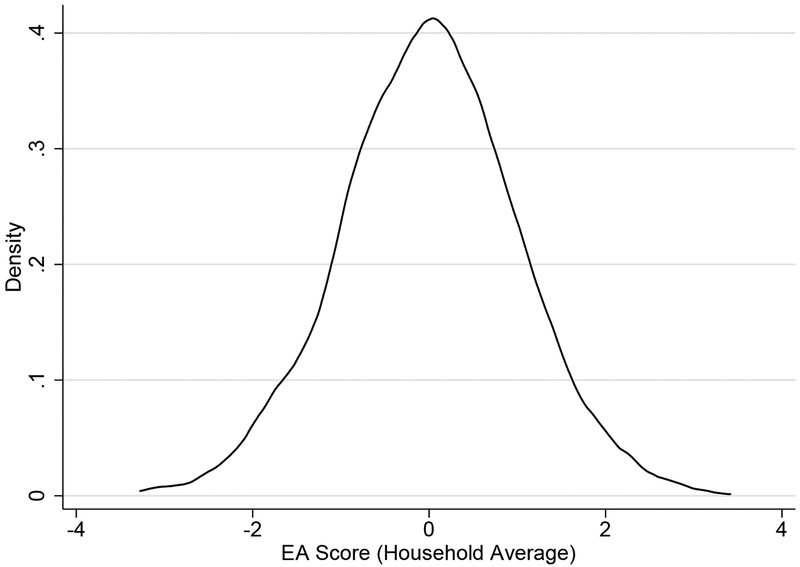
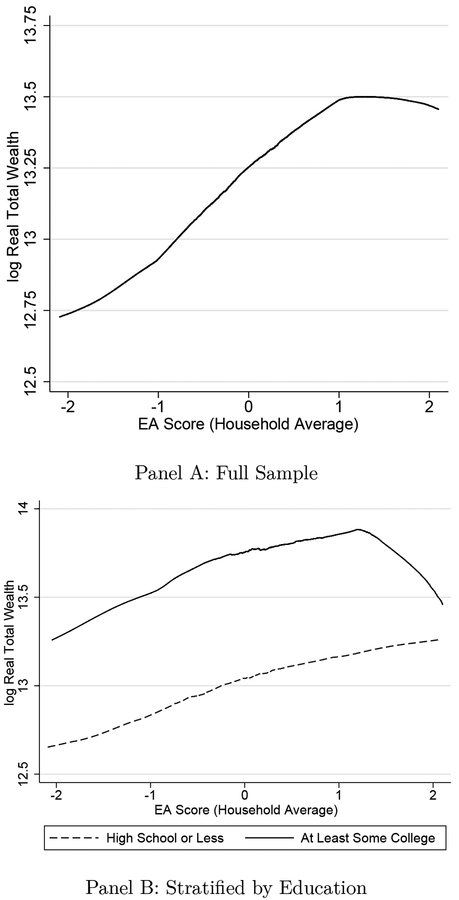
References
-
- Abdulkadiroğlu Atila, Angrist Joshua, and Pathak Parag. 2014. “The Elite Illusion: Achievement Effects at Boston and New York Exam Schools.” Econometrica 82 (1):137–196.
-
- Angrist Joshua D, Cohodes Sarah R, Dynarski Susan M, Pathak Parag A, and Walters Christopher R. 2016. “Stand and Deliver: Effects of Boston’s Charter High Schools on College Preparation, Entry, and Choice.” Journal of Labor Economics 34 (2):275–318.
-
- Arrondel Luc, Calvo Pardo Hector F, and Tas Derya. 2014. “Subjective Return Expectations, Information and Stock Market Participation: Evidence from France” Manuscript, University of Southampton.
-
- Bach Stefan, Thiemann Andreas, and Zucco Aline. 2015. “The Top Tail of the Wealth Distribution in Germany, France, Spain, and Greece” Discussion Paper no. 1502, DIW; Berlin.
-
- Beauchamp Jonathan P., Cesarini David, Johannesson Magnus, van der Loos Matthijs J. H. M., Koellinger Philipp D., Groenen Patrick J.F., Fowler James H., Rosenquist J. Niels, Thurik A. Roy, and Christakis Nicholas A.. 2011. “Molecular Genetics and Economics.” Journal of Economic Perspectives 25 (4):57–82. - PMC - PubMed
Grants and funding
LinkOut - more resources
Full Text Sources