


Amy ty lilin-draza'ay: Building Archaeological Practice on Principles of Community
- PMID: 32863520
- PMCID: PMC7447962
- DOI: 10.1007/s10437-020-09404-8
Amy ty lilin-draza'ay: Building Archaeological Practice on Principles of Community
Abstract
The significant economic and health impacts of the COVID-19 pandemic have forced archaeologists to consider the concept of resilience in the present day, as it relates to their profession, students, research projects, cultural heritage, and the livelihoods and well-being of the communities with a stake in the sites they study. The global crisis presents an opportunity to cement archaeological practice in a foundation of community building. We can learn from the ancestors, razana, how investing in community-social networks at different scales-makes us more resilient to crises. In so doing, we can improve the quality and equity of the science we produce and ensure relevant outcomes for living communities and future generations.
Les impacts économiques et de santé considérables de la pandémie COVID-19 obligent les archéologues à considérer le concept de résilience à l'heure actuelle, en ce qui concerne leur profession, leurs étudiants, leurs projets de recherche, le patrimoine culturel et les modes de vie et le bien-être des communautés ayant un intérêt dans les sites qu'ils étudient. La crise mondiale offre une opportunité de cimenter la pratique archéologique dans un fondement communautaire. Nous pouvons apprendre de nos ancêtres, les razana, que le fait d'investir dans des réseaux communautaires et sociaux à différentes échelles nous rend plus résistants aux crises. Ce faisant, nous pouvons améliorer la qualité et l'équité de la science que nous produisons et garantir des résultats pertinents pour les communautés vivantes et les générations futures.
Keywords: Ancestors; Community building; Intergenerational knowledge; Resilience.
© Springer Science+Business Media, LLC, part of Springer Nature 2020.
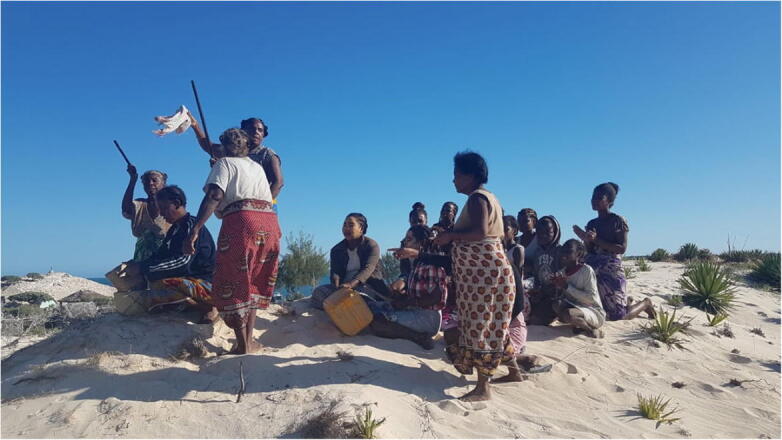
Figures
References
-
- Capoeira N. Capoeira: Roots of the dance-fight-game. Berkeley: Blue Snake Books; 2002.
-
- Chirikure S. “Do as I say and not as I do”: On the gap between good ethics and reality in African archaeology. In: Haber A, Shepherd N, editors. After Ethics. New York: Springer; 2015. pp. 27–37.
-
- Chirikure, S. (2020). Archaeology shows how ancient African societies managed pandemics. The Conversationhttps://theconversation.com/archaeology-shows-how-ancient-african-societ.... Accessed 27 July 2020.
-
- Dávalos LM, Austin RM, Balisi MA, Begay RL, Hofman CA, Kemp ME, Lund JR, Monroe C, Mychajliw AM, Nelson EA, Nieves-Colón MA, Redondo SA, Sabin S, Tsosie KS, Yracheta JM. Pandemics’ historical role in creating inequality. Science. 2020;368(6497):1322–1323. - PubMed
-
- Douglass K, Morales EQ, Manahira G, Fenomanana F, Samba R, Lahiniriko F, Chrisostome ZM, Vavisoa V, Soafiavy P, Justome R, Leonce H, Hubertine L, Pierre BV, Tahirisoa C, Colomb CS, Lovanirina FS, Andriankaja V, Robison R. Toward a just and inclusive environmental archaeology of southwest Madagascar. Journal of Social Archaeology. 2019;19(3):307–332. doi: 10.1177/1469605319862072. - DOI
LinkOut - more resources
Full Text Sources