


A non-central beta model to forecast and evaluate pandemics time series
- PMID: 32863610
- PMCID: PMC7443326
- DOI: 10.1016/j.chaos.2020.110211
A non-central beta model to forecast and evaluate pandemics time series
Abstract
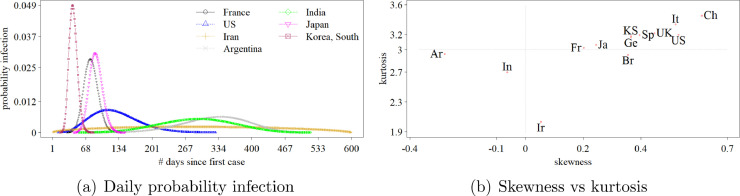
Government, researchers, and health professionals have been challenged to model, forecast, and evaluate pandemics time series (e.g. new coronavirus SARS-CoV-2, COVID-19). The main difficulty is the level of novelty imposed by these phenomena. Information from previous epidemics is only partially relevant. Further, the spread is local-dependent, reflecting a number of social, political, economic, and environmental dynamic factors. The present paper aims to provide a relatively simple way to model, forecast, and evaluate the time incidence of a pandemic. The proposed framework makes use of the non-central beta (NCB) probability density function. Specifically, a probabilistic optimisation algorithm searches for the best NCB model of the pandemic, according to the mean square error metric. The resulting model allows one to infer, among others, the general peak date, the ending date, and the total number of cases as well as to compare the level of difficult imposed by the pandemic among territories. Case studies involving COVID-19 incidence time series from countries around the world suggest the usefulness of the proposed framework in comparison with some of the main epidemic models from the literature (e.g. SIR, SIS, SEIR) and established time series formalisms (e.g. exponential smoothing - ETS, autoregressive integrated moving average - ARIMA).
Keywords: COVID-19; Forecasting; Optimisation; Pandemic models; Time series.
© 2020 Elsevier Ltd. All rights reserved.
Conflict of interest statement
The authors declare that they have no known competing financial interests or personal relationships that could have appeared to influence the work reported in this paper.
Figures
References
-
- Organization W.H.. Coronavirus disease (COVID-19) outbreak situation. 2020. https://www.who.int/emergencies/diseases/novel-coronavirus-2019.
-
- Kermack W.O., McKendrick A.G. A contribution to the mathematical theory of epidemics. Proc R Soc London Ser A, Contain Paper Math Phys Character. 1927;115(772):700–721.
LinkOut - more resources
Full Text Sources
Miscellaneous
