


Novel hematological biomarkers predict survival in renal cell carcinoma patients treated with nephrectomy
- PMID: 32863995
- PMCID: PMC7444725
- DOI: 10.5114/aoms.2017.70250
Novel hematological biomarkers predict survival in renal cell carcinoma patients treated with nephrectomy
Abstract
Introduction: The association between novel blood-based inflammatory indices and patient survival has been reported with reference to various cancers. The aim of this study was to investigate the prognostic value of preoperative platelet-lymphocyte ratio (PLR), neutrophil-lymphocyte ratio (NLR), derived neutrophil-lymphocyte ratio (dNLR) and lymphocyte-monocyte ratio (LMR) in patients with renal cell carcinoma (RCC) treated with nephrectomy.
Material and methods: From 2003 to 2012, 455 patients who underwent partial or radical nephrectomy for RCC were enrolled in the study. The study endpoints were overall survival (OS) and cancer-specific survival (CSS).
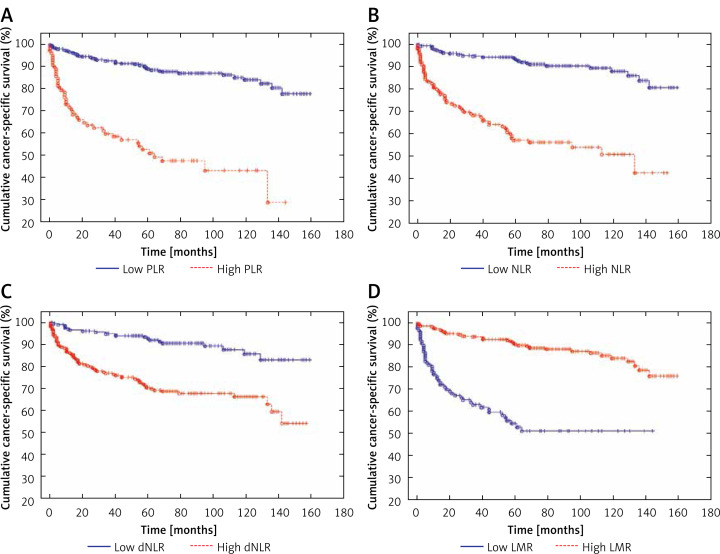
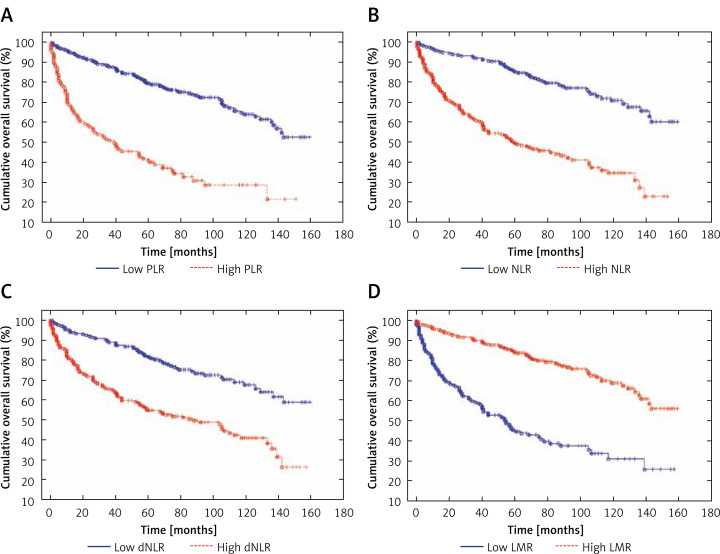
Results: The median follow-up was 70 months. Groups of patients with high levels of PLR, NLR and dNLR and a low level of LMR more often underwent radical nephrectomy, had a higher cancer stage in the TNM classification, and were more frequently diagnosed with tumor necrosis in histopathological examination. Both cancer-specific mortality and overall mortality were significantly higher in patients with high PLR, NLR and dNLR and low LMR. Multivariate analysis of CSS, adjusted for standard clinicopathological factors, identified only dNLR (p = 0.006) as an independent prognostic factor. PLR (p = 0.0002), dNLR (p = 0.0003) and NLR (p = 0.002), but not LMR (p = 0.1), achieved prognostic significance in multivariable analysis regarding OS.
Conclusions: Only dNLR was an independent prognostic factor for CSS and OS. Nevertheless, our study indicates that all examined complete blood count-based biomarkers may be useful tools in managing RCC patients treated with a surgical approach.
Keywords: derived neutrophil-lymphocyte ratio; lymphocyte-monocyte ratio; neutrophil-lymphocyte ratio; platelet-lymphocyte ratio; renal cell cancer; renal cell carcinoma.
Copyright: © 2017 Termedia & Banach.
Conflict of interest statement
The authors declare no conflict of interest.
Figures
References
-
- Siegel RL, Miller KD, Jemal A. Cancer statistics, 2017. CA Cancer J Clin. 2017;67:7–30. - PubMed
-
- Ljungberg B, Campbell SC, Cho HY, et al. The epidemiology of renal cell carcinoma. Eur Urol. 2017;60:615–21. - PubMed
-
- Chow WH, Gridley G, Fraumeni JFJ, Jarvholm B. Obesity, hypertension, and the risk of kidney cancer in men. N Engl J Med. 2000;343:1305–11. - PubMed
-
- Ljungberg B, Bensalah K, Canfield S, et al. EAU guidelines on renal cell carcinoma: 2014 update. Eur Urol. 2015;67:913–24. - PubMed
LinkOut - more resources
Full Text Sources
